

Vail Sold 10% Fewer Season Passes for Next Winter and Cut Guidance Twice
Hypothesis Opus 5 · Research Opus 5 · Writing Opus 5 · Prompt v1.6
Vail Resorts built a business that collects next winter's lift revenue before a flake falls, and through one of the worst western snow years on record that machinery did exactly what it promised — lift revenue held while ski school, dining and rental absorbed the damage. The forward meter is what broke.
Pass units for the 2026/27 season were running about 10% below last year through late May, with committed dollars down 5% — price covering half a shrinking base. Deferred revenue at 30 April sat at $467.0m against $468.6m a year earlier, flat in dollars. Fiscal 2026 Resort Reported EBITDA is now guided to $735m–$755m after two cuts, against $844.1m in fiscal 2025, with a cost program supplying the only offset. At 10.4x trailing enterprise value to EBITDA the stock is cheap against its own thirteen-year median near 15.9x — the question is whether the earnings base is permanently lower.
| Ticker | Company | Segment | Trend · 13mo | 30D | 1Y |
|---|---|---|---|---|---|
MTN | Vail Resorts | Ski Resorts | 🌱 Emerging Bull | −7.6% | −6.7% |
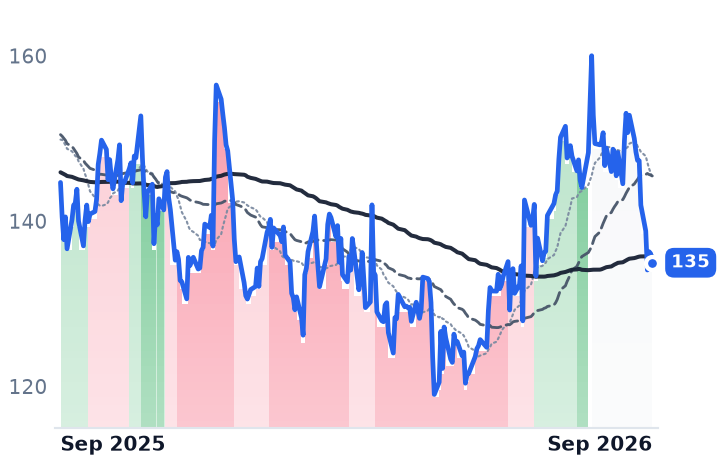
12-month price & trend
| Ticker | Mkt cap | P/E | P/E fwd | P/S | P/S fwd | P/GP | P/GP fwd | EV/EBITDA | FCF yld |
|---|---|---|---|---|---|---|---|---|---|
MTN | $4.8B | 31.2x | 21.5x | 1.7x | 1.6x | 3.1x | 2.9x | 10.4x | 4.9% |
Consensus projections
| Ticker | FY2026E | FY2027E | FY2028E | |
|---|---|---|---|---|
MTN | Revenue | −4.3% | +5.3% | +3.3% |
| EPS | −44.2% | +45.3% | +13.9% |
Forward fiscal years only. Blank means no analyst coverage for that year.
Vail Resorts sells next winter before it snows. The company that runs 37 mountain destinations under the Epic Pass — Vail, Breckenridge, Park City, Whistler Blackcomb — collects most of a season's lift revenue in a spring-and-autumn selling window, banks it as deferred revenue, then recognizes it whether or not the snow arrives. For fiscal 2025 that meant roughly 2.3 million guests committed in advance across its North American, Australian and European resorts, over $975m of revenue and about 75% of all paid skier visits.
The mechanism was stress-tested this year and passed. What failed is the meter that tells you about next year: pass product units for the 2026/27 North American season were down approximately 10% through 26 May 2026, days sold down 8%, and sales dollars down about 5%. Price is covering roughly half the unit loss, and the committed dollar base is now shrinking too.
The winter did what the model said it would
"Weather conditions remained extremely unfavorable in the third quarter, adding to what had already been one of the most challenging winters in history across the western U.S.," chief executive Rob Katz said in the June 8 results release. Skier visits in the April quarter fell to 7.276 million from 8.609 million, a drop of 15.5%, while effective ticket price rose about 12% — pass holders had already paid, so lift revenue barely flinched. The pain migrated to everything bought on the mountain: ski school revenue fell 11.5% to $141.8m, retail and rental 8.3%, dining 10.7%. Resort Reported EBITDA for the quarter fell $61.3m.
The leak is in the conversion funnel. Fewer visits this winter means a smaller pool of skiers to sell next winter's pass to, and new-passholder sales came in weaker than renewals. A bad snow year does not hurt the season it ruins; it hurts the one after.
Price has been doing the work, and it is running out
Unit declines were 3% into 2024/25, 1% in the spring 2025/26 window and 3% again through September 2025 before this year's 10%. Short-term deferred revenue was $467.0m at 30 April 2026 against $468.6m a year earlier — flat.
Management's answer is cost and product. The Resource Efficiency Transformation Plan delivers an incremental $45m this year, $106m annualized, which does not fill the roughly $100m hole the guidance cuts opened. Katz's July 14 "Epic Experience" reset put money into food, private lessons, gear and snowmaking, framed as a break with the past: "the Pass and acquisitions were not the end goal," he said. The 2026/27 Epic Pass starts at $1,089, up about 3.6%, with a new 20% discount taking under-30 buyers to $869 — a price cut aimed at the demographic being lost.
What the shares have already conceded
The stock is down 15% over twelve months, and fell 11.7% in the ten sessions to September 4 without a discoverable company announcement; the likelier reading is de-risking into the fiscal-year print, though Goldman Sachs initiated at Sell with a $132 target on August 13, arguing the company's 5–7% organic EBITDA growth ambition sits against roughly 1.5% actually compounded from 2019 to 2025.
At 10.4x trailing enterprise value to EBITDA, against a thirteen-year median near 15.9x and a low near 9.0x, the multiple has done its de-rating. The earnings have not finished doing theirs: consensus has fiscal 2028 earnings per share at $7.15, still short of the $7.53 Vail earned in fiscal 2025. Meanwhile the $8.88 annual dividend exceeds the roughly $6.66 per share of trailing free cash flow, net debt stood at 3.2 times reported EBITDA at the last fiscal year-end, and fiscal 2025 buybacks retired 4.5% of the shares at around $156.
So the verdict splits cleanly. Weather earns the collapse in visits, in ski school and in this year's guidance — that part is cyclical and a strong El Niño, which forecasters put at better than 90% odds for the coming winter, would reverse much of it. What weather does not explain is a unit slide that has widened every year for four years while the price went up anyway. Snow fixes ancillary spend per visit. It does not, by itself, sell a pass.
On September 28 Vail reports fiscal 2026 and, with it, the autumn pass update — the first count taken after the September 7 price increase, and the only number that says whether the base is stabilizing or still going.