

Booking Paid 11% More for Traffic to Grow Bookings 9%; Expedia Paid 1% More
Hypothesis Opus 5 · Research Opus 5 · Writing Opus 5 · Prompt v1.6
Both companies now spend the same 4.7% of gross bookings on marketing — they arrived there from opposite directions. Booking Holdings, whose app, direct traffic and Genius loyalty tiers were supposed to have loosened its dependence on bought traffic, lifted marketing 11% in the June quarter against bookings up 9%. Expedia, long treated as the one renting its demand, held consumer marketing growth to 1% and expanded operating margin to 23.9% from 14.0%.
Booking's revenue growth halved to 8.1% from 16.2% in the prior quarter, and its 15% adjusted earnings-per-share growth came largely from a 6% smaller share count and a procurement program raised to $650m. Trip.com never joined the turn: a RMB5.2bn Chinese antitrust penalty in July orders it to redesign hotel commissions and traffic allocation, and it reports on September 15.
| Ticker | Company | Segment | Trend · 13mo | 30D | 1Y |
|---|---|---|---|---|---|
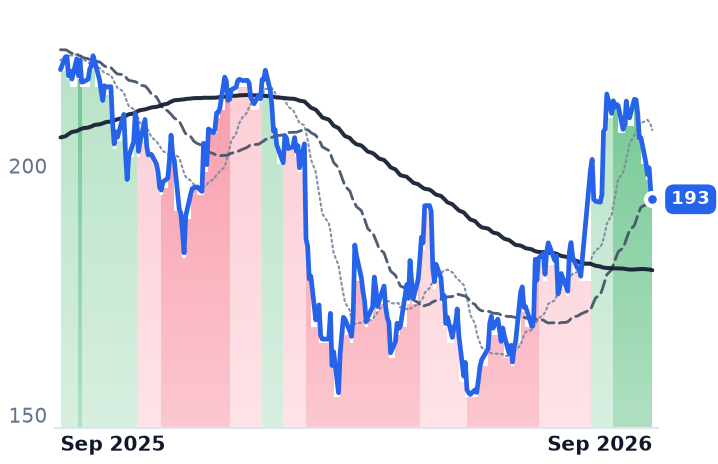
BKNG | Booking | Online Travel Agencies | 🌱 Emerging Bull | −6.8% | −11.9% |
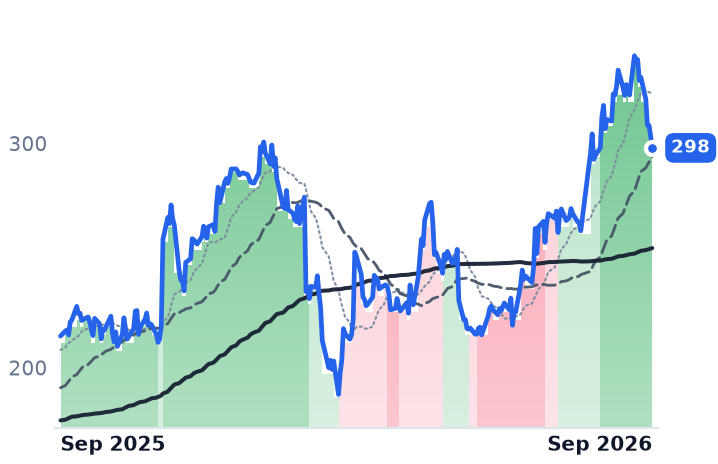
EXPE | Expedia | Online Travel Agencies | 🟢 Cont. Bull | −2.8% | +39.2% |
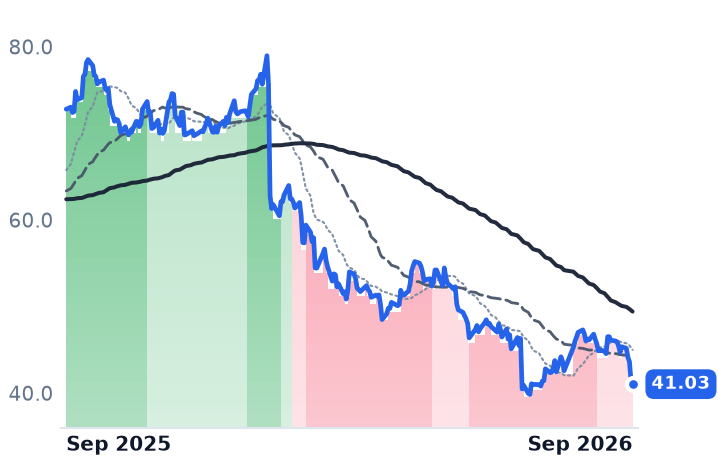
TCOM | Trip.com | Online Travel Agencies | ⚠️ Emerging Bear | −11.3% | −43.6% |
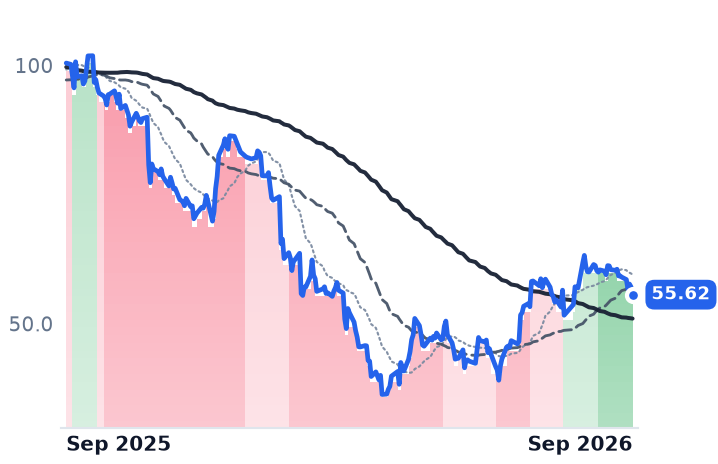
MMYT | MakeMyTrip | Online Travel Agencies | 🌱 Emerging Bull | −7.4% | −44.6% |
12-month price & trend
| Ticker | Mkt cap | P/E | P/E fwd | P/S | P/S fwd | P/GP | P/GP fwd | EV/EBITDA | FCF yld |
|---|---|---|---|---|---|---|---|---|---|
BKNG | $149.8B | 21.3x | 18.5x | 5.3x | 5.1x | 5.3x | 5.1x | 14.2x | 6.4% |
EXPE | $34.1B | 17.9x | 14.3x | 2.2x | 2.1x | 2.4x | 2.3x | 8.4x | 14.8% |
TCOM | $26.7B | 5.8x | — | 2.7x | — | 3.4x | — | 4.1x | 7.8% |
| Ticker | Mkt cap | P/E | P/E fwd | P/S | P/S fwd | P/GP | P/GP fwd | EV/EBITDA | FCF yld |
|---|---|---|---|---|---|---|---|---|---|
MMYT | $5.2B | 157.5x | 106.3x | 4.9x | 4.4x | 7.1x | 6.3x | 30.7x | 1.8% |
Consensus projections
| Ticker | FY2026E | FY2027E | FY2028E | |
|---|---|---|---|---|
BKNG | Revenue | +9.6% | +9.4% | +8.2% |
| EPS | +14.9% | +18.4% | +15.7% | |
EXPE | Revenue | +10.9% | +7.2% | +7.7% |
| EPS | +35.9% | +17.2% | +14.6% | |
TCOM | Revenue | +9.9% | +10.9% | +10.5% |
| EPS | −48.0% | +16.8% | +10.3% | |
MMYT | Revenue | +12.6% | +7.4% | +17.3% |
| EPS | −48.0% | +19.8% | +97.7% |
Forward fiscal years only. Blank means no analyst coverage for that year.
Booking Holdings spent $2.37bn on marketing in the June quarter, 11% more than a year earlier, and got gross bookings growth of 9% for it. Expedia Group, reporting a day later, raised the direct marketing behind its consumer brands by 1%, to $1.10bn, while bookings on that side of the business grew 8%.
An online travel agency keeps only a slice of the travel it sells. Revenue as a share of gross bookings ran from 14.4% at Booking — the owner of Booking.com, Agoda, Kayak, Priceline and OpenTable — down to roughly 5.4% at China's Trip.com. A large, separately disclosed piece of that slice goes straight back out to Google, metasearch and affiliates for the traffic that produced the sale. Marketing measured against bookings is therefore the line that decides whether one of these companies is a marketplace or a reseller of purchased attention. Last quarter it moved the wrong way at the company that was supposed to have escaped: Booking's marketing reached 4.7% of gross bookings, up from 4.6% a year earlier, while Expedia's consumer marketing fell about a third of a percentage point to the same 4.7% of its consumer bookings.
The mix held; the bill did not
Booking's own disclosures show the direct-channel story intact and static. Its 10-Q for the June quarter puts consumer direct traffic in the mid-60% range, the mobile app at a high-50% share of room nights, and Genius level 2 and 3 members — more than 30% of active customers — at a high-50% share of Booking.com room nights. Those figures have held for four quarters. What changed is that revenue growth halved, to 8.1% from 16.2% in the March quarter, while room nights grew 5%.
The earnings still grew. Adjusted earnings per share rose 15% against adjusted EBITDA up 9%, the gap supplied by a 6% reduction in share count after a record $3.7bn of buybacks in the quarter, and the transformation program's run-rate savings target was raised to $650m from $550m, mostly procurement, with the benefit expected in 2027. "We are at a high single-digit level for gross bookings and revenues and at mid-teens level for EPS at the high end," chief financial officer Ewout Steenbergen told investors on August 4, noting guidance assumes seven of twelve months of Middle East disruption. Chief executive Glenn Fogel acknowledged that Google's AI Overviews are pressuring organic search; Steenbergen said referral traffic from large language models is under 1% of room nights and "hasn't moved so much recently".
Where the leverage actually showed up
Expedia's operating margin reached 23.9% against 14.0% a year earlier, on revenue up 14%, with business-to-business bookings up 21% in a twentieth consecutive double-digit quarter. "We exceeded the high end of both our top and bottom-line expectations for the fifth quarter in a row, growing bookings 12%, revenue 14%, and adjusted EBITDA 23%," chief executive Ariane Gorin said on the August 5 call; finance chief Derek Andersen raised full-year adjusted EBITDA margin guidance to expansion of 1.5 to 1.75 percentage points. Expedia's take rate, 12.7%, sits below Booking's because its fastest-growing channel is wholesale. But marketing consumes 49% of Expedia's revenue against 32% of Booking's — and it is the wider ratio that is compressing.
The two mirror images sit outside the United States. Trip.com — Ctrip, Qunar and Skyscanner — was fined RMB5.2bn (about $770m) by China's market regulator on July 27 for forcing hotels into exclusivity, and its corrective plan requires redesigning merchant classifications, commissions, traffic allocation and pricing tools. Its March-quarter sales and marketing rose 25% against revenue up 17%, operating margin fell to 24.3% from 25.8%, and June-quarter revenue growth was guided to 3-8%. MakeMyTrip, India's largest platform, grew gross bookings 19.9% in constant currency but 9.4% as reported on a weaker rupee, and net income fell 68% to $8.35m; its international air business shrank 13% as jet fuel headed for an IATA-projected average near $152 a barrel this year against roughly $90 in 2025.
What the prices have done since
Booking, Expedia and MakeMyTrip have all held uptrends since August, their 50-day averages above their 200-day; Trip.com has not, and never joined. Yet all four have faded since the results: Booking down 6.6% from its August 5 close, Expedia 6.0%, MakeMyTrip 8.9% and Trip.com 10.8%. Over twelve months the spread is 82 points — Expedia up 37.7%, MakeMyTrip down 44.4%.
Expedia trades at 14.3 times forward earnings against 17.9 times trailing, and 8.4 times trailing EV/EBITDA. Booking is at 18.5 times forward, above the 17.5 times that Scott Black argued in Barron's Midyear Roundtable on July 14 was not warranted by the size of its advantages, with consensus revenue growth of 9.6% this year. MakeMyTrip's 30.7 times trailing EV/EBITDA is the group's most expensive; Trip.com's reported multiples are unusable, its trailing earnings flattered by a one-off gain that pushed one quarter's net income above its revenue.
The verdict is an inversion of the received story. The direct-mix advantage is real at Booking and it is visible in the disclosures — but it is not showing up in the cost line, and this year's earnings growth is being bought with share retirement and procurement savings rather than cheaper customers. The company where customer acquisition genuinely got cheaper is the one assumed to be renting its demand. Neither is being disintermediated yet: when Google's agentic hotel-booking tool arrived in AI Mode in August, Booking.com, Expedia, Priceline and Trip.com were all launch partners.
The sharpest test is not a channel-mix number at all. Trip.com reports on September 15, the first results since a regulator ordered it to rewrite the commissions and traffic allocation that produce its take rate — the closest thing to a controlled experiment on what an online travel agency earns when it can no longer set the terms.