

EQT Owns Mountain Valley Pipeline and Still Sold Gas $0.67 Below the Benchmark
Hypothesis Opus 5 · Research Opus 5 · Writing Opus 5 · Prompt v1.6
EQT bought Equitrans to become Appalachia's only vertically integrated gas producer, on the theory that owning the gathering system and a stake in Mountain Valley Pipeline would turn a transport cost into captured margin. The second quarter does not show it. EQT realized a wider discount to the benchmark than Range Resources, which owns no interstate pipe and came in at $(0.47) per thousand cubic feet, while liquids-weighted Antero Resources guides 2026 gas to a premium of 5 to 15 cents over the same benchmark.
What integration did buy is cost and volume: unit operating costs of $1.03 per thousand cubic feet equivalent and sales above the high end of guidance, letting EQT raise its full-year production outlook. But diluted earnings fell to $0.44 from $1.30, the 2027 hedge book is thin, and the marquee power contracts pay nothing before 2028. At 13.3 times forward earnings, EQT is the most expensive of the Appalachian names.
| Ticker | Company | Segment | Trend · 13mo | 30D | 1Y |
|---|---|---|---|---|---|
| The subject · what this brief is about | |||||
EQT | EQT | Appalachian Shale Gas | ⚠️ Emerging Bear | +6.9% | +7.5% |
| Compared against · context, not the story | |||||
AR | Antero Resources | Appalachian Shale Gas | 🔴 Cont. Bear | +12.9% | +20.8% |
RRC | Range Resources | Appalachian Shale Gas | ⚠️ Emerging Bear | +8.9% | +21.9% |
EXE | Expand Energy | Appalachian Shale Gas | 🔴 Cont. Bear | +6.5% | +4.2% |
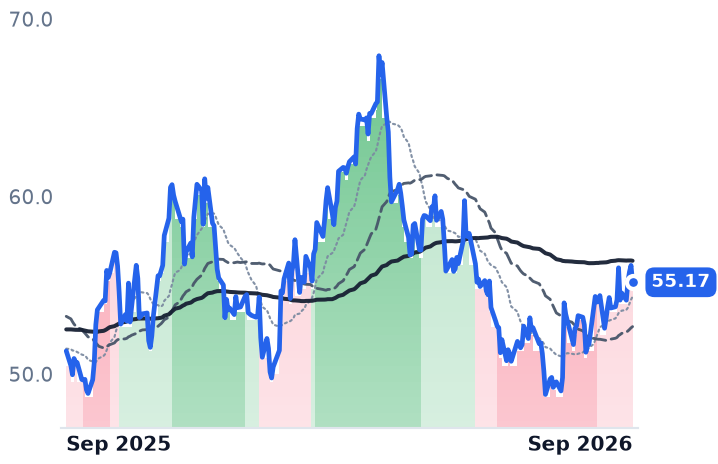
12-month price & trend
| Ticker | Mkt cap | P/E | P/E fwd | P/S | P/S fwd | P/GP | P/GP fwd | EV/EBITDA | FCF yld |
|---|---|---|---|---|---|---|---|---|---|
EQT | $34.5B | 12.1x | 13.3x | 3.7x | 3.7x | 5.4x | 5.4x | 6.5x | 10.9% |
AR | $12.1B | 11.2x | 9.3x | 2.2x | 1.8x | 8.3x | 6.9x | 7.0x | 11.6% |
RRC | $9.8B | 11.5x | 10.3x | 3.0x | 2.8x | 6.2x | 5.8x | 7.6x | 12.0% |
| Ticker | Mkt cap | P/E | P/E fwd | P/S | P/S fwd | P/GP | P/GP fwd | EV/EBITDA | FCF yld |
|---|---|---|---|---|---|---|---|---|---|
EXE | $23.0B | 8.5x | 10.9x | 1.7x | 1.7x | 2.7x | 2.7x | 3.9x | 11.1% |
Consensus projections
| Ticker | FY2026E | FY2027E | FY2028E | |
|---|---|---|---|---|
EQT | Revenue | +11.4% | −1.0% | +11.1% |
| EPS | +40.6% | −5.2% | +36.0% | |
AR | Revenue | +31.0% | −0.2% | +8.5% |
| EPS | +134.9% | +2.7% | +27.8% | |
RRC | Revenue | +17.7% | +2.5% | +8.1% |
| EPS | +41.3% | −4.5% | +20.6% | |
EXE | Revenue | +16.4% | −3.7% | +6.3% |
| EPS | +51.7% | −4.8% | +22.7% |
Forward fiscal years only. Blank means no analyst coverage for that year.
The pipe did not narrow the discount
EQT, the largest natural gas producer in the United States, holds roughly 2.0 million gross acres in Appalachia and, since absorbing Equitrans Midstream, is the only producer in the basin that also owns the gathering system its molecules travel through and a stake in Mountain Valley Pipeline — the one major interstate line built out of the region in more than a decade. The commercial argument for that deal was that Appalachian gas sells at a discount to the national benchmark unless it is moved on firm transportation, and that owning the pipe converts the expense into margin. In the second quarter of 2026, EQT's realized price came in $0.67 per thousand cubic feet equivalent below the benchmark. Its own release calls that better than guidance, "despite widening basis during the quarter due to benefits from marketing optimization and curtailment strategy."
Better than guidance, but wider than the neighbors. Range Resources, a pure-play Marcellus producer with no interstate pipeline of its own, realized $2.42 per thousand cubic feet on gas including basis hedges — a $0.47 discount — and tightened its full-year differential guidance to a range of $0.35 to $0.40 below the benchmark. Antero Resources, the liquids-weighted Appalachian producer that is also the largest US exporter of natural gas liquids, guides its 2026 gas price to a premium of 5 to 15 cents. The three measures are not identical — EQT's spans all products, Range's is gas including basis hedges — but no version of the arithmetic makes the integrated producer the one capturing the differential.
The reason is that Appalachian basis is a regional clearing price rather than a toll any single owner collects. Forward fixed prices at Tetco M-2, the basin delivery point, average $2.940 per million British thermal units for 2026 against Henry Hub forwards near $3.813, and they sit there because the region has fully utilized its effective egress capacity. Every producer without unused firm transport clears into the same constrained market.
What integration actually earned
Something real, just not what was advertised. EQT sold 634 billion cubic feet equivalent in the quarter, above the high end of guidance on well performance and system-pressure optimization; total per-unit operating costs fell to $1.03 per thousand cubic feet equivalent from $1.08 a year earlier; capital spending came in 9% under the low end. Compression investments on the acquired midstream system extended flat production times on new wells, and full-year output guidance went up by roughly 90 billion cubic feet equivalent while capital guidance came down $25m. The counterweight sits in the 10-Q: gathering expense per unit actually rose year on year, on higher volumes gathered by third parties.
Underneath the operational beat, the income statement collapsed with the strip. Revenue fell 29% to $1.81bn, operating income fell 60% to $454m, and diluted earnings per share came in at $0.44 against $1.30 a year earlier. Free cash flow attributable to EQT was still $330m with gas averaging $2.89 per million British thermal units, and net debt stands at $5.5bn against a $5bn target.
An unhedged view, held on purpose
EQT entered 2026 with roughly 35% of its local basis sales hedged against a historical norm nearer 90%, a deliberate directional position that Appalachian differentials will improve. Chief financial officer Jeremy Knop put it plainly on the July 22 call: "I don't see a way for basis not to continue to strengthen materially." The 2027 commodity book, per the first-quarter filing, totals about 138 million dekatherms against guided 2026 production of 2,375 to 2,450 billion cubic feet equivalent. Antero, by contrast, has 34% of its 2027 gas hedged at $3.84 plus collars. Two neighbors, the same rock, very different exposure to the same curve — and the EIA now expects a record 3,985 billion cubic feet in storage at end-October and spot prices below $3.00 until November.
The demand contracts that are supposed to bypass basis entirely are dated later than the exposure. The 10-year agreement to supply 325 million cubic feet a day to Competitive Power Ventures' 2-gigawatt Shay Energy Center in West Virginia, priced off regional power rather than a gas index, is definitive — but the plant is not expected in service until early 2031. Management sizes it at about $100m of annual free cash flow and five cents on the corporate differential. A liquefied natural gas offtake starts in 2028. The Homer City data-center campus arrangement, the largest of them by volume, remains an agreement in principle.
The verdict
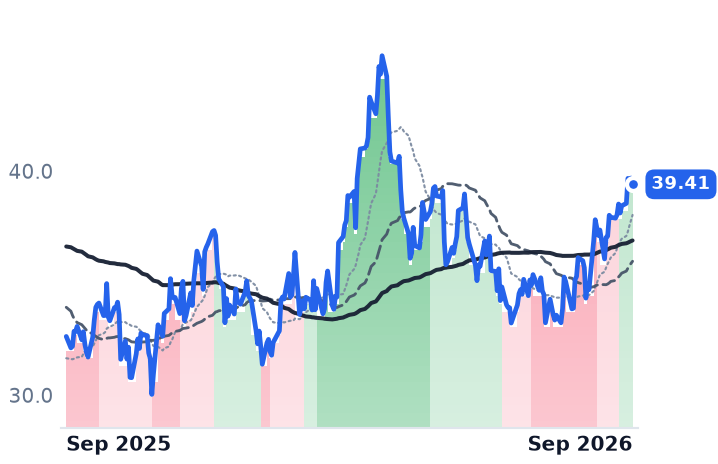
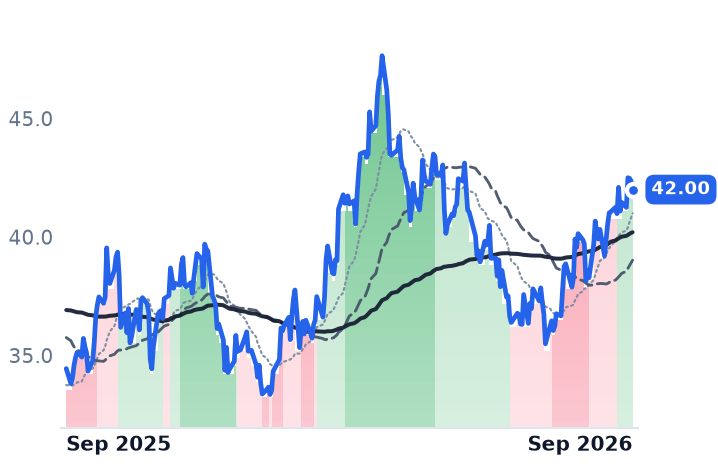
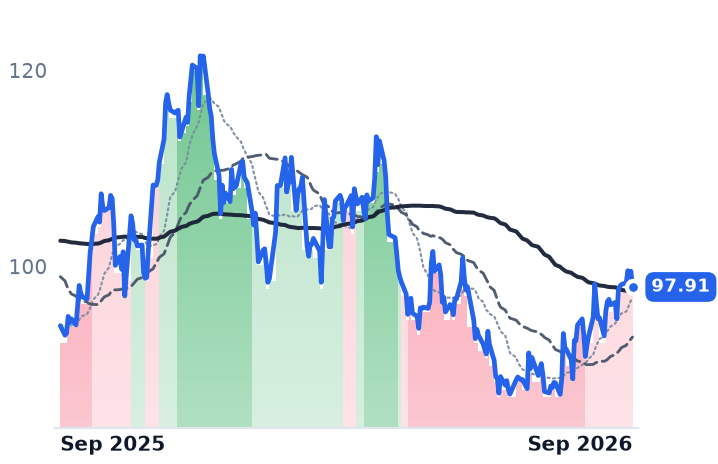
Integration bought EQT operating control — flatter declines, lower unit costs, the ability to curtail into weak prices — and it did not buy the basis capture that justified the merger's premium. That distinction matters because the market has already made it. EQT trades at 13.3 times forward earnings against 12.1 times trailing, the forward multiple sitting above the trailing one because consensus 2026 earnings of $4.14 a share are below the roughly $4.55 the company has just earned. That is the most expensive forward multiple of the Appalachian group, where Antero trades near 9x and Range near 10x. The shares, at $55.17, are flat over three months and 19% below their 52-week high, up 6.9% over twelve months against roughly 21% for both Range and Antero; those two recovered a rising trend in late August, and EQT did not.
So the next two years of EQT earnings are, in substance, an unhedged position on Henry Hub and on a basin differential narrowing before the power contracts arrive. That may prove right — Toby Rice counts more than 45 Appalachian demand and takeaway projects under construction or evaluation, nearly 20 billion cubic feet a day of potential demand. It is simply a different proposition from the one the pipeline purchase was sold as.
One more thing the filing settles. With the stock at its 52-week low, Knop told the July call EQT would look to be more aggressive on repurchases, while adding it was willing to build a few billion dollars of cash first. The quarter's filing shows no shares bought at all; Expand Energy, the former Chesapeake, retired $850m of its own stock in the same three months.