

AMN's Travel-Nurse Volume Rose 6% at Flat Bill Rates; Astrana's Growth Was All Acquired
Hypothesis Opus 5 · Research Opus 5 · Writing Opus 5 · Prompt v1.6
AMN Healthcare's revenue has fallen every year since 2022, from $5.24bn to $2.73bn, and the sell side models it falling further — consensus puts 2027 revenue at $2.66bn, below what the company actually booked last year. Its own order book says something different.
On August 6 AMN reported travel-nurse volume up for the first time in four years, with bill rates flat, and chief executive Cary Grace said orders in early August were running about 40% ahead of a year earlier. Astrana Health, reporting the same day, showed the mirror image: gross margin has widened three quarters running while sequential revenue has been flat for four, so its 48.5% headline growth is the Prospect Health acquisition rather than the underlying capitated book.
AMN's turn is volume without price. Astrana's is cost without volume.
| Ticker | Company | Segment | Trend · 13mo | 30D | 1Y |
|---|---|---|---|---|---|
| The subject · what this brief is about | |||||
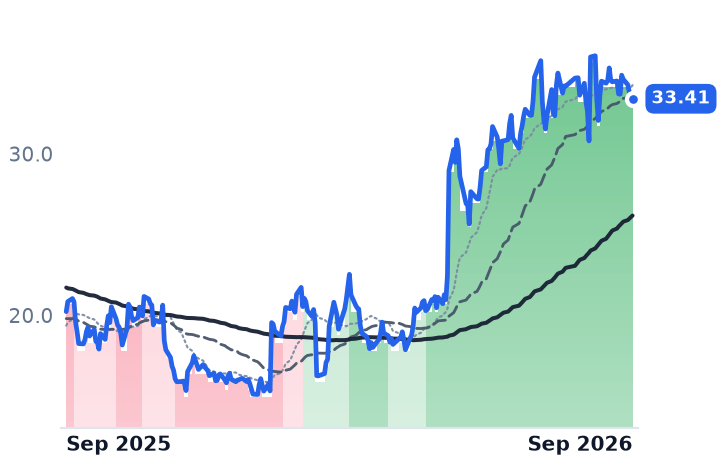
AMN | AMN Healthcare Services | Physician Services & Staffing | 🌱 Emerging Bull | +2.4% | +65.2% |
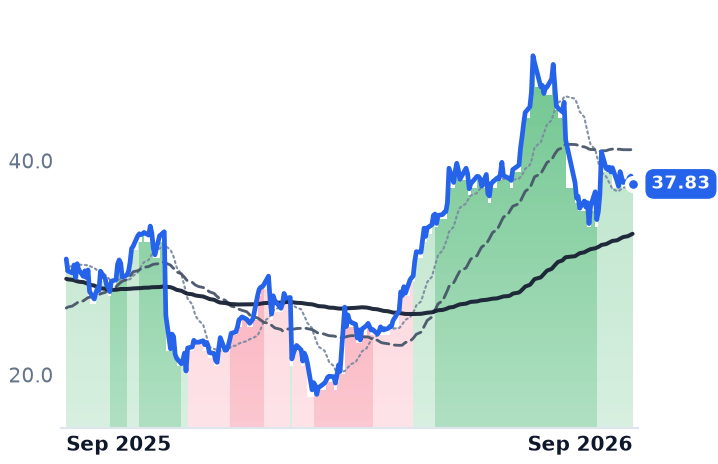
ASTH | Astrana Health | Physician Services & Staffing | 🌱 Emerging Bull | +4.9% | +22.7% |
| Compared against · context, not the story | |||||
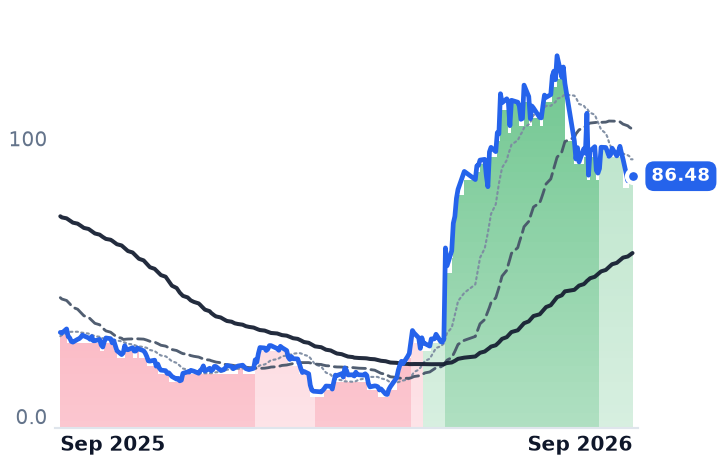
AGL | Agilon Health | Physician Services & Staffing | 🌱 Emerging Bull | −20.8% | +185.9% |
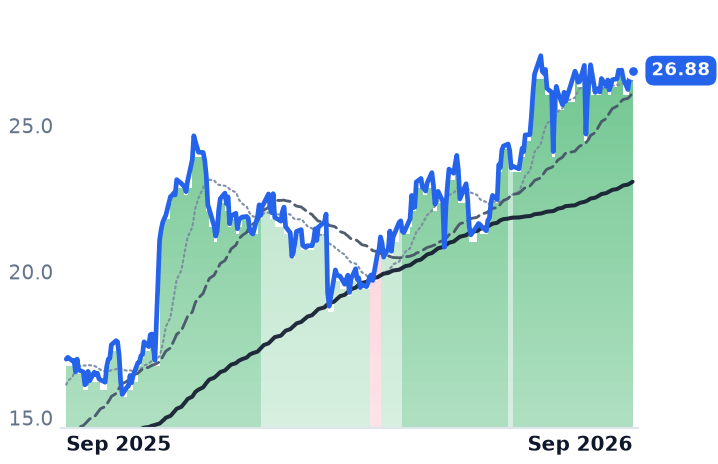
MD | Pediatrix Medical | Physician Services & Staffing | 🟢 Cont. Bull | +3.4% | +58.0% |
12-month price & trend
| Ticker | Mkt cap | P/E | P/E fwd | P/S | P/S fwd | P/GP | P/GP fwd | EV/EBITDA | FCF yld |
|---|---|---|---|---|---|---|---|---|---|
AMN | $1.3B | 12.4x | 10.2x | 0.4x | 0.4x | 1.4x | 1.4x | 5.0x | 33.9% |
ASTH | $1.9B | 45.7x | 27.2x | 0.5x | 0.5x | 5.3x | 5.1x | 14.0x | 8.4% |
AGL | $1.4B | n/m | — | 0.2x | 0.2x | — | — | n/m | -7.8% |
| Ticker | Mkt cap | P/E | P/E fwd | P/S | P/S fwd | P/GP | P/GP fwd | EV/EBITDA | FCF yld |
|---|---|---|---|---|---|---|---|---|---|
MD | $2.2B | 12.7x | 11.4x | 1.1x | 1.1x | 4.4x | 4.3x | 9.5x | 10.4% |
Consensus projections
| Ticker | FY2026E | FY2027E | FY2028E | |
|---|---|---|---|---|
AMN | Revenue | +23.9% | −20.5% | +3.8% |
| EPS | +133.6% | −71.5% | +29.5% | |
ASTH | Revenue | +26.0% | +10.2% | +10.7% |
| EPS | +182.8% | +39.6% | +32.3% | |
AGL | Revenue | −0.0% | +7.2% | +10.8% |
| EPS | −89.4% | −181.1% | +162.9% | |
MD | Revenue | +3.0% | +2.4% | +4.5% |
| EPS | +12.6% | +3.9% | −0.4% |
Forward fiscal years only. Blank means no analyst coverage for that year.
AMN Healthcare filled more travel-nurse shifts in the second quarter than in any comparable stretch since 2022, and it did so without charging hospitals more per hour. Travel-nurse volume rose 6% year on year and allied-health volume 7%, both four-year highs, with average bill rates flat.
That combination is the first hard evidence in four years that the labor-arbitrage engine underneath hospital staffing has stopped deflating on price. It matters because almost nobody has marked it: consensus has AMN's 2027 revenue at $2.66bn, below the $2.73bn the company actually reported for 2025, against a book of orders management describes as growing at double digits. Astrana Health, which reported the same day, is running the opposite experiment — its revenue line barely moves and its entire improvement sits in the cost of care.
The price per hour stopped falling before the volume turned
AMN places travel and local nurses, allied clinicians, locum tenens physicians and interim hospital executives, and sells the vendor-management software hospitals use to buy that labor. Its annual revenue fell 27.7% in 2023, 21.3% in 2024 and 8.5% in 2025 — a decelerating collapse as hospitals rebuilt permanent staff and pushed contingent hours into managed-service programs that squeeze the spread on every shift. The clinician's own pay tracks it: the average US travel nurse earned just under $2,300 a week in 2025, down 42% from the pandemic peak.
Grace put the floor in plain terms on the August 6 call: "pre-COVID, you would have seen that premium of contingent to permanent labor be in the mid- to high teens. During COVID, you got up to 100% premium just because of the significant spike in demand. We're now back down into the mid- to high single digits." On orders, she said: "Year-over-year, travel nurse orders turned positive in May and accelerated in June. As of early August, the improvement continued with orders up about 40% year-over-year and 20% higher than August 2024."
The recovery is one segment deep. Nurse and Allied Solutions revenue was $422m, up 11%; Physician and Leadership Solutions fell 6% to $165m and Technology and Workforce Solutions fell 15% to $87m. Reported 2026 figures also flatter: the first quarter carried $722m of one-off strike-coverage revenue, and revenue round-tripped to $673.2m in the second. Brian Scott, chief financial and operating officer, told investors on August 6 that residual items "added about $27 million to revenue, 290 basis points to our consolidated gross margin and 370 basis points to our adjusted EBITDA margin." Net leverage is 1.5x, and the company refinanced in October 2025, issuing $400m of 2031 notes to retire the 2027s.
AMN trades at just under 5x trailing enterprise value to EBITDA against Pediatrix's 9.5x. Its headline forward price-to-earnings of 10.2x is an artifact of the strike quarter; on 2027 consensus earnings of $0.94 a share the same price is nearly 36x. The market and the sell side are not describing the same company.
Astrana's improvement is in the denominator
Astrana takes capitated payments from Medicare Advantage, Medicaid and commercial plans across roughly 1.5 million value-based lives and keeps what it does not spend on care. Gross margin — the inverse of its blended cost ratio — has widened three straight quarters, from 8.27% to 10.70%. Full-year adjusted EBITDA guidance rose to $255–280m and net leverage fell to 2.26x, ahead of the company's own sub-2.5x commitment.
But quarterly revenue has gone $956m, $951m, $965m, $973m — up 1.7% across a year. The 48.5% year-on-year headline is Prospect Health, acquired on July 1, 2025, where synergies are tracking to the high end of a $12–15m target. Only 42% of membership sits in full risk against 81% of capitation revenue, which management frames as conversion upside. Chief executive Brandon Sim said roughly three-quarters of first-half outperformance went back into new provider partnerships: "We believe that allocating some of our outperformance towards these growth opportunities is among the highest return capital allocation decisions available to us." The policy backdrop helped — CMS finalized a 2.48% growth rate for 2027 and declined to recalibrate the v28 risk model now fully in the base — while California's Medicaid work requirement lands January 1, 2027, with 4.8 million Medi-Cal enrollees in the affected category. At about 9.2x guided 2026 EBITDA against 14.0x trailing, most of the cost-ratio repair is already priced.
The other two names in the same corner of care facilities frame the range. agilon health is up 476.5% over six months but still loss-making, with negative trailing EV/EBITDA and consensus showing a $34m 2026 loss — a distress recovery, not an earnings re-rating. Pediatrix, the neonatology group, grew revenue 4.0% on 4% same-unit pricing while volumes fell, and anchors the group at 9.5x.
What each rally has earned
Astrana's advance is paid for: three quarters of margin, a guidance raise, a turn of leverage retired. What it has not bought is growth — strip Prospect out and the book is flat, and the multiple already assumes the cost ratio keeps improving. AMN's is the unpaid one, and that is why it is the more interesting. Its move rests on a single segment, one clean quarter and an order figure only management has published. If those orders convert, the 2027 revenue line the market has penciled in is wrong by a wide margin; if they do not, a company at 5x EBITDA is simply cheap because it is still shrinking. Note that AMN's chief competitors did not consolidate: Aya Healthcare walked away from its $615m purchase of Cross Country in December after the Federal Trade Commission objected, so nothing structural has tightened pricing.
A 40% order book and a forecast of shrinking revenue cannot both survive two more quarters. The third-quarter print is where they meet.