

New Jersey Natural Gas Filed an 8.9% Bill Cut to Make Room for a $157.6m Rate Increase
Hypothesis Opus 5 · Research Opus 5 · Writing Opus 5 · Prompt v1.6
A gas distributor earns nothing on the gas. It earns on the pipe — and the price of the molecule it passes through at cost sets the customer bill that decides whether regulators will let it earn more on the pipe. This year cheap gas has been handing the pure-play distributors that room, and they are spending it.
New Jersey Natural Gas asked the state's utility board on June 1 for a $157.6m delivery increase on a $4.05bn rate base at a 10.10% return on equity, and simultaneously filed to cut the pass-through commodity charge so customer bills land nearly flat. ONE Gas got every recovery it asked for — a full $28.7m Oklahoma order, a $36.9m Texas surcharge — and raised 2026 guidance to $4.89–$4.95.
Where the commodity headroom is absent, regulators said no: Indiana denied NiSource's $741m gas tracker, and Southwest Gas is earning 8.1% against 9.89% authorized.
| Ticker | Company | Segment | Trend · 13mo | 30D | 1Y |
|---|---|---|---|---|---|
| The subject · what this brief is about | |||||
OGS | ONE Gas | Natural Gas Distribution | ⚠️ Emerging Bear | +2.0% | +6.7% |
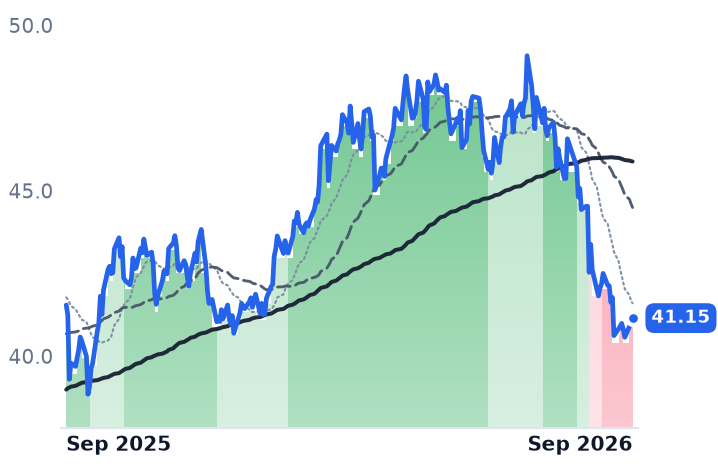
NJR | New Jersey Resources | Natural Gas Distribution | 🟢 Cont. Bull | −7.6% | +16.9% |
| Compared against · context, not the story | |||||
ATO | Atmos Energy | Natural Gas Distribution | ⚠️ Emerging Bear | −3.0% | +2.5% |
SWX | Southwest Gas | Natural Gas Distribution | 🟢 Cont. Bull | −0.7% | +14.7% |
NI | NiSource | Natural Gas Distribution | ⚠️ Emerging Bear | −7.6% | −1.0% |
12-month price & trend
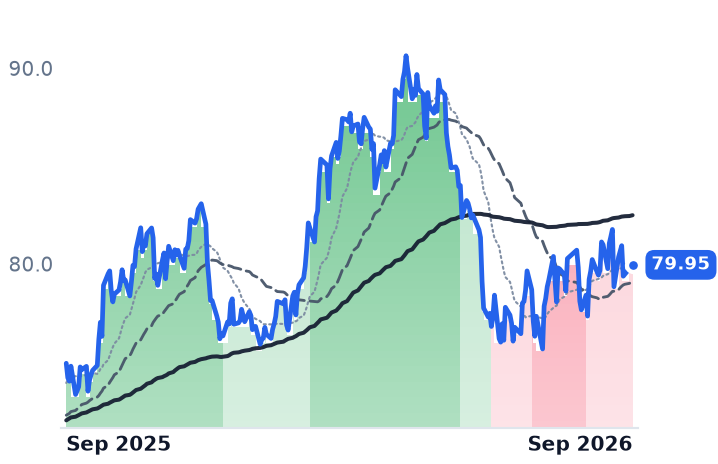
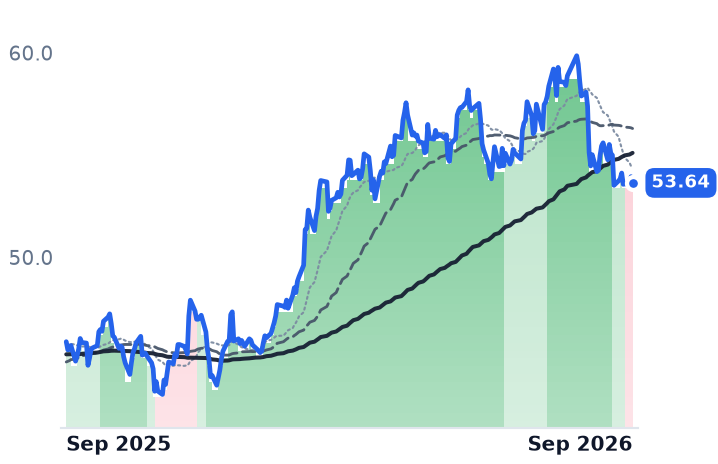
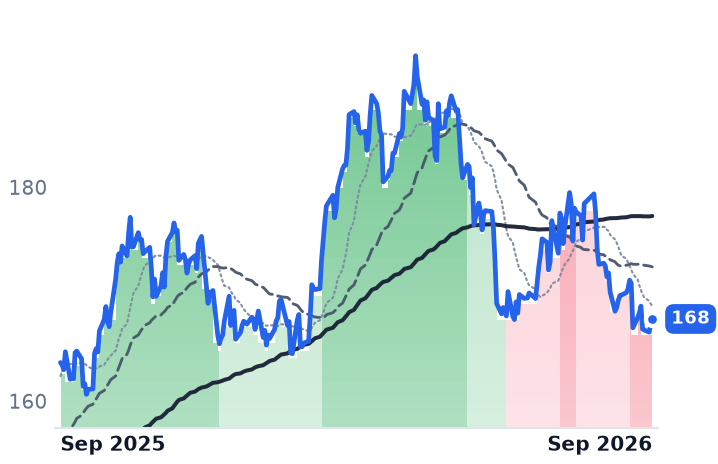
| Ticker | Mkt cap | P/E | P/E fwd | P/S | P/S fwd | P/GP | P/GP fwd | EV/EBITDA | FCF yld |
|---|---|---|---|---|---|---|---|---|---|
OGS | $5.0B | 17.2x | 16.3x | 2.2x | 2.0x | 2.9x | 2.7x | 10.7x | -3.4% |
NJR | $5.4B | 14.8x | 15.0x | 2.4x | 2.4x | 8.6x | 8.7x | 11.7x | 1.4% |
ATO | $28.0B | 19.8x | 19.8x | 5.7x | 5.4x | 9.3x | 8.9x | 14.1x | -7.2% |
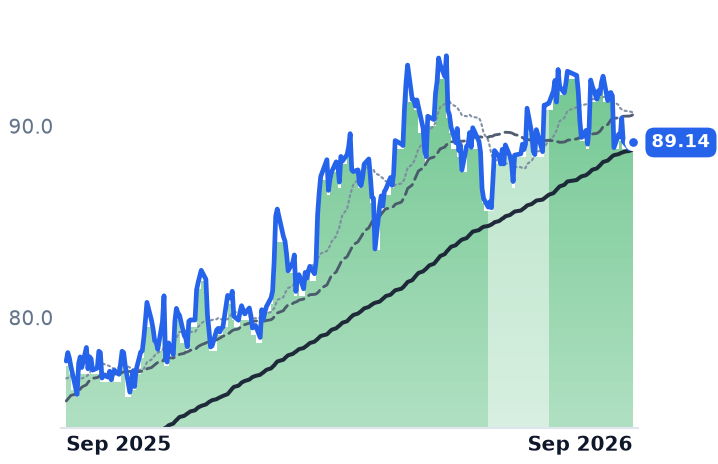
| Ticker | Mkt cap | P/E | P/E fwd | P/S | P/S fwd | P/GP | P/GP fwd | EV/EBITDA | FCF yld |
|---|---|---|---|---|---|---|---|---|---|
SWX | $6.5B | 12.4x | 21.0x | 3.7x | 3.3x | 6.5x | 5.9x | 11.0x | -12.9% |
NI | $19.7B | 21.7x | 20.0x | 2.9x | 2.8x | 5.6x | 5.5x | 11.6x | -5.5% |
Consensus projections
| Ticker | FY2026E | FY2027E | FY2028E | |
|---|---|---|---|---|
OGS | Revenue | −3.2% | +3.5% | +2.9% |
| EPS | +11.8% | +3.3% | +8.4% | |
NJR | Revenue | +12.2% | −2.8% | +4.5% |
| EPS | +10.1% | −5.1% | +8.2% | |
ATO | Revenue | +6.8% | +7.7% | +8.7% |
| EPS | +14.2% | +6.8% | +8.4% | |
SWX | Revenue | −46.4% | +5.8% | +6.2% |
| EPS | −22.1% | +15.6% | +19.4% | |
NI | Revenue | +15.3% | +5.6% | +6.3% |
| EPS | +9.0% | +9.7% | +10.2% |
Forward fiscal years only. Blank means no analyst coverage for that year.
New Jersey Natural Gas, the regulated utility serving about 564,000 customers across six New Jersey counties, asked the state Board of Public Utilities on June 1 for a $157.6m increase in delivery revenue — and filed, the same day, to take roughly $158 a year off the average residential bill by cutting the pass-through cost of the gas itself, an 8.9% reduction ahead of the coming winter.
That pairing is the entire economics of a local distribution company. It buys the molecule and hands it to households at cost, earning nothing on it; every dollar of profit comes from the pipe, recovered in periodic rate cases and, between them, through surcharge mechanisms. Which means the commodity it does not profit from sets the bill that determines whether regulators will let it earn more on the pipe it does. Cheap gas is regulatory headroom. The question this year is who has it and who has spent it.
Buying room
New Jersey Natural Gas's ask rests on a $4,046.1m rate base, a 10.10% return on common equity and a 55.5% equity layer, and seeks to reflect roughly $950m of system investment not currently in rates. The company timed implementation for the end of the 2026-2027 heating season, when usage falls, and notes the board's review of base-rate filings typically runs nine to twelve months and typically ends in a settlement. On parent New Jersey Resources' August 4 call, management called the case "plain vanilla" and described the package as leaving customer rates "nearly flat." It is flat only because the commodity line fell far enough to absorb the delivery increase.
ONE Gas, which is essentially all regulated distribution — 2.2 million customers in Oklahoma, Kansas and Texas — got everything it asked for. An Oklahoma administrative law judge approved Oklahoma Natural Gas's full $28.7m base-rate request, worth about $1.53 a month to the average household. Texas Gas Service won a $36.9m statewide infrastructure surcharge in July. The Kansas legislature went further and loosened the mechanism outright, raising the maximum monthly residential surcharge to $1.35 from $0.80 and cutting the review clock to 90 days. A separate Texas statute allowing deferral of depreciation and taxes on capital awaiting rate treatment is worth about $0.42 to 2026 earnings per share.
The result was second-quarter adjusted earnings of $0.82 a share against $0.54, on weather 25% warmer than normal, and full-year guidance raised to $4.89–$4.95. Rate base averages $6.3bn this year on roughly $800m of capital spending. The bill for that comes in dilution and cash: the diluted share count is up 4.5% year over year and trailing free cash flow yield is minus 3.4%.
Where the room ran out
Elsewhere the affordability squeeze is real and visible. The Indiana Utility Regulatory Commission denied NiSource's $741m five-year gas modernization plan 3-0 on August 5, finding the utility "failed to provide sufficient evidence for the commission to determine that each proposed eligible improvement is cost-justified". Commissioners Bob Deig, Anthony Swinger and David Veleta added: "We decline to accept NIPSCO's suggestion that cost-justification can be inferred because the projects were selected by internal subject-matter experts." Two days later Indiana convened a technical conference on returns and trackers. NiSource reaffirmed 2026 adjusted earnings guidance of $2.02–$2.07 anyway; its shares are down 13% over six months.
Southwest Gas, the Arizona-Nevada-California distributor, shows the same pressure as an earnings gap: an 8.1% return earned over twelve months against 9.89% authorized, with Nevada intervenors recommending about $40m of a $74m request at a 9.3% return, an order targeted for October. Its forward multiple of 21x is the highest here; the trailing figure is distorted by a one-off 2025 gain. Atmos Energy, the largest pure distributor, is the counter-case on throughput: 51,000 net customer additions in the year to June and $396m of annualized operating income increases already implemented.
What the de-rating is actually pricing
Every one of these companies has been marked down. ONE Gas trades at 17.2 times trailing and 16.3 times forward earnings, against 20.2 times in early May. Atmos is at 19.8 times both ways, against 24.4 times in May. New Jersey Resources sits at 14.8 times trailing against 17.4 times in May — but its forward multiple of 15.0 times sits above trailing, because consensus 2027 earnings of $3.40 are 5.1% below this year's $3.59. That is not the regulator. Roughly 38-41% of New Jersey Resources' earnings come from outside the utility, per its own segment guidance: unregulated Energy Services at 21-23%, Clean Energy Ventures at 10-13%, midstream at 8-11%.
So the two pure-plays are not one trade. Over the past month ONE Gas rose 3.4% while New Jersey Resources fell 6.5%; over six months the order reverses, ONE Gas down 8.6% against 1.1%. Nothing in the rate-case record explains either. What does explain most of it is the discount rate — the 30-year Treasury above 5.3% in August, with the utilities sector down about 5.6% on the month — against an authorized return fixed in nominal terms for the nine to twelve months a case takes. Affordability is throttling recovery in Indiana and Nevada. At ONE Gas and New Jersey Natural Gas it is not yet touching the rate base; it is being managed with someone else's money.
That money is borrowed from a commodity price nobody at these companies controls. The Energy Information Administration's July outlook put Henry Hub at $3.67 per million British thermal units for the year; a colder winter or a tighter market takes the headroom back, raises the bill without adding a cent to the utility's return, and forces the next filing to argue for the pipe on its own merits.