

SailPoint Paid About $200m for Entro and Still Won't Put a Dollar on Agent Identity
Hypothesis Opus 5 · Research Opus 5 · Writing Opus 5 · Prompt v1.6
The company that governs who — and what — may touch enterprise data is growing its cloud subscriptions ten percentage points faster than its total book, and has guided the year to slow down anyway. SailPoint's software-as-a-service annual recurring revenue reached $781m in the April quarter, up 36%, against total recurring revenue of $1.163bn, up 26%; the remaining licence and maintenance third grew roughly 9%.
Management then guided fiscal 2027 recurring revenue to $1.36–1.37bn, 21–22% growth against 28% delivered last year, and the shares fell about 12% on 9 June. Its largest accounts, those above $1m, rose 32% to 225. The August re-rating came on a competitor's results; the 9 September report is SailPoint's first chance in three months to supply its own.
| Ticker | Company | Segment | Trend · 13mo | 30D | 1Y |
|---|---|---|---|---|---|
| The subject · what this brief is about | |||||
SAIL | SailPoint | Identity & Access Management | 🌱 Emerging Bull | +14.2% | −6.4% |
| Compared against · context, not the story | |||||
OKTA | Okta | Identity & Access Management | 🌱 Emerging Bull | +19.6% | +89.3% |
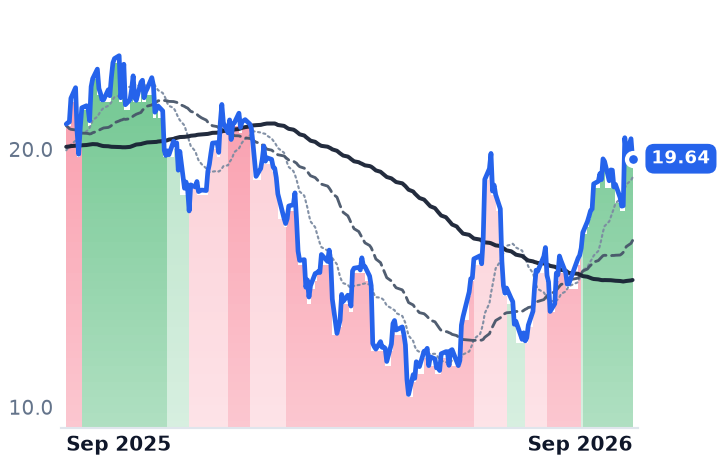
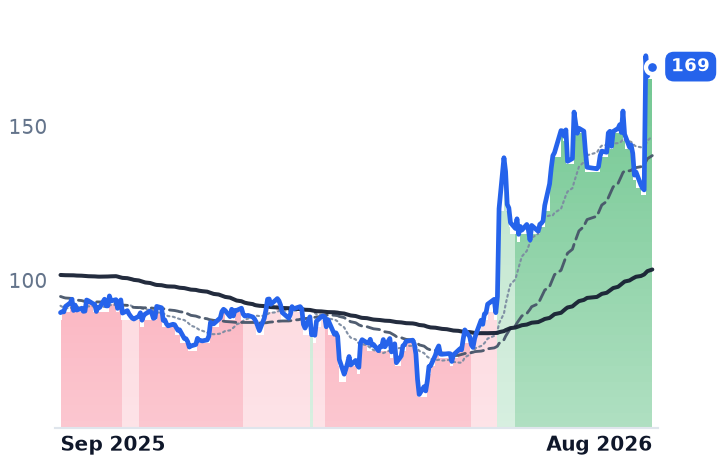
12-month price & trend
| Ticker | Mkt cap | P/E | P/E fwd | P/S | P/S fwd | P/GP | P/GP fwd | EV/EBITDA | FCF yld |
|---|---|---|---|---|---|---|---|---|---|
SAIL | $11.1B | n/m | — | 9.9x | — | 15.0x | — | 853.3x | 1.7% |
OKTA | $27.6B | 98.4x | 42.3x | 9.0x | 8.6x | 11.5x | 11.0x | 68.3x | 3.5% |
Consensus projections
| Ticker | FY2026E | FY2027E | FY2028E | |
|---|---|---|---|---|
OKTA | Revenue | +12.0% | +10.8% | +9.9% |
| EPS | +24.3% | +14.1% | +10.6% |
Forward fiscal years only. Blank means no analyst coverage for that year.
SailPoint closed its purchase of Entro Security, a Tel Aviv specialist in non-human identity, on 29 June in a deal reported at roughly $200m. When the company — which governs which employees, contractors, service accounts and AI agents may reach which applications, and was founded in Austin in 2005 — reports fiscal second-quarter results on 9 September, it will be the first period to carry Entro. It will almost certainly not carry a disclosed dollar of agent-identity revenue.
That gap is the story. SailPoint's unit of billing is an identity governed, and machine identities already outnumber human ones by something between 82 and 109 to one, which is why the meter is supposed to expand mechanically as software agents proliferate. What the company actually reports is a migration: customers moving off the self-hosted IdentityIQ product onto Identity Security Cloud, its subscription platform.
The mix is doing the work
In the quarter ended 30 April, SailPoint's total annual recurring revenue reached $1.163bn, up 26%, while subscription recurring revenue reached $781m, up 36%. Subscriptions are now about 67% of the base against 64% two quarters earlier. The arithmetic leaves the licence-and-maintenance remainder growing around 9% — the company is cannibalizing its own slower third, and guides 90–95% of net new recurring revenue to the subscription line, so that third keeps shrinking.
The expansion is concentrated at the top. Accounts above $1m of recurring revenue rose 32% to 225; accounts above $250k rose 24%. Net revenue retention was 113% in the January quarter, a point below the 114% before it. At its June investor day the company targeted more than $2.1bn of recurring revenue by fiscal 2029, with over $800m from AI-driven products and an on-premises migration it says delivers two to four times the prior spend per customer.
What management will not say
"In the new era of Agentic AI, identity security is the most critical layer of the enterprise security stack," founder and chief executive Mark McClain told investors on the 9 June call, adding that SailPoint is in the "very early innings" of the shift. The agentic pipeline doubled quarter over quarter; the company builds "very minimal" emerging-AI revenue into guidance. Okta's chief financial officer Brett Tighe used near-identical language on 26 August: agent revenue is "[s]till immaterial. Still very small."
The hard number went the other way. Fiscal 2027 recurring revenue is guided to $1.36–1.37bn, or 21–22% growth against 28% delivered, and the shares fell about 12% on 9 June despite beating on both lines. September's guide is for recurring revenue near $1.22bn and revenue near $310m.
The balance sheet is cleaner than the sponsor history suggests: the term loans were repaid at the February 2025 listing with a $15.3m write-off of deferred finance costs, stock compensation ran at 14% of revenue last quarter, and free cash flow was $32.5m against minus $100.7m a year earlier — though the business still lost $79.8m at the operating line. Thoma Bravo retained roughly 86% of the stock at the initial public offering and holds rights to demand registered sales.
The verdict
The subscription meter is real and is compounding at a rate the reported total understates. What the last month's advance rests on is not: SailPoint sold at 14.96x trailing gross profit against about 22.6x at its $23.00 listing, but also against roughly 8.0x at April's low, and its 27 August jump came on Okta's and CrowdStrike's results rather than its own — Okta, growing 10.6%, fetches 11.5x the same measure. Twelve months of 26% compounding have left the shares slightly lower than a year ago.
On 9 September the company can either widen the subscription premium or confirm the deceleration it already guided to. Until an agent line is billed in dollars, the fastest-growing part of SailPoint is customers it already had, buying the same platform a second time.