

Salesforce Prices Agent Actions at $0.10; Seats Still Bill Two-Thirds of Its Revenue
Hypothesis Opus 5 · Research Opus 5 · Writing Opus 5 · Prompt v1.6
Salesforce's newly disclosed subscription split answers the question the whole application-software group has been trading on, and not in the direction the re-rating implies. The seat-billed core — Sales, Service, Marketing, Commerce and Slack — is $7.2bn of the quarter's subscription revenue and grew 8% in constant currency. The faster-growing data and platform half looks like a usage story until you remove Informatica, consolidated this year, which supplied $440m of roughly $600m of that half's dollar growth.
The metered product is real and small: Agentforce annual recurring revenue passed $1.5bn, about 3.5% of the annualized subscription run-rate. The monetization lever management pushed hardest on the August 26 call was a premium-seat upgrade. Contracted backlog growth earns part of the August move; the pricing migration itself has not happened.
| Ticker | Company | Segment | Trend · 13mo | 30D | 1Y |
|---|---|---|---|---|---|
| The subject · what this brief is about | |||||
CRM | Salesforce | Customer Experience & CRM | 🔴 Cont. Bear | +37.8% | +2.2% |
| Compared against · context, not the story | |||||
NOW | ServiceNow | Specialized Enterprise Solutions | 🌱 Emerging Bull | +24.7% | −21.9% |
TEAM | Atlassian | Developer Tools & DevOps | 🌱 Emerging Bull | +80.2% | +8.0% |
HUBS | HubSpot | Customer Experience & CRM | 🔴 Cont. Bear | +4.2% | −47.0% |
ADBE | Adobe | Design & Content Creation | 🔴 Cont. Bear | +14.7% | −16.6% |
ORCL | Oracle | Cloud Infrastructure & Platforms | 🔴 Cont. Bear | −0.5% | −36.9% |
WDAY | Workday | Enterprise Resource Planning | 🌱 Emerging Bull | +20.3% | −13.3% |
MSFT | Microsoft | Cloud Infrastructure & Platforms | 🔴 Cont. Bear | +2.5% | −0.7% |
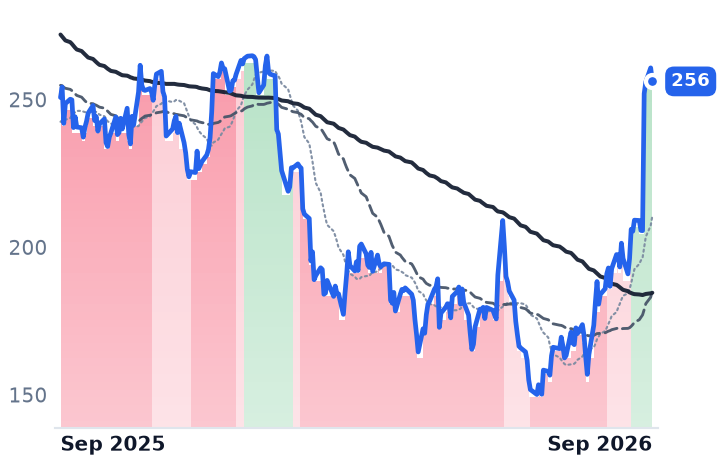
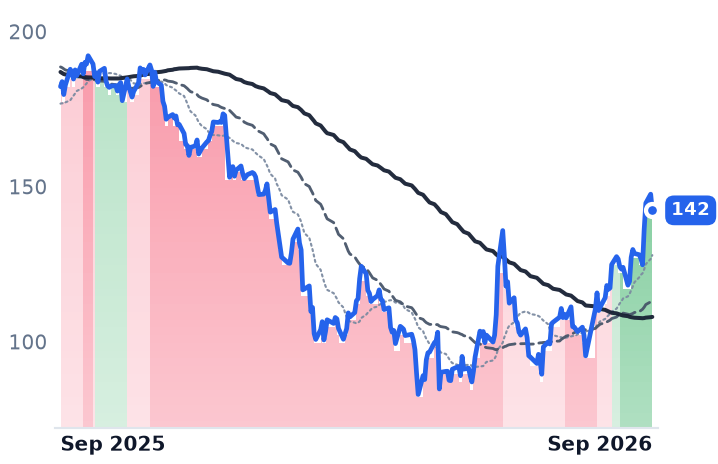
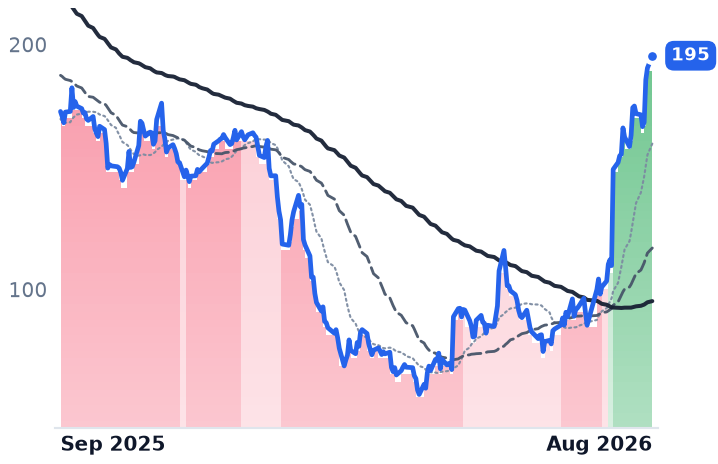
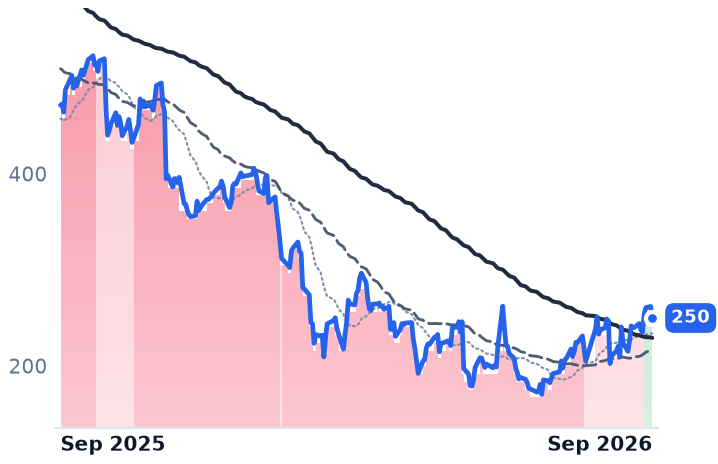
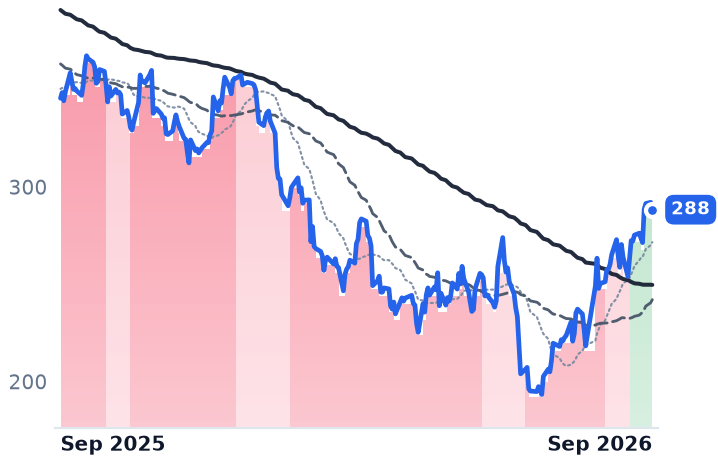
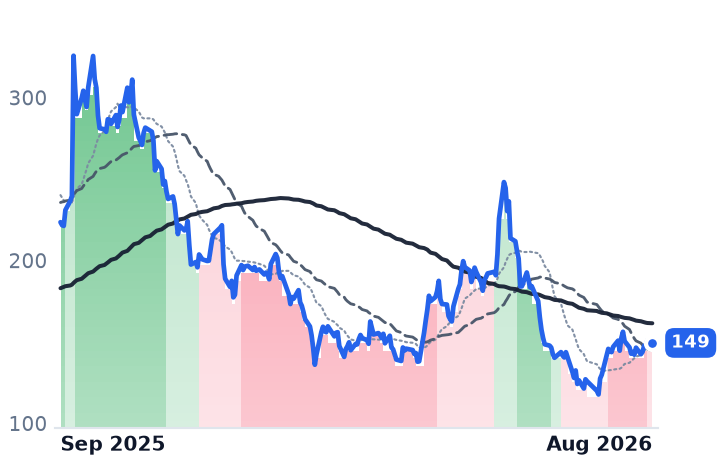
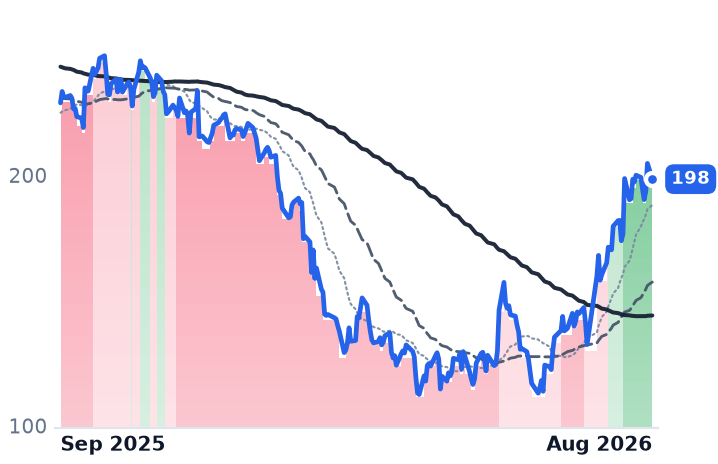
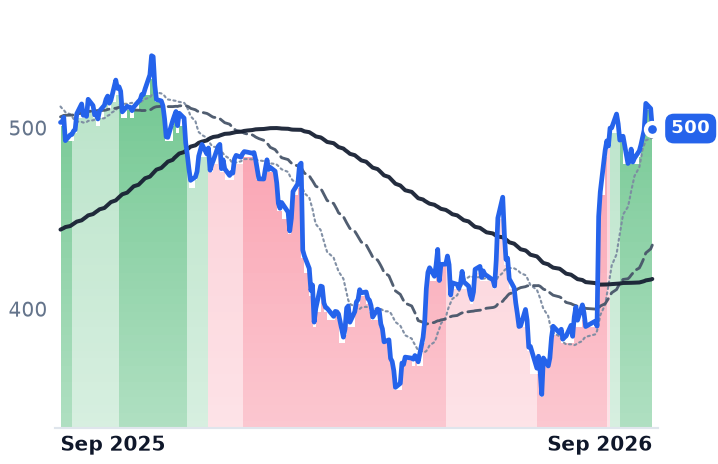
12-month price & trend
| Ticker | Mkt cap | P/E | P/E fwd | P/S | P/S fwd | P/GP | P/GP fwd | EV/EBITDA | FCF yld |
|---|---|---|---|---|---|---|---|---|---|
CRM | $211.4B | 23.5x | 15.8x | 4.8x | 4.6x | 6.2x | 5.9x | 15.5x | 7.2% |
NOW | $132.8B | 79.8x | 31.6x | 9.0x | 8.2x | 12.1x | 11.0x | 39.8x | 3.4% |
TEAM | $50.0B | n/m | 34.6x | 7.6x | 6.7x | 9.0x | 7.9x | 331.1x | 2.6% |
| Ticker | Mkt cap | P/E | P/E fwd | P/S | P/S fwd | P/GP | P/GP fwd | EV/EBITDA | FCF yld |
|---|---|---|---|---|---|---|---|---|---|
HUBS | $13.4B | 92.2x | 19.6x | 3.9x | 3.6x | 4.7x | 4.4x | 44.5x | 5.7% |
ADBE | $116.4B | 16.7x | 12.0x | 4.6x | 4.4x | 5.2x | 4.9x | 11.9x | 9.1% |
ORCL | $433.0B | 25.3x | 18.7x | 6.4x | 4.8x | 9.8x | 7.3x | 17.4x | -5.5% |
| Ticker | Mkt cap | P/E | P/E fwd | P/S | P/S fwd | P/GP | P/GP fwd | EV/EBITDA | FCF yld |
|---|---|---|---|---|---|---|---|---|---|
WDAY | $53.6B | 41.6x | 18.5x | 5.3x | 5.0x | 6.6x | 6.3x | 32.8x | 5.3% |
MSFT | $3.8T | 28.6x | 26.1x | 11.5x | 9.8x | 17.0x | 14.4x | 19.0x | 1.7% |
Consensus projections
| Ticker | FY2026E | FY2027E | FY2028E | |
|---|---|---|---|---|
CRM | Revenue | +9.3% | +11.4% | +9.6% |
| EPS | +17.4% | +38.4% | −2.0% | |
NOW | Revenue | +22.4% | +18.7% | +18.6% |
| EPS | +17.1% | +23.2% | +21.4% | |
TEAM | Revenue | +24.7% | +15.4% | +14.7% |
| EPS | +55.5% | −0.1% | +21.6% | |
HUBS | Revenue | +18.2% | +14.2% | +14.0% |
| EPS | +38.2% | +25.9% | +18.4% | |
ADBE | Revenue | +12.0% | +9.1% | +8.8% |
| EPS | +17.2% | +12.7% | +14.2% | |
ORCL | Revenue | +17.8% | +33.2% | +45.5% |
| EPS | +25.3% | +7.6% | +35.6% | |
WDAY | Revenue | +13.4% | +11.8% | +10.5% |
| EPS | +26.5% | +21.9% | +19.5% | |
MSFT | Revenue | +18.0% | +18.6% | +19.5% |
| EPS | +26.7% | +16.0% | +19.0% |
Forward fiscal years only. Blank means no analyst coverage for that year.
Salesforce has started reporting its subscription line in two pieces, and the pieces settle an argument that has been running through enterprise software all year. The seat-billed core — Sales, Service, Marketing, Commerce and Slack — came in at $7.2bn for the July quarter, growing 8% in constant currency, while Data 360, headless platform and other revenue reached $3.6bn and grew 20%. Two-thirds of the $10.82bn subscription book is still billed by the human logging in.
That matters beyond one print because the answer the market took from Salesforce's August 26 results — that artificial-intelligence revenue adds to seat revenue instead of eating it — lifted the entire group. Salesforce sells customer-relationship-management software, from pipeline and service desks to Tableau analytics, the MuleSoft integration tools and Slack, to enterprises that buy it a license at a time. If agents genuinely displace those licenses, the per-seat model inverts. The company has now published enough to check.
The meter is real, and it is small
Agentforce is priced per action, not per user: an agent action costs 20 Flex Credits, or $0.10, with a voice action at $0.15 and credits sold in 100,000-credit packs for $500, billed monthly in arrears. Consumption shows up in a customer dashboard. Roughly half of Agentforce bookings in the quarter came from existing customers refilling credits, with 2,000 new paying customers in production, up about 70% sequentially — the meter is being consumed and re-bought. Agentforce annual recurring revenue passed $1.5bn, up more than 240%, though the definition was widened this quarter to include Slackbot and headless products. Against an annualized subscription run-rate near $43bn, $1.5bn is about 3.5%.
Nor is the fast-growing half of the business mostly usage. Informatica, consolidated this year and absent from the year-ago base, contributed $440m of subscription revenue. The data-and-platform side grew roughly $600m year over year on the disclosed splits, which puts about three-quarters of the growth in Salesforce's consumption-adjacent segment down to an acquisition.
The lever management leaned on hardest was a seat lever. Only 5% of knowledge workers in sales and service sit on premium tiers, which carry a 60% to 80% price premium — that upgrade, not a credit meter, is the near-term monetization path executives described. Four pricing models now coexist: per-seat, Flex Credits, usage-based, and outcome-based deals under negotiation with accounts spending $40m or more. The scale ambition is not in doubt. "The Army Human Resources Command expects to drive up to 55 million Agentforce conversations every single month," chief executive Marc Benioff told investors on the August 26 call. What is missing is any aggregate unit: no seat count, no agent count, no total credits consumed.
What the shares priced
The stock had been in a downtrend from September 2025 until mid-August, when its 50-day average crossed back above its 200-day; it then gained 22.58% on August 27, its second-best session on record. Price-to-gross-profit has gone from 4.47x on July 29 to 6.23x, a 39% re-rating in five weeks, against a trailing price-to-earnings ratio of 23.5x. The 15.83x forward multiple is flattered: the earnings guidance raise of $2.60 at the midpoint is almost entirely the $2.53 per share of unrealized gain on Salesforce's Anthropic stake, and on the pre-raise midpoint of $14.09 the shares sit near 18.3x.
Underneath, the income statement did not participate. Reported growth decelerated to 10.8%, and near 6.4% without Informatica. Gross margin fell 145 basis points. Operating income was flat year over year. Per-share growth came from a share count cut from 962m to 821m, financed by a $25bn accelerated repurchase funded with $25bn of debt that lifted quarterly interest expense from $67m to $473m and halved full-year free-cash-flow growth guidance to 4-5%.
One line genuinely earns part of August: current remaining performance obligation of $33.5bn, up 14% in constant currency, three points faster than revenue and a point ahead of guidance. Contracted work is growing faster than recognized work, which is what a demand recovery looks like before it reaches the profit-and-loss statement. What nothing in the disclosure explains is a 39% expansion in what buyers pay for each dollar of gross profit while organic growth slowed and operating profit stood still.
So the migration thesis fails on the evidence available, and something better replaces it: Salesforce has not moved its revenue onto a meter, it has added a small one alongside a seat business whose upgrade ceiling — 95% of relevant workers on standard tiers — is the actual story. Whether that ceiling gets sold is testable on December 8, when the second-half organic re-acceleration management promised either shows up without another acquisition attached, or does not.