

Rene Lacerte's Sales Reorganization Left BILL Adding 1,800 Businesses in the June Quarter
Hypothesis Opus 5 · Research Opus 5 · Writing Opus 5 · Prompt v1.6
BILL's payments meter is working and its customer funnel is not. In the June quarter the company moved $98bn of supplier payments across 37m transactions and kept a wider cut of them — roughly 33.1 basis points of transaction fees against about 32.3 a year earlier — while its count of businesses served fell from 498,500 in December to 479,300 in June.
The profit that re-rated the shares is a cost program. Fiscal-2026 non-GAAP operating income rose just 5% to $323.7m, and the fiscal-2027 guide of $421–451m rests on $90.9m of restructuring charges that bought about $110m of gross savings. Float income — interest on customer money in transit, the leg most often feared — is a 9% slice of revenue and set to shrink about 7% next year on its own.
The flagship accounts-payable franchise grew 10%, with subscription revenue per customer up 1.4%.
| Ticker | Company | Segment | Trend · 13mo | 30D | 1Y |
|---|---|---|---|---|---|
| The subject · what this brief is about | |||||
BILL | Bill.com | Fintech & Digital Finance | 🌱 Emerging Bull | +11.5% | +7.7% |
| Compared against · context, not the story | |||||
CPAY | Corpay | Payment Processing & Fintech | 🌱 Emerging Bull | +6.7% | +28.3% |
12-month price & trend
| Ticker | Mkt cap | P/E | P/E fwd | P/S | P/S fwd | P/GP | P/GP fwd | EV/EBITDA | FCF yld |
|---|---|---|---|---|---|---|---|---|---|
BILL | $5.0B | n/m | 13.4x | 3.0x | 2.7x | 3.8x | 3.5x | 58.7x | 9.6% |
CPAY | $26.7B | 24.5x | 14.9x | 5.3x | 5.0x | 7.2x | 6.8x | 14.0x | 6.1% |
Consensus projections
| Ticker | FY2026E | FY2027E | FY2028E | |
|---|---|---|---|---|
BILL | Revenue | +13.2% | +11.3% | +10.5% |
| EPS | +26.1% | +41.5% | +17.6% | |
CPAY | Revenue | +17.7% | +8.7% | +9.2% |
| EPS | +28.5% | +14.2% | +17.0% |
Forward fiscal years only. Blank means no analyst coverage for that year.
BILL Holdings, which sells cloud accounts-payable and expense software to small businesses and settles the resulting supplier payments itself, closed its fiscal year having added roughly 1,800 net business customers in the June quarter — below its recent run rate, after a reorganization of the sales force. Its separately disclosed count of businesses using its solutions went the other way, falling to 479,300 at June 30 from 498,500 at the end of December. The two figures cover different populations and the company has not publicly reconciled them; both point the same direction.
What grew instead was the amount each surviving customer runs through the network — and what grew earnings was a layoff. For fiscal 2027 management guided non-GAAP operating income of $421–451m against $323.7m, an increase of roughly a third, on top of $90.9m of restructuring charges booked in fiscal 2026 that delivered about $110m of gross savings against roughly $30m of reinvestment. Strip that out and the operating leverage is thinner than the headline: full-year non-GAAP operating income rose 5%, even as the June quarter's jumped 80% to $101.6m.
The volume is monetized better, by fewer customers
BILL earns three unrelated things: a small software subscription, a cut of the dollars it routes, and interest on money in transit. The middle line is doing the work. Transaction fees of $324.3m on $98bn of volume put the June quarter at about 33.1 basis points of payment volume, against roughly 32.3 a year earlier; volume is disclosed only to the nearest billion, so each reading carries about half a basis point of rounding. Throughput per business rose from about $178.7k in the September quarter to $204.5k in June, a 14% increase — arithmetic helped along by a shrinking denominator. Joint customers using both the payables and expense products grew 35%.
The original bill-pay franchise is the laggard. Accounts payable and receivable served 183,300 customers and grew core revenue 10%, with subscription revenue per customer up 1.4%. Management told the August 19 call it expects that unit's take rate to hold near the June-quarter level because automated clearing house payments — the cheapest rail on the platform — keep growing fastest, and guided the spend-and-expense take rate to about 260 basis points. Mix, not competition, is what caps further expansion.
Float is a drag, and the buyback is not the story
The four disclosed fiscal-2026 quarters sum to $148.3m of float revenue, 9.0% of the year's $1,653.2m. The fiscal-2027 wedge between the $1.807–1.857bn total guide and the $1.669–1.719bn core guide implies roughly $138m — another decline of about 7%. Rates are not driving it: the Federal Reserve held at 3.50–3.75% on July 29 with three members dissenting in favor of a hike. Against $4.353bn of customer funds, each quarter-point move is worth roughly $11m a year.
Nor are buybacks flattering the per-share line. BILL repurchased $300m of stock in the June quarter, but non-GAAP net income rose 25.0% and per-share earnings 25.3% — convertible notes hold the non-GAAP diluted count near 113.6m. On generally accepted accounting principles the year produced a first operating profit of $17.4m and still a net loss of $11.2m, after $306.3m of add-backs. Gross margin slipped to 80.9% from 81.4%.
Where it trades
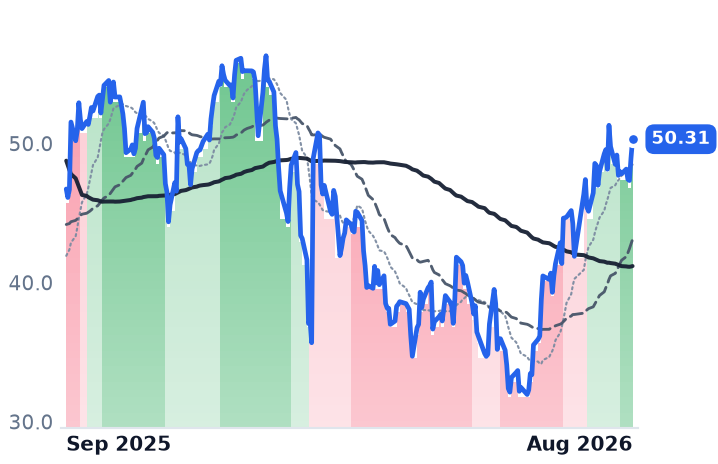
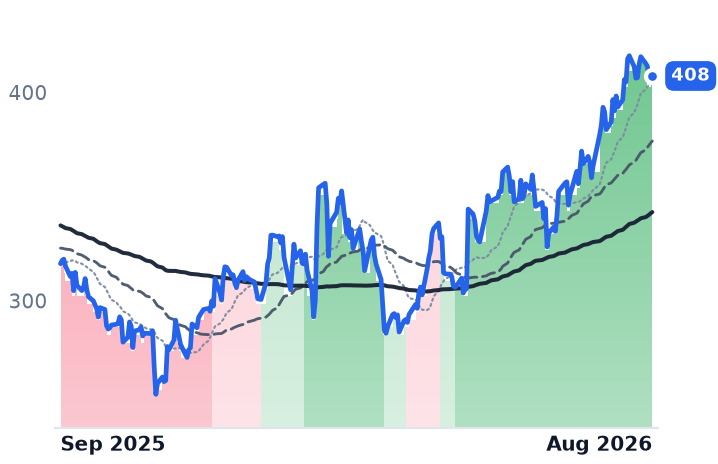
At $50.31 on August 28 the shares are 44.4% above their late-May level and 2.3% above a year ago; the 50-day average crossed above the 200-day on August 20, the first session after results. BILL fetches 3.84 times trailing gross profit, against 3.04 at the May trough and 3.58 a year ago, and 13.4 times fiscal-2027 consensus earnings of $3.74, with a trailing free-cash-flow yield of 9.56%. Corpay, the $26.7bn payments group that grew June-quarter revenue 21.5%, trades at 7.24 times gross profit — and told investors its corporate payments unit grew 16% organically despite a 1.8-point revenue drag from lower float income, confirming the headwind is industry-wide. At the other end, Expensify's expense platform shrank 5.3% to $33.9m with card interchange of just $5.9m; "if you look at our kind of neo card competitors, Ramp, Brex and the like, you have to use their card," chief financial officer Ryan Schaffer said on August 6. "We don't require you to switch."
The verdict splits cleanly. BILL earns the margin half of its advance: monetization per dollar routed is genuinely rising, cross-sell is working, and the cost program is real money. It has not yet earned the growth half, because the guided profit step is a reorganization annualized while the base of paying businesses contracts — and revenue per business cannot carry a 11–14% core growth guide indefinitely on its own.
Rene Lacerte told the August 19 call that more than 175,000 businesses have now used BILL's artificial-intelligence agents. Every one of them was already a customer. The harder number to move is the count of businesses that are not.