

Klaviyo Slowed to 26.4% Growth for a Fourth Quarter as Text Messaging Cut Its Margin
Hypothesis Opus 5 · Research Opus 5 · Writing Opus 5 · Prompt v1.6
Two vendors bill for the same thing — consumer profiles stored and messages sent — and their businesses have moved in opposite directions while their valuations moved the other way. Klaviyo's customer count passed 205,000 in the June quarter, but revenue growth decelerated for a fourth straight quarter, to 26.4%, and gross margin fell to 72.6% from 75.7%. Braze accelerated for a fourth straight quarter, to 30.2%, with dollar-based net retention at 110% and contracted backlog of $1.1bn growing in line with revenue rather than ahead of it.
Neither is a price-migration story on a flat base: both split roughly sixteen points of new logos against nine to twelve points of account expansion. Both surrender about five points of gross-profit growth to messaging they resell. The company whose numbers are improving now carries the dearer valuation; the one decelerating carries the cheaper.
| Ticker | Company | Segment | Trend · 13mo | 30D | 1Y |
|---|---|---|---|---|---|
| The subject · what this brief is about | |||||
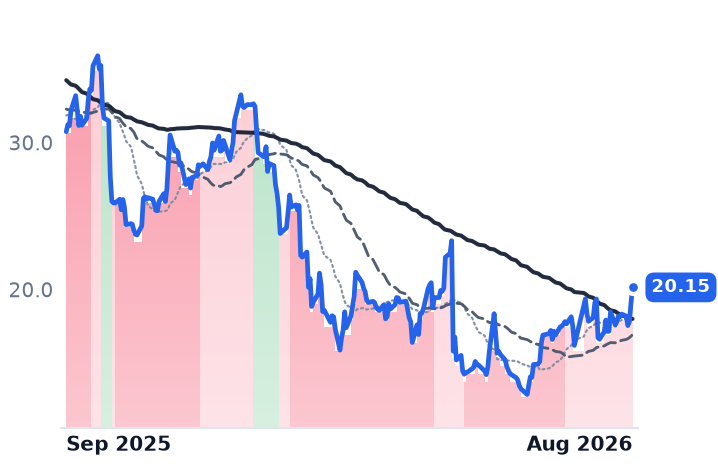
KVYO | Klaviyo | Marketing Automation | 🔴 Cont. Bear | +12.9% | −34.5% |
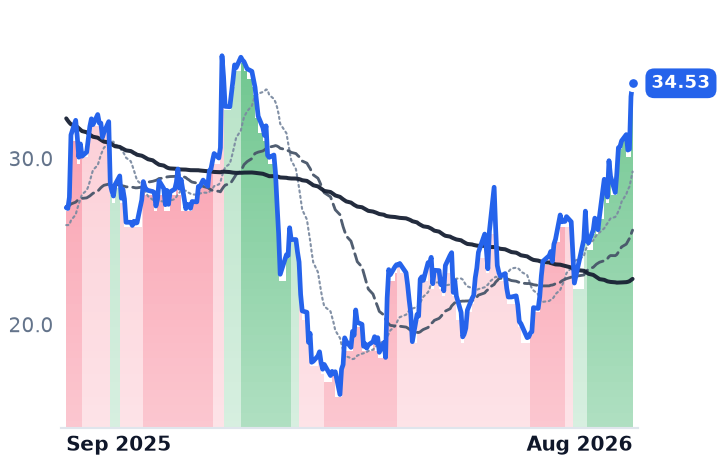
BRZE | Braze | Customer Experience & CRM | 🌱 Emerging Bull | +38.6% | +27.7% |
| Compared against · context, not the story | |||||
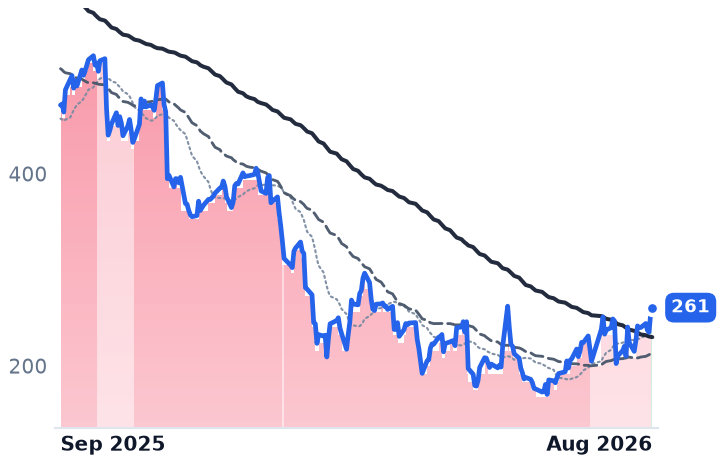
HUBS | HubSpot | Customer Experience & CRM | 🔴 Cont. Bear | +9.8% | −44.7% |
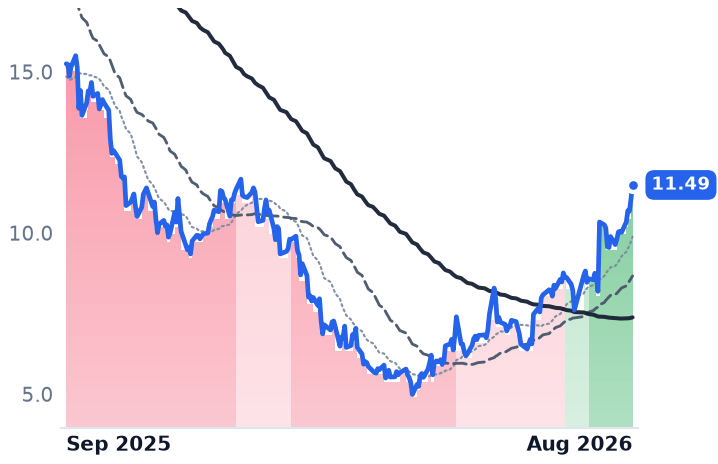
SPT | Sprout Social | Software - Application | 🌱 Emerging Bull | +33.9% | −24.7% |
CRM | Salesforce | Customer Experience & CRM | 🔴 Cont. Bear | +39.1% | +2.1% |
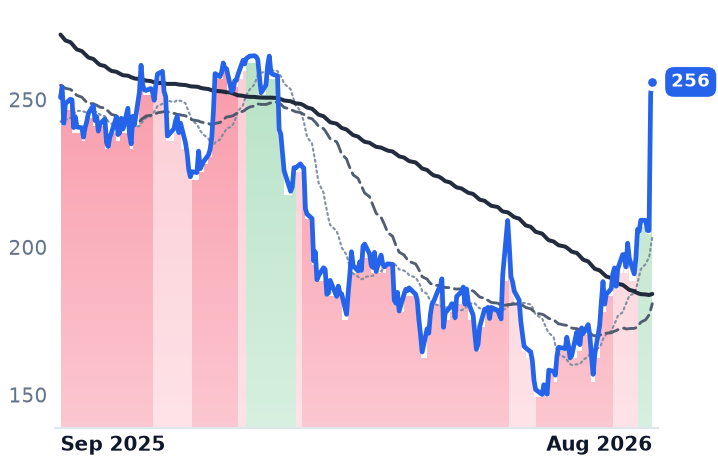
12-month price & trend
| Ticker | Mkt cap | P/E | P/E fwd | P/S | P/S fwd | P/GP | P/GP fwd | EV/EBITDA | FCF yld |
|---|---|---|---|---|---|---|---|---|---|
KVYO | $6.0B | 937.2x | 24.4x | 4.3x | 3.9x | 5.9x | 5.3x | 197.1x | 4.1% |
BRZE | $3.9B | n/m | 54.5x | 4.9x | 4.3x | 7.4x | 6.5x | n/m | 1.7% |
HUBS | $13.4B | 92.2x | 19.6x | 3.9x | 3.6x | 4.7x | 4.4x | 44.5x | 5.7% |
| Ticker | Mkt cap | P/E | P/E fwd | P/S | P/S fwd | P/GP | P/GP fwd | EV/EBITDA | FCF yld |
|---|---|---|---|---|---|---|---|---|---|
SPT | $690.6M | n/m | 10.2x | 1.4x | 1.4x | 1.9x | 1.8x | n/m | 7.5% |
CRM | $209.7B | 23.3x | 15.8x | 4.8x | 4.5x | 6.2x | 5.9x | 15.4x | 7.2% |
Consensus projections
| Ticker | FY2026E | FY2027E | FY2028E | |
|---|---|---|---|---|
KVYO | Revenue | +25.7% | +19.6% | +18.9% |
| EPS | +27.3% | +28.3% | +25.3% | |
BRZE | Revenue | +24.3% | +22.8% | +16.6% |
| EPS | +281.2% | +50.3% | +52.1% | |
HUBS | Revenue | +18.2% | +14.2% | +14.0% |
| EPS | +38.2% | +25.9% | +18.4% | |
SPT | Revenue | +8.6% | +5.8% | +9.7% |
| EPS | +43.9% | +39.2% | +20.6% | |
CRM | Revenue | +9.3% | +11.4% | +9.6% |
| EPS | +17.4% | +37.6% | −1.6% |
Forward fiscal years only. Blank means no analyst coverage for that year.
Klaviyo, the Boston platform that stores consumer profiles for e-commerce brands and sends their email, text and push campaigns, finished the June quarter with more than 205,000 customers, against more than 176,000 a year earlier. That is roughly 16.5% more brands paying, and revenue rose 26.4% to $370.6m — so about two-thirds of the growth is new logos and one-third is existing accounts spending more, with annualized revenue per customer up about 8.5% to roughly $7,230.
That decomposition matters because this rung of software is not billed by the seat. The meter is the customer's own audience: profiles stored, messages sent. It grows when a brand grows, which is the attraction, and it drags a cost of goods along with every message, which is the defect. Klaviyo's growth has now decelerated four quarters running — 32.2%, 29.6%, 27.9%, 26.4% — and the company guided the September quarter to $377–381m, or 21.5–22.5%.
The margin is the meter's price
Gross profit grew 21.3% against that 26.4% of revenue, and reported gross margin fell to 72.6% from 75.7% a year earlier. Klaviyo told investors margin steps down again in the September quarter and falls by more than the normal seasonal amount in December, because text grows faster than the company overall; a pricing change shifting carrier fees onto customers is expected to be neutral to this year's revenue and margin. "Text has strong unit economics, driven by its lower cost of acquisition and higher rates of expansion," chief financial officer Amanda Whalen said on the August 5 call — she is being succeeded by Erica Smith from September 1. The quarter also swung to a $15.0m operating loss from a small profit in March, as spending on the new agent products rose.
Upmarket, the business is working: customers above $50,000 of annual recurring revenue rose 36% to 4,477 and supply about 40% of recurring revenue, and net retention held at 109% while lapping a prior-year billing enforcement that costs three points into early next year. "We signed our largest deal ever last quarter, an 8-figure multiproduct contract with one of the fastest-growing brands in e-commerce," co-chief executive Andrew Bialecki said on the same call.
Braze runs the same meter faster
Braze, the New York engagement platform whose software kits ingest app behavior and orchestrate cross-channel campaigns, grew April-quarter revenue 30.2% to $211.0m — its fourth straight quarter of acceleration, and 27% excluding its acquisition of OfferFit. Its split is similar to Klaviyo's: 2,713 customers against 2,342, up 15.8%, with revenue per account up 12.4%. Accounts above $500,000 rose 33% to 349, net retention improved to 110%, and remaining performance obligations of $1.1bn grew 30% — in line with revenue, not ahead of it, which is the test for whether growth is being pulled forward into unburned backlog. It is not.
Braze pays the same toll: gross profit grew 24.7% against 30.2% of revenue, and margin fell to 65.7% from 68.6%. On charging for artificial intelligence the two diverge. Braze disclosed $5.7m of Decisioning Studio revenue in the quarter, about 2.7% of the total, and gates its agents behind mandatory message and action credits. Klaviyo prices Composer and its Customer Agent as separate credit-metered products with free allotments, and has published no dollar figure; Composer reached 95,000 users in its first month, and Bialecki said the share of generated campaigns users actually ran improved "to 46%, up from 35% just a few weeks ago."
What the shares have priced
Klaviyo closed August 28 at $20.15, up 36.7% in three months but 38% below a year ago, having fallen 13.6% the session after the June-quarter print. Braze closed at $34.53, up 47.8% in three months and up 28.7% since late July, the only one of the pair higher over twelve months. About thirteen points of each name's month came in two sessions after Salesforce rose 22% on August 27 — the whole of Klaviyo's thirty-day advance and roughly half of Braze's.
Because gross margins across these vendors differ by seventeen points and both companies are barely profitable under standard accounting, price against gross profit is the comparable measure. Braze trades at 7.43x trailing and 6.51x forward gross profit, against 5.41x on July 29 — a re-rating of roughly 37% in a month on no new disclosure since May 27, and 54.5x forward earnings. Klaviyo trades at 5.88x trailing and 5.34x forward, below its 6.59x reading on May 3 at nearly the same market value, and 24.4x forward earnings. HubSpot, the seat-and-bundle comparator that grew 19.8% at an 82.4% gross margin and cut its net customer-add target to 5,000–6,000 a quarter, sits at 4.65x.
The market has priced trajectory rather than level. Braze earns the improving half of that: the acceleration is organic, its largest accounts are compounding, and backlog is not flattering the top line. What it does not earn is the multiple's timing — the re-rating happened between disclosures. Klaviyo's business explains its logo growth and its enterprise displacements; it does not explain why a company guiding to low-twenties growth, with a margin it has told investors will keep falling, should be treated as the safer of the two.
Braze reports fiscal second-quarter results after the close on September 8 — its first numbers since the shares were repriced on the strength of an April quarter. A fifth acceleration makes the summer look prescient; anything less makes it a bet placed on a three-month-old press release.