

Snowflake's AI Revenue Run-Rate Reached $100m Against a $5.5bn Product Base
Hypothesis Opus 5 · Research Opus 5 · Writing Opus 5 · Prompt v1.6
Snowflake's product revenue accelerated to 34% growth in the April quarter, the strongest sequential dollar gain in its history — and its own guidance for the July quarter it reports on September 2 implies 30%. Net revenue retention has climbed to 126% and customers spending more than $1m a year reached 779, up 29%, so enterprises are consuming more compute around AI work.
What is harder to see is AI billed as its own product. The disclosed AI run-rate is roughly 2% of the annualized product base; everything else is counted in accounts, not dollars. Meanwhile the market's price on each dollar of Snowflake's gross profit has more than doubled since early May, to 33.74x, past Datadog at 27.42x — a company growing revenue faster. The consumption is real; the re-rating has run ahead of what the disclosure proves.
| Ticker | Company | Segment | Trend · 13mo | 30D | 1Y |
|---|---|---|---|---|---|
| The subject · what this brief is about | |||||
SNOW | Snowflake | Data & Analytics Platforms | 🌱 Emerging Bull | +17.0% | +37.3% |
| Compared against · context, not the story | |||||
DDOG | Datadog | Data & Analytics Platforms | 🌱 Emerging Bull | −9.6% | +69.4% |
MDB | MongoDB | Data Management & Analytics | 🟢 Cont. Bull | +40.1% | +41.5% |
ESTC | Elastic | Data & Analytics Platforms | 🌱 Emerging Bull | +53.7% | +12.8% |
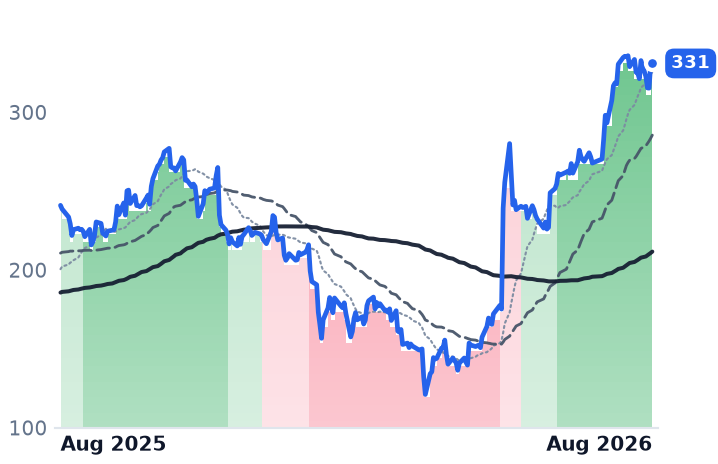
12-month price & trend
| Ticker | Mkt cap | P/E | P/E fwd | P/S | P/S fwd | P/GP | P/GP fwd | EV/EBITDA | FCF yld |
|---|---|---|---|---|---|---|---|---|---|
SNOW | $114.0B | n/m | 170.0x | 22.7x | 18.7x | 33.7x | 27.8x | n/m | 1.0% |
DDOG | $86.5B | 488.6x | 96.0x | 21.8x | 19.4x | 27.4x | 24.3x | 331.7x | 1.3% |
MDB | $34.7B | n/m | 70.4x | 13.3x | 11.7x | 18.5x | 16.2x | — | 1.7% |
| Ticker | Mkt cap | P/E | P/E fwd | P/S | P/S fwd | P/GP | P/GP fwd | EV/EBITDA | FCF yld |
|---|---|---|---|---|---|---|---|---|---|
ESTC | $10.3B | 27.5x | 30.7x | 5.7x | 5.2x | 7.6x | 6.9x | 158.5x | 3.4% |
Consensus projections
| Ticker | FY2026E | FY2027E | FY2028E | |
|---|---|---|---|---|
SNOW | Revenue | +29.4% | +31.1% | +26.0% |
| EPS | +72.3% | +59.6% | +42.0% | |
DDOG | Revenue | +31.7% | +22.3% | +22.9% |
| EPS | +25.3% | +17.0% | +22.2% | |
MDB | Revenue | +23.1% | +21.6% | +18.0% |
| EPS | +59.1% | +27.0% | +19.7% | |
ESTC | Revenue | +17.6% | +15.0% | +14.5% |
| EPS | +30.3% | +28.2% | +18.8% |
Forward fiscal years only. Blank means no analyst coverage for that year.
Snowflake has done something most of its neighbors have not: put an actual dollar figure on its artificial-intelligence business. The company that sells the Data Cloud — a consumption-priced platform where enterprises pool their data and pay for the compute they burn querying it — reached a $100m AI revenue run-rate in its fiscal third quarter of 2026, a quarter earlier than it had guided.
Set that against an annualized product-revenue base of roughly $5.5bn and it is about 2% of the company. Which means the thing that has actually accelerated — product revenue growth from 30% in the January quarter to 34% in the April quarter — is core warehouse consumption stirred up by AI workloads, rather than AI products being billed. That distinction is the whole question on Wednesday September 2, when Snowflake reports its July quarter after the close.
The consumption is real
"Snowflake delivered a milestone quarter, with product revenue of $1.33 billion, up 34% year-over-year, marking the strongest sequential dollar acceleration in our history," chief executive Sridhar Ramaswamy told investors on the May 27 first-quarter call. "AI continues to be a powerful tailwind for Snowflake."
The supporting metrics agree. Net revenue retention — what existing customers spend this year against last — has ground up from 124% to 126% across five quarters. Customers with more than $1m of trailing product revenue went from 606 to 779 over the same stretch, growing 29%, faster than revenue. Remaining performance obligations — contracted work not yet recognized — stood at $9.21bn, up 38%.
Two cautions inside that. RPO fell sequentially from $9.77bn at the January year-end, and its growth rate decelerated from 42% while revenue growth rose. And Snowflake publishes neither a current-RPO figure nor an average contract duration, so a backlog swelled by longer multi-year paper cannot be distinguished from one swelled by demand. Elastic, reporting a day earlier, splits its committed cloud from its self-serve cloud; Snowflake does not offer the equivalent.
Beyond the $100m, AI is quantified in accounts: Cortex Code in more than 7,100 customer accounts in the April quarter, up from 4,400.
Where the margin comes from
GAAP gross margin peaked at 67.8% in the October quarter and has slipped for two quarters to 66.6% — consistent with graphics-processor-served inference costing more to serve than a table scan. The 75% non-GAAP product gross-margin guide is held partly by bandwidth savings under a new Amazon Web Services contract, a procurement term rather than the AI products' own economics. That contract runs the other way on cash: Snowflake committed $6bn of compute and AI spend to AWS over five years, roughly $1.2bn a year against a company whose entire annual cost of revenue is about $1.5bn.
The improvement in the operating loss, narrowed 27% to $326m, is expense discipline: operating costs grew 9.8% while revenue grew 33.5%. Buybacks are not the mechanism either — $873.5m repurchased in fiscal 2026 against $1.48bn of stock compensation, with diluted shares still rising to 345.4m.
What the shares have already paid for
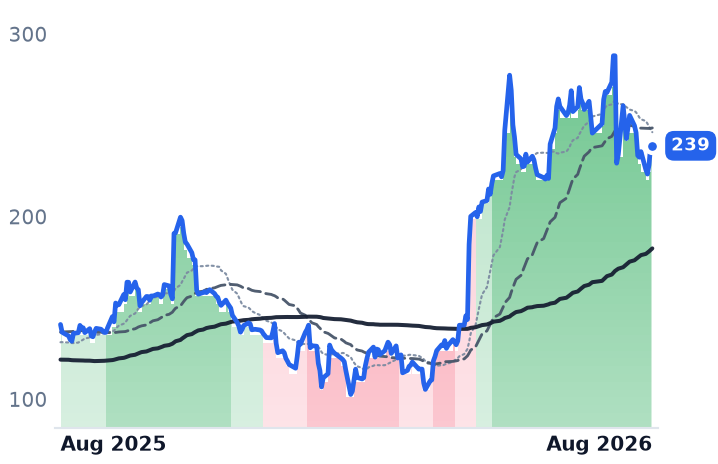
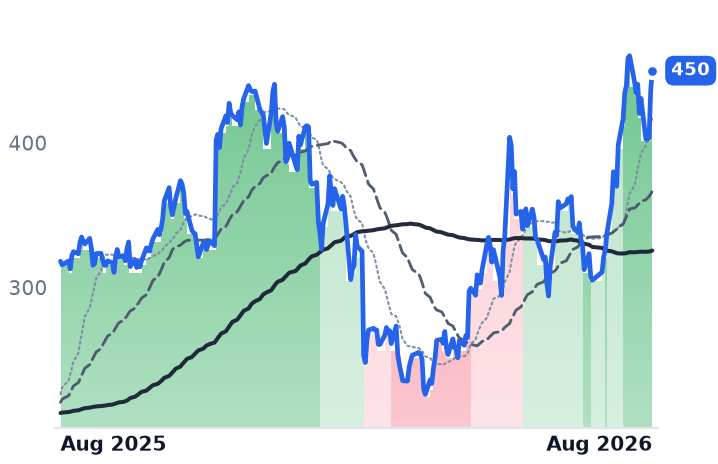
Snowflake closed at $330.97 on August 28, up 22% in thirty days and 86% from the two sessions before May's print, and its 50-day average has sat above its 200-day since late June. The market now pays 33.74x trailing gross profit, against 15.66x in early May and 27.73x in late July. Datadog, the monitoring platform, trades at 27.42x while growing revenue 35.6%; MongoDB, the document-database company, at 18.50x growing 25%. Datadog also supplied the cautionary case, falling 20.4% in the August 6 session on a large AI customer's usage cut despite that growth rate. No Snowflake-specific news explains the thirty-day move; the likelier reading is the broad software rotation plus positioning into September 2.
So: the business earns the direction of the move and not its size. Consumption, retention and large-account counts all improved, and the AI disclosure is better than the adoption-count fog its peers offer. But the company guided July product revenue to $1.415–1.420bn, four points of growth below what it just reported; gross margin is drifting the wrong way; and Databricks, private and self-reporting, claims $7bn of annualized revenue growing about 80%, with its directly competing warehouse product at $1.5bn. Snowflake is now the most expensive dollar of gross profit among its listed peers while growing slower than one of them.
Snowflake has promised Amazon $1.2bn a year of compute it must find customers to consume. September 2 is the first read on whether the demand arrives on that schedule.