

Jeff Green Bought $150m of The Trade Desk in March; It Now Guides Revenue Down 12%
Hypothesis Opus 5 · Research Opus 5 · Writing Opus 5 · Prompt v1.6
The argument about The Trade Desk has changed from how fast it grows to how long it shrinks: consensus now carries revenue falling in both 2026 and 2027, and a wave of brokers cut their ratings after the August 6 call.
Revenue growth decelerated across four quarters to 3.0% and operating income fell 13% year on year; the September quarter is guided to at least $650m, about 12% below last year. Connected television still grew double digits and accounts outside the top 500 grew more than 50%, which locates the shortfall in a handful of large advertisers rather than in the whole meter.
The de-rating is earned. Whether it has overshot rests on cash: 7.1 times enterprise value to trailing cash earnings prices decline, while on consensus earnings the shares cost more forward than trailing. No bottom is established.
| Ticker | Company | Segment | Trend · 13mo | 30D | 1Y |
|---|---|---|---|---|---|
| The subject · what this brief is about | |||||
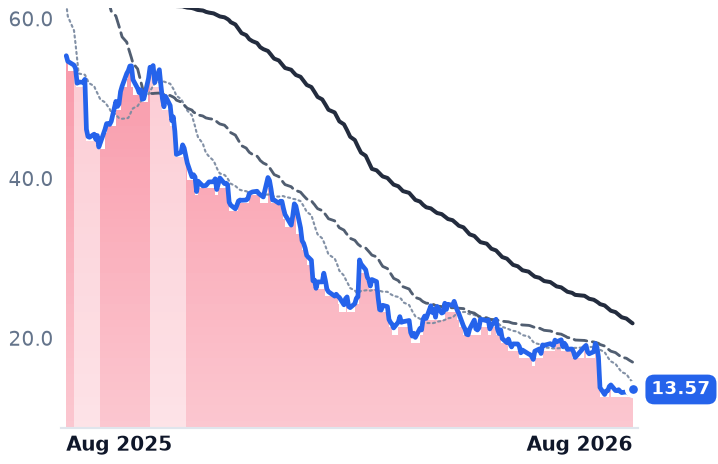
TTD | The Trade Desk | Programmatic Ad Platforms | 🔴 Cont. Bear | −28.9% | −75.5% |
| Compared against · context, not the story | |||||
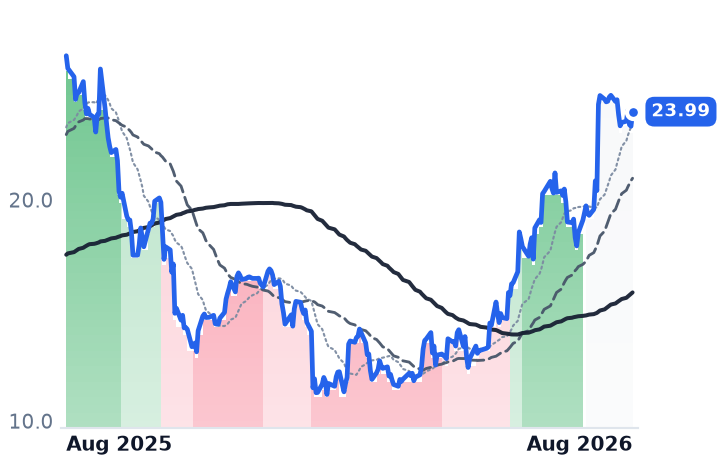
MGNI | Magnite | Programmatic Ad Platforms | 🌱 Emerging Bull | +21.6% | −9.5% |
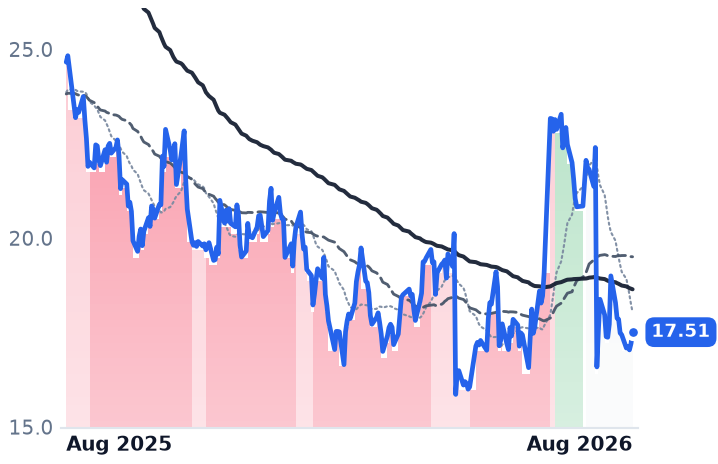
CRTO | Criteo | Programmatic Ad Platforms | 🔴 Cont. Bear | −20.6% | −29.0% |
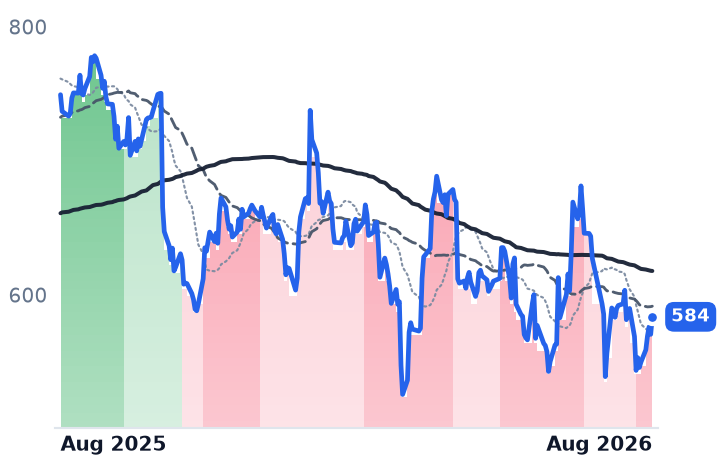
META | Meta Platforms | Social Media & Messaging | 🔴 Cont. Bear | −0.3% | −22.1% |
ROKU | Roku | Streaming Video Platforms | 🟢 Cont. Bull | +8.7% | +62.0% |
ZETA | Zeta Global | Marketing & Advertising Technology | 🟢 Cont. Bull | +38.4% | +56.3% |
DV | DoubleVerify | Marketing & Advertising Technology | 🔴 Cont. Bear | +15.7% | −17.9% |
AMZN | Amazon.com | Online Marketplaces | 🟢 Cont. Bull | +17.6% | +15.1% |
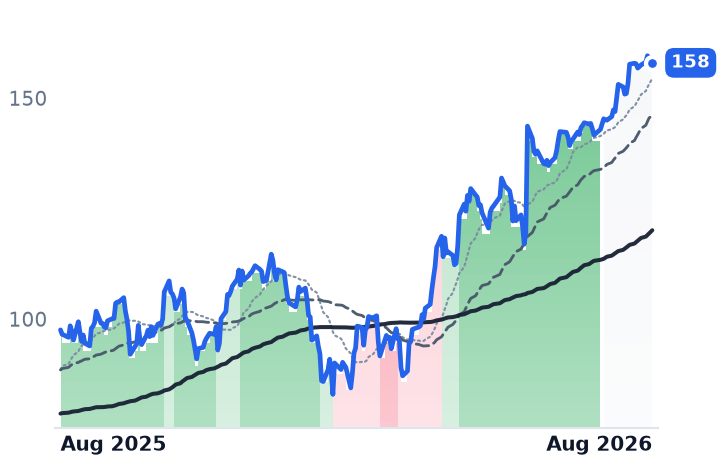
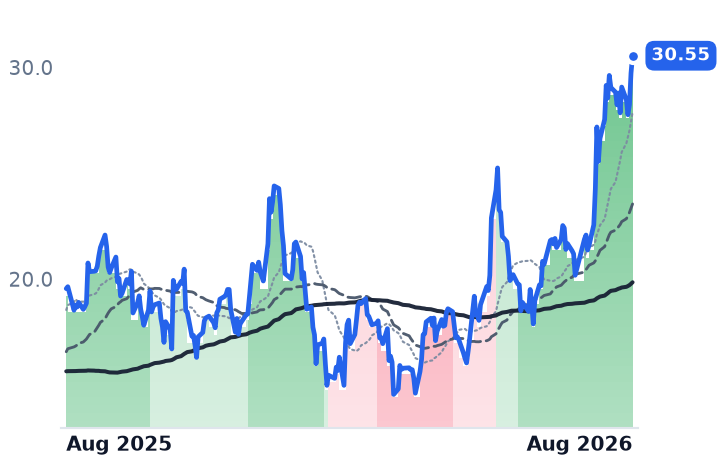
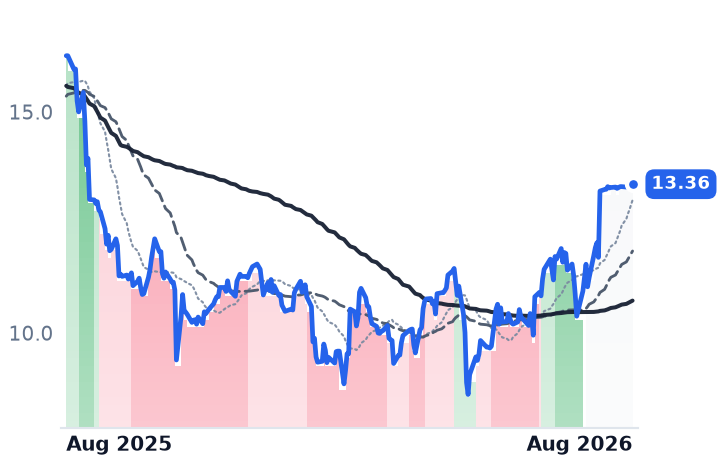
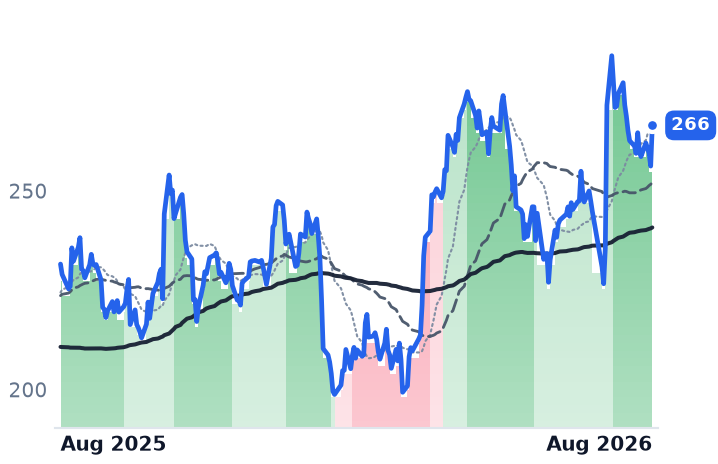
12-month price & trend
| Ticker | Mkt cap | P/E | P/E fwd | P/S | P/S fwd | P/GP | P/GP fwd | EV/EBITDA | FCF yld |
|---|---|---|---|---|---|---|---|---|---|
TTD | $6.4B | 16.2x | 33.8x | 2.1x | 2.3x | 2.6x | 2.8x | 7.1x | 13.5% |
MGNI | $3.4B | 20.3x | 20.9x | 4.6x | 4.5x | 7.1x | 6.9x | 22.3x | 6.3% |
CRTO | $877.3M | 8.6x | 4.8x | 0.5x | 0.8x | 0.9x | 1.6x | 3.1x | 20.2% |
| Ticker | Mkt cap | P/E | P/E fwd | P/S | P/S fwd | P/GP | P/GP fwd | EV/EBITDA | FCF yld |
|---|---|---|---|---|---|---|---|---|---|
META | $1.5T | 21.5x | 18.2x | 6.5x | 5.8x | 7.9x | 7.1x | 14.7x | 2.8% |
ROKU | $18.3B | 90.8x | 50.9x | 3.7x | 3.3x | 8.3x | 7.5x | 47.9x | 3.6% |
ZETA | $7.1B | n/m | 29.2x | 4.5x | 3.9x | 7.3x | 6.3x | 92.2x | 3.2% |
| Ticker | Mkt cap | P/E | P/E fwd | P/S | P/S fwd | P/GP | P/GP fwd | EV/EBITDA | FCF yld |
|---|---|---|---|---|---|---|---|---|---|
DV | $2.0B | 35.9x | 27.9x | 2.6x | 2.5x | 3.3x | 3.1x | 12.3x | 7.6% |
AMZN | $2.9T | 21.2x | 21.1x | 3.7x | 3.5x | 7.3x | 6.8x | 11.9x | -0.4% |
Consensus projections
| Ticker | FY2026E | FY2027E | FY2028E | |
|---|---|---|---|---|
TTD | Revenue | −4.6% | −4.5% | +9.5% |
| EPS | −52.9% | −41.3% | +87.1% | |
MGNI | Revenue | +13.7% | +10.7% | +13.6% |
| EPS | +29.5% | +18.5% | +11.0% | |
CRTO | Revenue | −10.3% | +2.3% | +6.6% |
| EPS | −22.2% | +14.0% | +10.4% | |
META | Revenue | +27.3% | +20.1% | +17.8% |
| EPS | +38.3% | +6.9% | +15.4% | |
ROKU | Revenue | +18.1% | +11.9% | +13.0% |
| EPS | +626.0% | +46.2% | +48.7% | |
ZETA | Revenue | +41.0% | +16.1% | +14.0% |
| EPS | +47.2% | +23.7% | +18.6% | |
DV | Revenue | +8.9% | +9.7% | +8.3% |
| EPS | +63.8% | +28.2% | +19.9% | |
AMZN | Revenue | +15.9% | +14.6% | +16.0% |
| EPS | +76.8% | −16.1% | +30.8% |
Forward fiscal years only. Blank means no analyst coverage for that year.
The sell side has stopped debating how fast The Trade Desk can grow and started modeling how long it will shrink. Consensus now carries revenue falling 4.6% this year and a further 4.5% in 2027 at the Ventura, California company, which runs an independent demand-side platform — the software advertising agencies use to buy connected television, display, audio and mobile inventory on behalf of brands.
That reset followed the August 6 second-quarter call, and it dragged the price with it. HSBC's Mohammed Khallouf cut the shares to Reduce on 17 August with a $10 target, down from $20, sending them to their lowest level since January 2019; Guggenheim, Evercore ISI, DA Davidson, BMO and Scotiabank also downgraded, and the average target fell 43% to $13.89 — roughly where the stock actually trades. The stake now is the floor rather than the miss: a company that still generated $136m of free cash flow in the June quarter, at a 13.5% trailing free-cash-flow yield, is being priced as though the meter it charges against is permanently smaller.
The meter is running slower
Growth did not break in one quarter. It ran 17.7%, then 14.3%, then 11.8%, then 3.0% on June-quarter revenue of $715.1m. Third-quarter revenue is guided to at least $650m, about 12% below last year, with adjusted earnings before interest, tax, depreciation and amortization of around $160m against $241m in the second quarter. Operating income fell 13% year on year and net income 28.6% — profit contracting faster than the top line slows.
Underneath, the volume signals are uneven rather than uniformly bad. Connected TV grew double digits and is more than half of revenue; joint business plans with large advertisers grew 38%; accounts outside the top 500 grew more than 50%. The shortfall is concentrated in a handful of the biggest accounts, in consumer-goods and automotive categories that management put at about a quarter of platform spend, with some brands moving from premium decisioning to cheaper guaranteed buying.
The pricing story is not where it is usually assumed to be. Management's position is that its take rate has been flat for a decade, and that Kokai, its unified identifier and new artificial-intelligence tools went in without rate increases. The visible take-rate compression is at Criteo, the retail-media and performance advertising company, whose media spend grew 9% to $1.1bn last quarter while its own contribution net of traffic-acquisition costs fell 12% in constant currency. What squeezes The Trade Desk instead is the price of the media itself: Amazon made ads the default on Prime Video, adding roughly 50 billion impressions and taking its own connected-TV prices from about $35 per thousand views to $28 within a year, with buyers reporting broad declines of 10% to 30%. A percentage-of-spend meter runs slower on cheaper impressions — and Amazon's demand-side platform, which charges nothing on its own inventory, went from under 10% to just under 20% of global programmatic share in about fifteen months.
The macro alibi
"These numbers are not a reflection of our company or the long-term opportunity in front of us," chief executive Jeff Green told investors on the August 6 call, pointing to tariffs, inflation and a weaker consumer alongside the company's own execution. The word "macro" was used 14 times on that call. Meta grew revenue 28.0% in the same quarter. Magnite, the sell-side platform that monetizes the connected-TV inventory The Trade Desk buys, grew 11.2% with gross profit up 20.7% and operating income up 42.2%; its shares are up 76% since late February while The Trade Desk's have roughly halved. The impressions are being transacted. The independent buy side is not capturing them.
What the price embeds
The market values the company at about 2.7 times trailing gross profit, against roughly 21 times at the August 2025 peak — between Magnite at 7.1 times and Criteo, in outright decline, at 0.9. On cash the same ordering holds: 7.1x enterprise value to trailing cash earnings versus Magnite's 22.3x. Buybacks are real, cutting diluted shares 5.2% year on year, with $78m repurchased last quarter and $269m of authorization left against $1.5bn of cash. Green himself bought roughly 6m shares in early March at weighted average prices between $23.49 and $25.08 — about $150m, which he called the biggest personal purchase of his life.
On earnings the picture reverses. Consensus models $0.402 of earnings per share this year against $0.91 last year, which puts the shares at 33.8 times forward earnings and 16.2 times trailing — dearer on next year than on last. Nor has the chart resolved anything: 15 sessions since 10 August between $12.95 and $14.14, with closing lows of $12.95 and then $13.03, is a flat shelf rather than a sequence of higher lows, inside a downtrend unbroken since 13 November.
So the year-long de-rating is earned, and the case that it has overshot has to be made on cash flow alone. The cash multiple prices a business in permanent decline; the forward earnings multiple prices one whose profits halve and then stabilize. Both cannot be right, and the guide gives no help — management has said forward visibility is now a constraint on what it can forecast at all.
The company has told investors to expect less revenue in the September quarter than it booked a year ago. Whether Green's March purchase was early or simply wrong turns on how many quarters like that follow it.