

Bandwidth's $905m 2026 Guide Hands Roughly $89m of the Growth Straight to Carriers
Hypothesis Opus 5 · Research Opus 5 · Writing Opus 5 · Prompt v1.6
Bandwidth's reported revenue is growing at nearly twice the rate of the business underneath it, and the difference is money that never stops at the company. June-quarter revenue rose 22% to $220m; cloud communications revenue — Bandwidth's own measure, which strips out the messaging surcharges it collects and remits to US mobile carriers — rose 12%, and gross profit rose 9.6%.
Management raised full-year guidance while cutting its 2026 political campaign revenue forecast to $13m, so the midterm texting cycle is not the explanation either. Profitability is genuinely improving: adjusted EBITDA reached a record margin and non-GAAP earnings are guided up sharply. But analysts expect revenue growth of 4.3% in 2027, once the carrier fee increases lap.
| Ticker | Company | Segment | Trend · 13mo | 30D | 1Y |
|---|---|---|---|---|---|
| The subject · what this brief is about | |||||
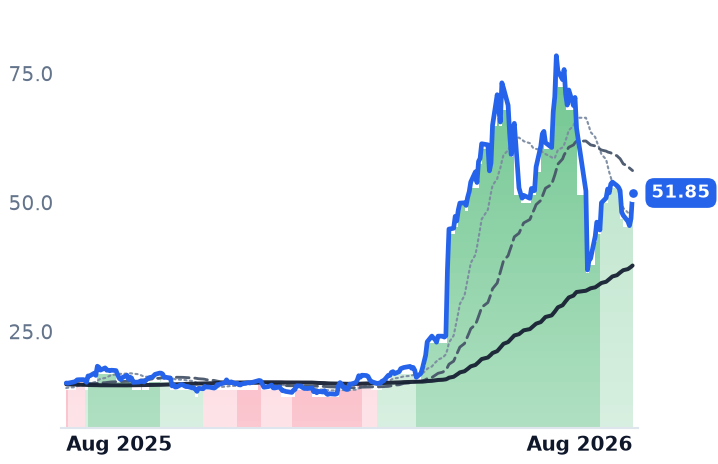
BAND | Bandwidth | Communications & Messaging Platforms | 🌱 Emerging Bull | +40.3% | +244.7% |
| Compared against · context, not the story | |||||
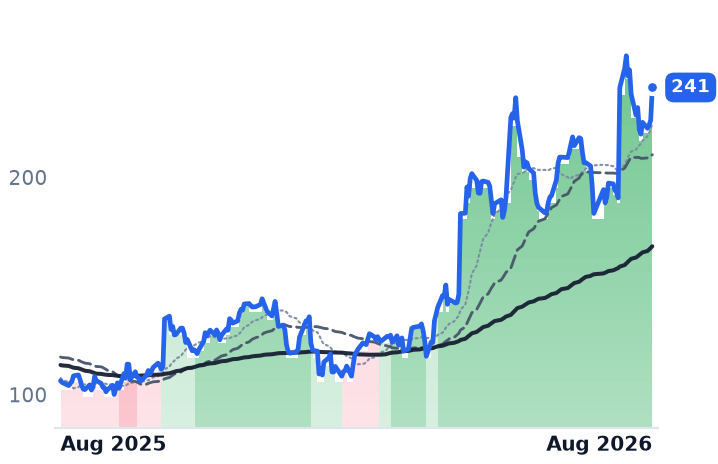
TWLO | Twilio | Communications & Messaging Platforms | 🟢 Cont. Bull | +28.2% | +126.8% |
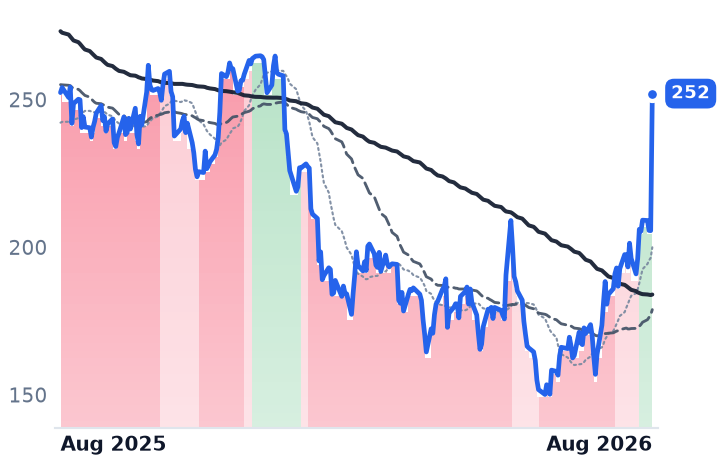
CRM | Salesforce | Customer Experience & CRM | 🔴 Cont. Bear | +33.8% | −0.1% |
12-month price & trend
| Ticker | Mkt cap | P/E | P/E fwd | P/S | P/S fwd | P/GP | P/GP fwd | EV/EBITDA | FCF yld |
|---|---|---|---|---|---|---|---|---|---|
BAND | $1.7B | n/m | 29.6x | 2.0x | 1.8x | 5.4x | 4.9x | — | 4.3% |
TWLO | $36.6B | 32.1x | 40.7x | 6.6x | 6.1x | 13.5x | 12.6x | 100.6x | 3.0% |
CRM | $168.4B | 18.7x | 14.5x | 3.8x | 3.7x | 5.0x | 4.7x | 12.4x | 9.0% |
Consensus projections
| Ticker | FY2026E | FY2027E | FY2028E | |
|---|---|---|---|---|
BAND | Revenue | +20.0% | +4.3% | +20.2% |
| EPS | +22.2% | +9.9% | +41.0% | |
TWLO | Revenue | +19.4% | +11.7% | +10.6% |
| EPS | +23.5% | +14.5% | +14.2% | |
CRM | Revenue | +9.3% | +11.1% | +9.4% |
| EPS | +17.4% | +20.2% | +10.4% |
Forward fiscal years only. Blank means no analyst coverage for that year.
Bandwidth cut its forecast for 2026 political campaign messaging to $13m from $15m on its July 29 call, a small revision inside an otherwise raised guide. It is also the clearest available evidence that the November US midterms are not what re-rated the stock: political texting works out to about 1.4% of guided full-year revenue, and contributed roughly $1m in the June quarter.
What inflated the top line was the carriers. Bandwidth, a Raleigh, North Carolina company that owns and operates its own carrier network and sells voice, messaging and emergency-services programming interfaces to enterprises and to the software vendors that resell them, guided full-year revenue to $900m–$910m, about 20% growth. It guided its own cloud communications measure — total revenue less pass-through messaging surcharges — to $622m–$626m, or 11%. Work from the midpoints against 2025's $753.8m and roughly $89m of the $151m of guided growth, near 59%, is surcharge money collected from customers and remitted to mobile carriers without markup. That split is arithmetic from disclosed midpoints, not a reported line item.
Three fee increases, one revenue line
The surcharges are not Bandwidth's doing. US mobile carriers raised application-to-person per-message fees three times this year — T-Mobile effective January 19, AT&T on April 1 and Verizon on May 1. Providers bill them through and hand them over. The effect on reported growth is dramatic and on profit is nil: Bandwidth's revenue went from -1.1% in the fourth quarter of 2025 to +19.8% and +22.2% in the two quarters since.
Gross profit did not follow. It rose 9.6% in the June quarter to $78.5m while revenue rose 22.2% to $219.9m, and GAAP gross margin fell 4.1 points to 35.7%. The company's own 10-Q quantifies it: first-half cost of revenue rose $61m, of which $41m was higher pass-through messaging surcharges. Bandwidth remains loss-making at the GAAP operating line, a fifth straight quarter.
The half that is real
"Strong customer demand across Voice and Messaging, combined with the structural advantages of our owned-and-operated global network, drove another quarter of margin expansion and profit growth," chief financial officer Daryl Raiford said in the July 29 release. On the non-GAAP measures he is right. Adjusted EBITDA rose 27% to a record 18.3% margin, non-GAAP gross margin improved about a point to 59.4%, and full-year non-GAAP earnings are guided up 48%. Customer name retention runs above 99% and revenue per customer hit a record $256,000. Bandwidth was picked in March to carry voice and messaging for Salesforce's Agentforce Contact Center, and all five of the quarter's million-dollar wins included its Maestro orchestration or AI services — though no dollar figure or customer count for AI voice traffic has ever been disclosed.
The expansion metric is the tell. Dollar-based net retention was 107%. Twilio, the closest listed comparable and a company that quantified the identical carrier-fee drag on its own August 6 call, reported 116% net expansion and grew gross profit 20.4% on the same 22% headline revenue growth.
What the price has already paid for
Bandwidth has risen about 245% over twelve months, to $51.85 on August 27 from $15.04 a year earlier, and is still 34% below its July 9 peak of $78.44 — the two sessions around earnings took 19% and then 29% out of it. Against gross profit, the only workable anchor while GAAP earnings are negative, the shares trade at 5.41x trailing and 4.95x forward, down from 6.52x in May but far above the roughly 1.5x implied a year ago. Twilio's 13.54x looks expensive beside it until the growth rates are laid alongside. On earnings, 29.6x forward is being paid for a year in which consensus has revenue growing 4.3%. Piper Sandler's James Fish lifted his target to $52 on August 19 while staying Neutral, citing risk-reward "especially looking at likely reported growth rates beyond this year."
The verdict splits cleanly. Bandwidth's earnings power has genuinely improved — the incremental margin on cloud communications growth is real and the balance sheet was refinanced at a zero coupon. What nothing in the business explains is a re-rating built on a revenue line that is 59% borrowed from mobile carriers and lapses on its own schedule. The AI voice story may eventually fill the hole, but it has produced anecdotes and no disclosed dollars.
Bandwidth has not yet set a date for third-quarter results; the last two years put it in late October. That report is the first read on whether midterm messaging showed up at all, and the last one before the carrier fee increases start comparing against themselves in January.