

Doosan Enerbility's Bobcat Loaders Out-Earn Its Turbines, Nuclear and Forgings Combined
Hypothesis Opus 5 · Research Opus 5 · Writing Opus 5 · Prompt v1.6
Doosan Enerbility is filed by most investors as the only credible challenger to the three firms that dominate heavy-duty gas turbines. Its own half-year accounts say something else: Doosan Bobcat, the North Dakota compact-loader maker it owns 46% of and consolidates in full, earned $777.9m of gross profit at a 24.6% margin, against ₩1.55tn for the entire group.
Hanwha Aerospace wears the same label and fits it worse. Its aero-engine division was 8.2% of second-quarter revenue and 2.7% of operating profit; ground defense delivered ₩533bn of profit on howitzers and air-defense guns.
Both shares round-tripped roughly 50% between May and August while GE Vernova, Siemens Energy and Mitsubishi Heavy moved a fraction of that, and both businesses improved throughout. The drawdown was Korean deleveraging. The label was wrong before it started.
| Ticker | Company | Segment | Trend · 13mo | 30D | 1Y |
|---|---|---|---|---|---|
| The subject · what this brief is about | |||||
034020.KS | Doosan Enerbility | Industrial - Machinery | ⚠️ Emerging Bear | — | — |
012450.KS | Hanwha Aerospace | Aerospace & Defense | ⚠️ Emerging Bear | — | — |
| Compared against · context, not the story | |||||
GEV | GE Vernova | GE Vernova Integrated | 🟢 Cont. Bull | +1.3% | +44.2% |
ENR.DE | Siemens Energy | Industrial - Machinery | ⚠️ Emerging Bear | — | — |
7011.T | Mitsubishi Heavy Industries | Industrial - Machinery | ⚠️ Emerging Bear | +7.6% | +6.5% |
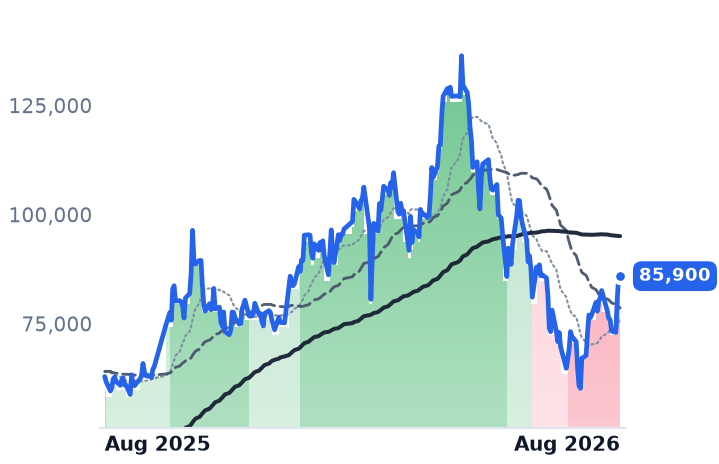
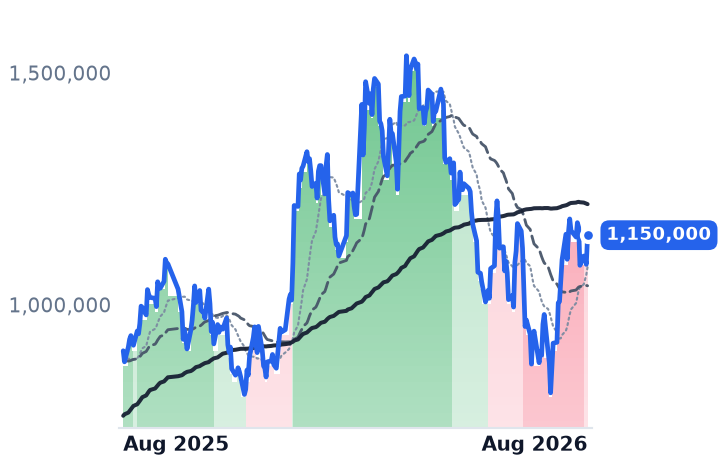
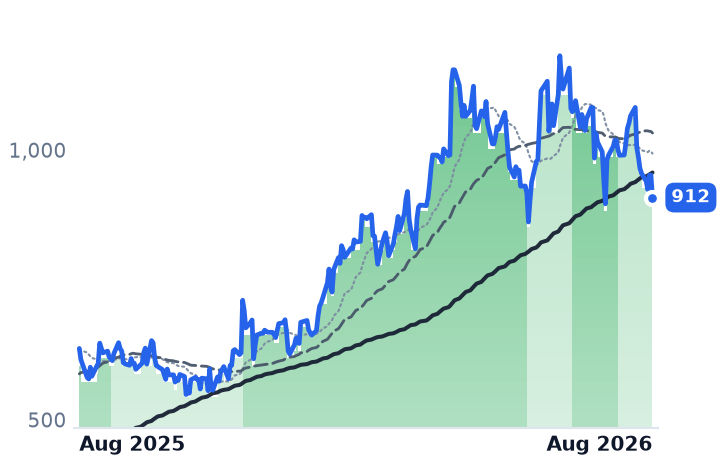
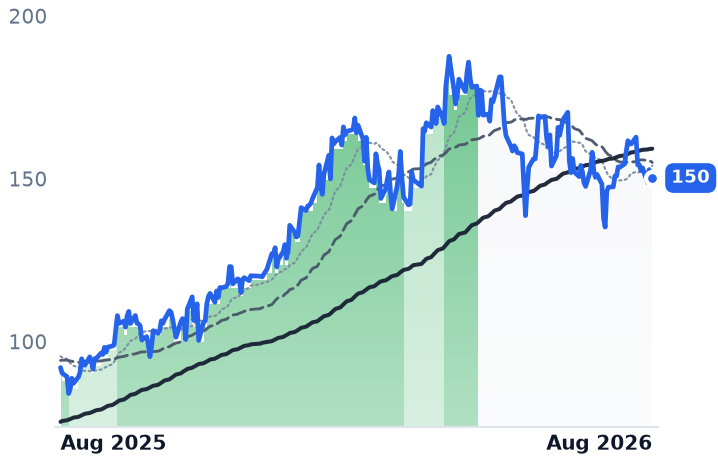
12-month price & trend
| Ticker | Mkt cap | P/E | P/E fwd | P/S | P/S fwd | P/GP | P/GP fwd | EV/EBITDA | FCF yld |
|---|---|---|---|---|---|---|---|---|---|
034020.KS | $56.5T | 312.0x | 152.3x | 3.2x | 3.1x | 20.1x | 19.5x | 63.5x | 0.1% |
012450.KS | $59.5T | 29.7x | 23.8x | 2.0x | 1.9x | 10.1x | 9.4x | 14.2x | 1.2% |
GEV | $242.9B | 25.9x | 29.7x | 5.9x | 5.2x | 29.0x | 26.0x | 27.0x | 5.1% |
| Ticker | Mkt cap | P/E | P/E fwd | P/S | P/S fwd | P/GP | P/GP fwd | EV/EBITDA | FCF yld |
|---|---|---|---|---|---|---|---|---|---|
ENR.DE | $128.0B | 47.5x | 33.6x | 3.1x | 2.9x | 14.7x | 14.0x | 21.2x | 6.0% |
7011.T | $13.5T | 33.9x | 31.3x | 2.7x | 2.4x | 12.3x | 11.0x | 18.2x | 7.1% |
Consensus projections
| Ticker | FY2026E | FY2027E | FY2028E | |
|---|---|---|---|---|
034020.KS | Revenue | +9.2% | +11.8% | +11.1% |
| EPS | +96.8% | +73.1% | +39.7% | |
012450.KS | Revenue | +19.3% | +8.6% | +8.0% |
| EPS | +42.7% | +24.9% | +11.3% | |
GEV | Revenue | +23.9% | +14.8% | +15.0% |
| EPS | +321.7% | −19.5% | +40.7% | |
ENR.DE | Revenue | +13.1% | +14.3% | +12.7% |
| EPS | +173.1% | +40.2% | +29.7% | |
7011.T | Revenue | −2.5% | +13.6% | +8.1% |
| EPS | +5.1% | +52.4% | +16.9% |
Forward fiscal years only. Blank means no analyst coverage for that year.
Doosan Enerbility is the fifth company in the world to independently commercialize a large gas turbine, and the only one outside GE Vernova, Siemens Energy and Mitsubishi Heavy Industries selling a frame in the H-class — the largest and hottest-running machines utilities buy. Open its first-half accounts, though, and most of the gross profit comes from skid-steer loaders built in North Dakota.
That matters because of what the shares are priced against. Doosan Enerbility trades at 20.1x trailing gross profit, between GE Vernova's 29.1x and Siemens Energy's 14.7x, and reads as a reasonable price for a challenger in a market where the incumbents are sold out into 2029 and turbine prices are heading toward roughly $600 per kilowatt by end-2027, about 195% above 2019 levels on Wood Mackenzie's numbers. The multiple is only reasonable because a construction-equipment subsidiary is padding the denominator.
What is actually in the profit pool
Doosan Enerbility still owns 46.06% of Doosan Bobcat and consolidates all of it — the 2024 plan to hive the stake off and fold Bobcat into Doosan Robotics collapsed in December that year after proxy adviser ISS told shareholders to oppose it. Bobcat reported first-half revenue of $3.16bn and gross profit of $777.9m at a 24.6% gross margin. Doosan Enerbility's consolidated first half was ₩8.99tn of revenue and ₩1.55tn of gross profit, a 17.3% blended margin. Converted at this year's dollar-won range of roughly ₩1,428 to ₩1,559, Bobcat is about half the revenue and roughly 70 to 74% of the gross profit — which also means the power businesses run a materially thinner margin than the loaders do.
The turbine business is real, and one part of the challenger case has already been overtaken. Doosan's H-class order book is no longer domestic: it now holds contracts for twelve gas turbines with US customers, including seven 380 MW units agreed on March 6 for monthly delivery from May 2029, with the buyer undisclosed and industry sources pointing to Elon Musk's xAI. What is not there is the supplier-to-the-oligopoly trade: the named customers for its ultra-large forgings are China's Laiyang units 5 and 6 and NuScale's small modular reactor program, with no disclosed forging sales into the three incumbents' supply chains.
The businesses got better while the shares halved
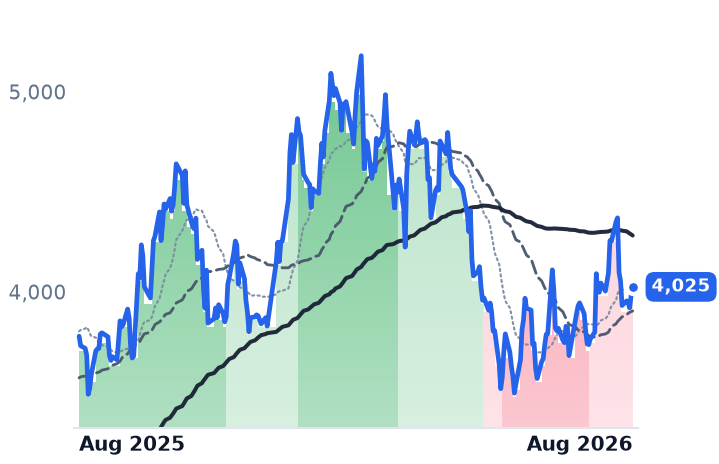
First-half operating profit rose 32.4% to ₩547.8bn, orders rose 89.6% to ₩7.12tn and backlog reached a record ₩26.35tn. The stock fell 55.9% from its May 7 close of ₩136,400 to ₩60,200 on July 30, then rebounded 46.5%. Over the same slide GE Vernova lost 13.9%, Mitsubishi Heavy 17.4% and Siemens Energy 25.2%, and none bounced more than 11%. Eugene Investment & Securities cut its target 26.7% to ₩110,000 in late July while keeping a buy rating; its analyst, quoted July 28, said that "given Doosan Enerbility's solid earnings and order momentum, U.S. investment in the second half, along with expanded supply of SMR and nuclear equipment, will drive the share price higher." The cut was attributed to peer de-ratings, not to anything at Doosan.
The cause sits offshore of the turbine cycle. Korean stocks fell 5.98% on July 29 and triggered consecutive trading halts, and the index went from bear to bull market inside a month on the Samsung Electronics and SK Hynix artificial-intelligence trade. Leverage went out and came back.
Hanwha Aerospace was never the turbine bet
Hanwha Aerospace makes engine components for aircraft and marine vessels, and it traced the same 47.3% fall and 42.8% rebound. Its aero-engine division booked ₩760bn of second-quarter revenue and ₩37bn of operating profit, against ₩9,292.9bn and ₩1,365.5bn for the group; ground defense alone delivered ₩2,107.5bn of revenue and ₩533bn of profit on K9 howitzers, the Cheonho anti-aircraft gun and shipments to Poland, Egypt and the Middle East, with backlog at ₩38.3tn after an April contract with Finland. The independent gas-turbine service business PSM belongs to affiliate Hanwha Impact, which unified it with Hanwha Power Systems under the Hanwha Power brand in March; Hanwha Aerospace shareholders own none of it.
At 23.8x forward earnings and 9.4x forward gross profit it is the cheapest of these four names, on 21 to 22% return on equity. The reason is visible: Korea's defense export orders ran near $8bn by end-July against $15.4bn for all of 2025, the big four contractors' combined backlog slipped sequentially to ₩98.5tn, and consensus models a 42% earnings decline in 2029.
The verdict
Neither drawdown was earned by the operating businesses, both of which posted record results through it. But the recovery should not be read as vindication of a turbine thesis either. Doosan's first US frames do not ship until 2029, its 63.5x trailing enterprise value to EBITDA rests on a 0.5% net margin, and the gross profit supporting its multiple is mostly compact equipment sold to American contractors — a cyclical business with no connection to data-center power. Hanwha's cheapness is defense cheapness, priced against an export pipeline that has halved.
The useful test is narrow. If Doosan's power segments cannot lift their margin above the loaders', then the challenger premium is being paid on a subsidiary the company twice tried to give away.