

Optical Fiber Now Supplies 44% of Corning's Sales and Nearly All of Its Profit Growth
Hypothesis Opus 5 · Research Opus 5 · Writing Opus 5 · Prompt v1.6
Corning's fiber business is accelerating into a share price a long way below its June peak. Optical communications sales grew 32% in the June quarter to $2.07bn, the segment's net income set a record, and the display and cover-glass half of the company grew 1%.
Nearly all of the company's incremental gross profit came from optical. The guidance that sank the stock in July came from phones — a mid-teens percentage decline in handset units, blamed on memory-chip costs. The contracts behind the fiber are dated and named: Meta up to $6bn, plus NVIDIA and Amazon. What is not disclosed is a dollar figure for artificial-intelligence optical revenue, and the plants built to serve those contracts do not run fully until the end of 2027.
| Ticker | Company | Segment | Trend · 13mo | 30D | 1Y |
|---|---|---|---|---|---|
| The subject · what this brief is about | |||||
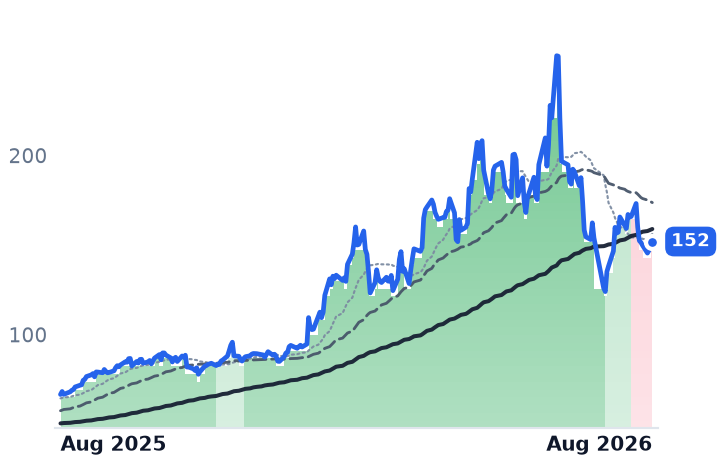
GLW | Corning | Display & Optical Materials | 🟢 Cont. Bull | +20.6% | +128.1% |
| Compared against · context, not the story | |||||
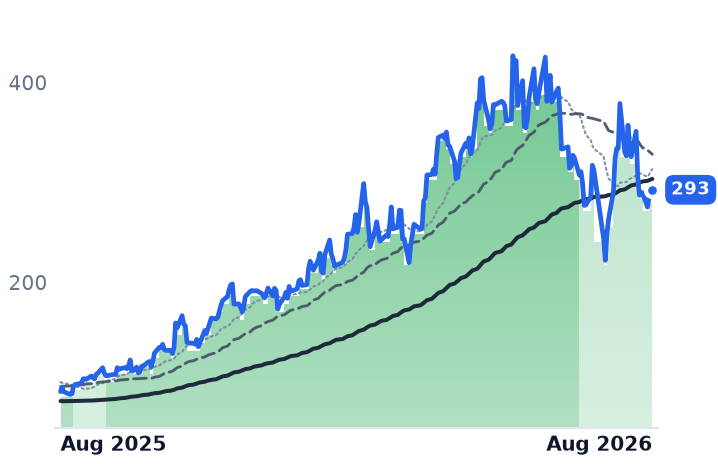
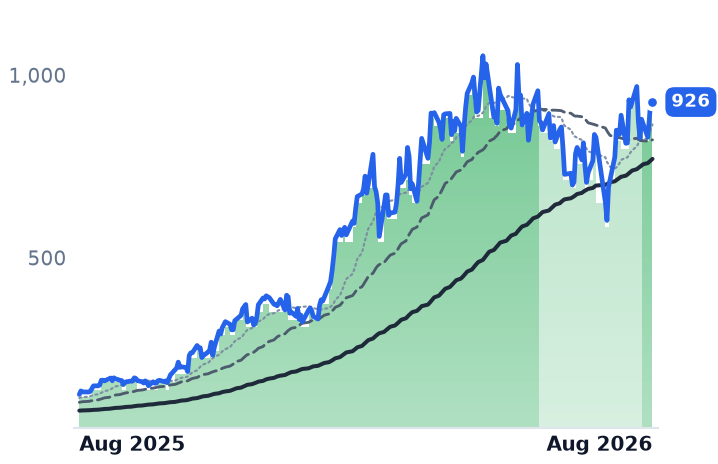
COHR | Coherent | Instrumentation & Test Equipment | 🟢 Cont. Bull | +20.3% | +222.7% |
LITE | Lumentum | Optical Transport & Switching | 🟢 Cont. Bull | +42.1% | +636.1% |
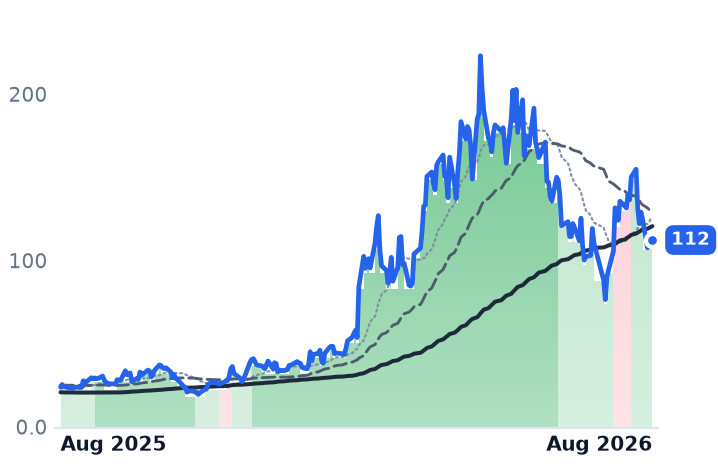
AAOI | Applied Optoelectronics | RF & Wireless | 🟢 Cont. Bull | +27.4% | +367.0% |
OLED | Universal Display | Display & Optical Materials | 🔴 Cont. Bear | +5.3% | −37.8% |
LPTH | LightPath Technologies | Display & Optical Materials | 🟢 Cont. Bull | +32.7% | +186.8% |
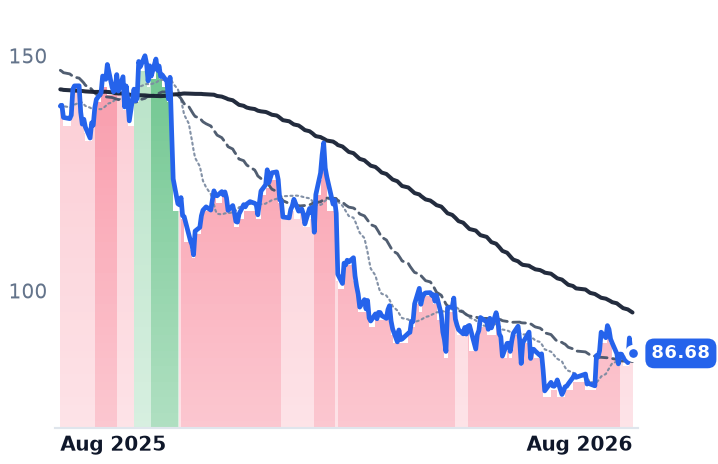
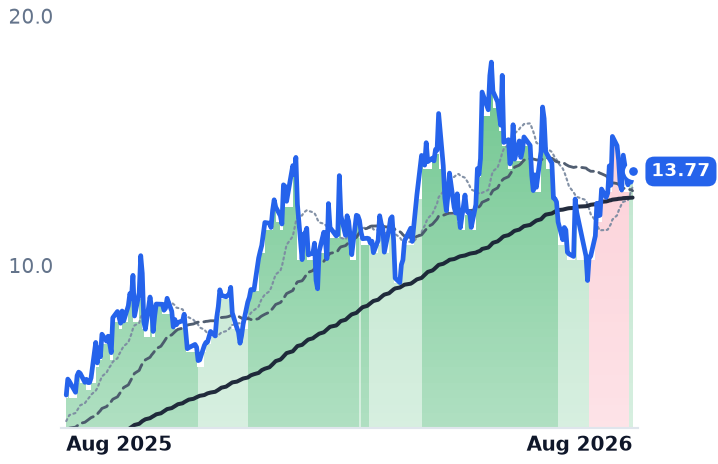
12-month price & trend
| Ticker | Mkt cap | P/E | P/E fwd | P/S | P/S fwd | P/GP | P/GP fwd | EV/EBITDA | FCF yld |
|---|---|---|---|---|---|---|---|---|---|
GLW | $131.6B | 69.1x | 46.6x | 7.8x | 6.9x | 21.4x | 18.9x | 35.5x | 1.8% |
COHR | $57.6B | 67.7x | 31.2x | 8.1x | 5.4x | 21.6x | 14.5x | 38.5x | -1.8% |
LITE | $74.4B | n/m | 44.5x | 24.7x | 12.0x | 59.2x | 28.7x | n/m | 0.7% |
| Ticker | Mkt cap | P/E | P/E fwd | P/S | P/S fwd | P/GP | P/GP fwd | EV/EBITDA | FCF yld |
|---|---|---|---|---|---|---|---|---|---|
AAOI | $9.1B | n/m | 153.1x | 15.3x | 8.7x | 52.7x | 30.0x | n/m | -4.5% |
OLED | $3.9B | 20.4x | 20.3x | 6.4x | 6.2x | 8.5x | 8.2x | 14.7x | 4.4% |
LPTH | $865.9M | n/m | 574.6x | 13.8x | 8.3x | 43.0x | 25.7x | n/m | -1.2% |
Consensus projections
| Ticker | FY2026E | FY2027E | FY2028E | |
|---|---|---|---|---|
GLW | Revenue | +17.4% | +18.7% | +21.5% |
| EPS | +29.9% | +31.8% | +37.3% | |
COHR | Revenue | +22.1% | +49.9% | +37.5% |
| EPS | +56.5% | +72.3% | +48.9% | |
LITE | Revenue | +83.9% | +107.3% | +52.3% |
| EPS | +314.0% | +161.3% | +54.6% | |
AAOI | Revenue | +131.7% | +182.3% | +72.7% |
| EPS | −327.3% | +650.2% | +92.2% | |
OLED | Revenue | −3.2% | +7.7% | +11.9% |
| EPS | −15.3% | +12.5% | +22.1% | |
LPTH | Revenue | +91.0% | +47.3% | +33.1% |
| EPS | −0.5% | −110.7% | +2025.0% |
Forward fiscal years only. Blank means no analyst coverage for that year.
Corning has signed three multiyear fiber contracts with the largest builders of artificial-intelligence data centers in the space of five months, and the factories meant to fill them are still under construction. The Hickory, North Carolina cable expansion that Meta anchored broke ground in March and is expected to be fully operational only at the end of 2027 — roughly eighteen months after the volume was booked.
That gap is the whole question at Corning, a 67,200-employee maker of optical fiber, cable and connectors that also supplies glass substrates for displays, Gorilla cover glass for phones, ceramic emissions substrates for cars and polysilicon for solar. For two years the company's re-rating has rested on promises about content per rack. The June quarter is the first in which the fiber line is unambiguously the company: optical communications sales of $2.07bn were 44% of core sales, and their $502m of year-on-year growth accounted for roughly three-quarters of the increase in the whole business.
The split inside optical
The growth is not the carrier business. Sales to telecom carriers were roughly flat in the quarter on order timing, though up 17% across the first half. Enterprise networks — the data-center line — grew 65%, with generative-AI optical sales nearly doubling. Segment net income rose 77% to a record $438m, a 21% margin after tax.
Everything else stood still. Glass Innovations, the display and Gorilla business, grew 1% to $1.46bn. Automotive grew 2% to $471m. Solar sales rose 90% to $438m and still posted a $7m net loss after a maintenance shutdown. The arithmetic settles the question of who is paying for the year: consolidated gross profit rose $236m to $1,628m, while the optical segment's net income alone rose $191m. Display pricing and the yen hedge did not do this work; fiber did.
Margins moved with it. Chief financial officer Ed Schlesinger said core gross margin expanded 1.2 points to 39.6% and core operating margin 1.9 points to 20.9%, with return on invested capital up to 14.9%. Chief executive Wendell Weeks told investors on the July 28 call that demand still exceeds Corning's ability to produce its highest-density optical products, and that any additional output could be sold immediately.
Contracted, not merely announced
The customer commitments are dated and specific. On January 27 Corning and Meta announced a multiyear agreement worth up to $6bn, with Meta as anchor customer for the Hickory expansion. On May 5 NVIDIA and Corning announced a long-term partnership under which Corning raises US optical-connectivity capacity tenfold and US fiber capacity by more than half across three new plants in North Carolina and Texas; NVIDIA took rights to invest up to $3.2bn in Corning. On June 8 Amazon added a multibillion-dollar supply agreement and 1,000 North Carolina jobs. Management said on the July 28 call that long-term agreements will become the "lion's share" of the optical business, with expansions underpinned by contracts that share investment risk with customers.
What is not disclosed is a revenue dollar. Generative-AI optical products are reported as growth rates and design status. Corning laid out a $10bn photonics revenue map by 2030 — co-packaged optics that replace copper inside the rack — and gave no 2027 guidance for it, naming the timing of scale-up adoption as the largest single adjustment in its risk-weighted plan. The engineering case is concrete enough: above 130,000 accelerators a cluster needs three optical layers instead of two, lifting fiber content per accelerator to 1.3–1.5 times current levels by 2028, and a fully optical scale-up would take about 160 fibers per accelerator against roughly 16 today. Capital spending is guided to about $2bn this year against $1.42bn of free cash flow in the quarter.
What the shares have done
Corning closed at $151.99 on August 27, 40.6% below its June 29 peak of $255.69 and 20.4% below three months ago, having lost roughly a fifth in a single session after the July results. The cause was the other half of the company: September-quarter core sales guided to $4.9–5.0bn, at or below consensus, alongside a warning that handset units would fall by a mid-teens percentage this year as memory-chip prices raise phone costs. Universal Display, which sells emitter materials into the same phone cycle, described the identical mechanism and guided to the low end of its year; its June revenue fell 11.4% to $152.2m and it trades near 8.5x trailing gross profit, priced as ex-growth. The optical names then took a second, macro hit in mid-August as the 30-year Treasury yield reached 5.33%, the highest since 2007, with Lumentum, Coherent and Fabrinet all down by around a tenth or more and no company news at Corning.
The verdict
The fiber segment earns its growth outright, and the merchant optics makers confirm the demand is physical rather than narrative — Applied Optoelectronics' chief financial officer Stefan Murry told investors on August 6 that "demand to support next generation AI infrastructure remains so robust that our near term revenue is bounded almost entirely by production capacity and key component availability." What the fiber does not do is set Corning's reported numbers. Consolidated revenue growth decelerated from 20.9% to 16.6% across four quarters and operating-income growth from 95% to 21.8%, because 56% of the company is not optical.
That is visible in the price of the profit stream. Corning trades at 21.4x trailing gross profit against roughly 35.7x at the June high, and 18.9x forward — a compression of about a tenth between the two, where Lumentum goes from 59.2x to 28.7x and Applied Optoelectronics from 52.7x to 30.0x. Consensus is not being asked to believe Corning's gross profit compounds like a pure-play optics maker's; it is being asked to hold a fiber business inside a conglomerate whose consumer end is contracting. Coherent, at 21.6x trailing and 14.5x forward, is the closer comparison and the cheaper one on next year.
So the drawdown is not a mispricing of fiber so much as a repricing of everything wrapped around it. The stake ahead is whether the phone-glass drag is one bad year or the permanent tax on owning the optical franchise. Until Hickory runs at the end of 2027, the AI half of Corning is three signatures and a growth rate — and the other half still writes the guidance.