

CEVA's Flagship AI License Won't Pay a Royalty Until 2028; Ambarella Reports September 3
Hypothesis Opus 5 · Research Opus 5 · Writing Opus 5 · Prompt v1.6
Ambarella has now given back the entire premium a reported NXP takeover approach put on its shares in July, and it reports fiscal second-quarter results next week with nothing but its own numbers to carry it.
That makes the billing question decisive. Ambarella is paid when chips ship, and its revenue growth has decelerated for four straight quarters, from 49.9% to 16.9%. CEVA is paid twice — a license fee up front, per-device royalties years later — and only the first installment has arrived: licensing revenue rose 21% to $18.2m in the June quarter while royalty revenue rose 1%.
The judgment: neither share price now embeds much edge-AI optimism. CEVA's business is accelerating and its shares are not; Ambarella's is decelerating into a print that will be its first company-generated news since May.
| Ticker | Company | Segment | Trend · 13mo | 30D | 1Y |
|---|---|---|---|---|---|
| The subject · what this brief is about | |||||
AMBA | Ambarella | Specialty Semiconductors | 🌱 Emerging Bull | +2.7% | −1.5% |
CEVA | CEVA | Specialty Semiconductors | 🌱 Emerging Bull | −11.1% | +24.8% |
| Compared against · context, not the story | |||||
NXPI | NXP Semiconductors | Analog & Mixed-Signal | 🟢 Cont. Bull | −12.3% | −3.0% |
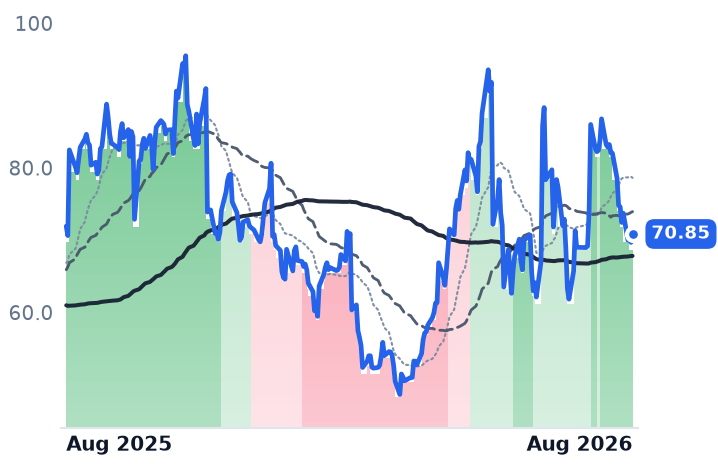
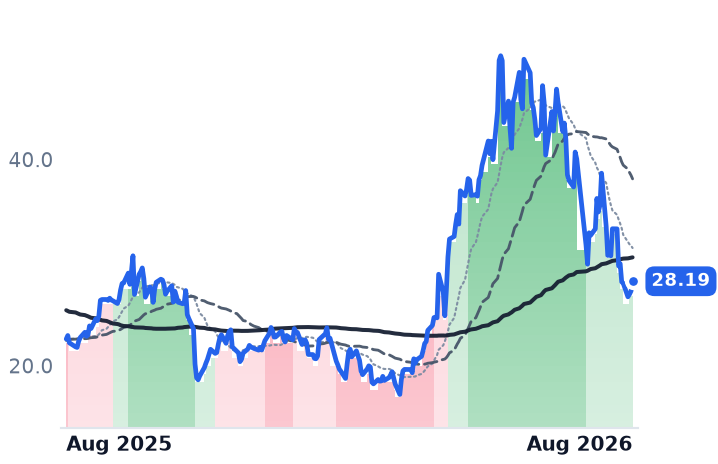
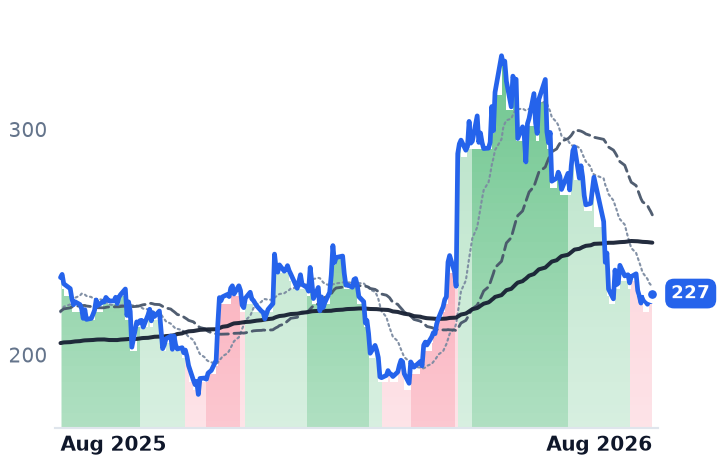
12-month price & trend
| Ticker | Mkt cap | P/E | P/E fwd | P/S | P/S fwd | P/GP | P/GP fwd | EV/EBITDA | FCF yld |
|---|---|---|---|---|---|---|---|---|---|
AMBA | $3.1B | n/m | 89.9x | 7.7x | 7.1x | 13.2x | 12.1x | n/m | 0.8% |
CEVA | $785.8M | n/m | 51.5x | 6.8x | 6.3x | 7.8x | 7.2x | n/m | -0.1% |
NXPI | $56.9B | 19.1x | 15.0x | 4.3x | 4.0x | 7.7x | 7.1x | 13.2x | 5.2% |
Consensus projections
| Ticker | FY2026E | FY2027E | FY2028E | |
|---|---|---|---|---|
AMBA | Revenue | +39.8% | +13.2% | +12.9% |
| EPS | −310.8% | +32.6% | +36.5% | |
CEVA | Revenue | +14.3% | +13.0% | +12.8% |
| EPS | +31.8% | +45.2% | +36.4% | |
NXPI | Revenue | +16.7% | +11.5% | +8.3% |
| EPS | +28.0% | +20.5% | +15.3% |
Forward fiscal years only. Blank means no analyst coverage for that year.
Ambarella, which sells low-power system-on-chip processors that run video compression and computer-vision inference inside dashcams, security cameras and robots, has handed back the whole takeover premium the market awarded it a month ago. The shares closed at $70.85 on 27 August, below the $74.09 they fetched the session before the Financial Times reported on 31 July that NXP Semiconductors was in talks to acquire it — a report that named no deal price, only a valuation around Ambarella's own market capitalization. Neither company has commented.
That matters because of what comes next. Ambarella confirmed on 12 August that it will report fiscal second-quarter results after the close on Thursday 3 September. It will be the first fundamental test of a stock whose entire 2026 gain came from deal speculation, and the test lands on a question that separates it cleanly from CEVA, the edge-AI intellectual-property licensor investors treat as its sibling: when does an edge-AI design win actually become money?
Two ways to bill for the same inference
Ambarella gets paid when a chip ships. Edge-AI processors were 80% of its record fiscal 2026 revenue of $390.7m, it has shipped more than 46 million of them cumulatively, and the average selling price recorded last quarter was about $15. That is a clean, immediate line — and it has been slowing. Reported revenue growth has decelerated four quarters running, from 49.9% to 31.2% to 20.1% to 16.9%, the last on $100.4m of revenue in the April quarter. The company's own release put GAAP gross margin at 58.4%, against 60.0% a year earlier. Guidance for the September quarter is $105-111m, a midpoint barely above where consensus already sat.
"Demand signals and the long-term secular growth outlook for edge AI remain very strong," chief executive Fermi Wang told investors on the 28 May call. The order book supports him — a ten-year agreement with South Korea's Hanwha Group worth more than $800m, and a semi-custom 2-nanometer part taped out in January for production in fiscal 2028. The reported line does not yet.
CEVA gets paid twice, and only the first check has cleared. Its June quarter showed licensing revenue up 21% to $18.2m, the best in three years, while royalties — the per-device stream — came in at $10.8m, up 1%. Customers shipped 567 million units, 16% more than a year earlier, which means royalty dollars per unit fell roughly 13%: the volume came from cheap connectivity sockets, and the largest of those, Bluetooth, shipped 295 million units, down 16%. The flagship win, NeuPro-M neural-processing IP selected for custom silicon by a large computing platform company, carries management's own timeline of 1.5 to 2 years to production. It cannot pay a royalty before roughly 2028.
CEVA raised full-year growth guidance to 13-15% from 12% and still fell 13.4% on the day, then 8.4% the next. Management said the shift toward platform-level deals delivers "meaningfully higher" license sizes and royalty per unit than component IP — true, and years away. The whole IP complex is being repriced on this lag: Arm's data-center royalties doubled and it cut its royalty growth guidance anyway.
What the prices now assume
Both companies are loss-making under generally accepted accounting principles, and their gross margins differ by nearly thirty points, so the comparable anchor is price against trailing gross profit. Ambarella sits at 13.2x, up from about 12.1x six months ago but well down from 18.1x at its 26 May peak; on forward earnings it is at 89.9x against consensus revenue growth of 13.2%. CEVA is at 7.8x, compressed from roughly 14.3x at its 3 June high while gross-profit dollars kept rising, though still above February's 6.3x.
The verdict is asymmetric. CEVA's business is doing what the edge-AI thesis requires — accelerating revenue, record licensing, operating margin up eight points — and its shares have priced the royalty delay as though it were a royalty failure; that is the more interesting mispricing of the two, tempered by the fact that the delay is real and management dated it. Ambarella's shares have simply discounted a rumor back to zero, leaving a decelerating top line to justify a forward earnings multiple that requires re-acceleration nobody has yet reported.
One line in next week's print will settle more than the revenue number. Inventory days jumped to 145 from 99 last quarter on a deliberate pre-build ahead of expected memory price increases — the same DRAM squeeze CEVA's customers flagged in handsets. On 3 September the market learns whether those chips were built for customers or for the channel.