

Salesforce Grew Revenue 10.8% and Its Operating Profit Not at All
Hypothesis Opus 5 · Research Opus 5 · Writing Opus 5 · Prompt v1.6
Salesforce sold its July quarter as an artificial-intelligence breakout, and the bookings support it: Agentforce annual recurring revenue passed $1.5bn. The income statement is more ambivalent. Gross margin fell to 76.65% from 78.10% a year earlier, and operating income under generally accepted accounting principles was flat year over year, so 10.8% revenue growth produced no operating leverage at all. The jump in earnings per share came instead from a diluted share count 14.7% smaller after a $25bn repurchase.
HubSpot, Braze and NICE show the same squeeze between revenue growth and gross-profit growth. What none of the four disclosed is the seat erosion the market has spent a year pricing: HubSpot's average revenue per customer rose, and its shortfall sat in new customers won rather than in existing ones shrinking.
| Ticker | Company | Segment | Trend · 13mo | 30D | 1Y |
|---|---|---|---|---|---|
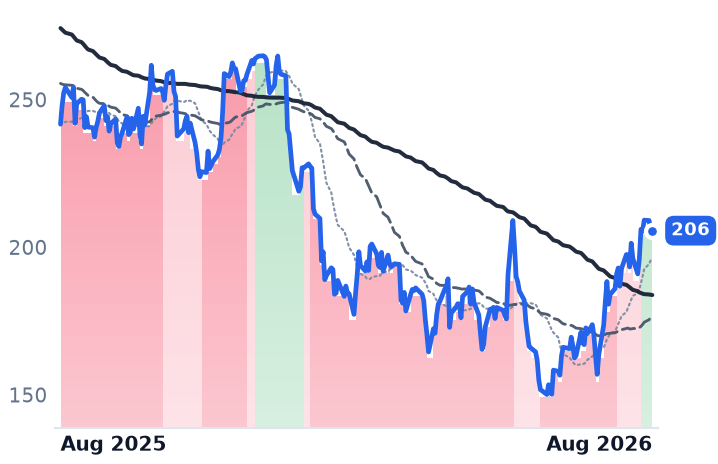
CRM | Salesforce | Customer Experience & CRM | 🔴 Cont. Bear | +18.4% | −14.9% |
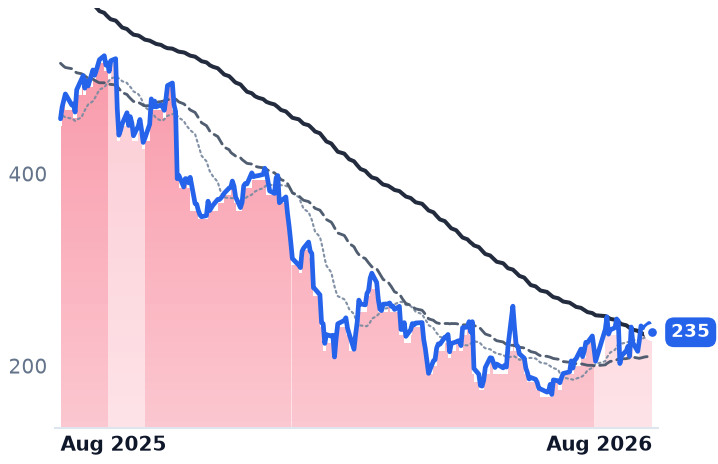
HUBS | HubSpot | Customer Experience & CRM | 🔴 Cont. Bear | −1.3% | −48.6% |
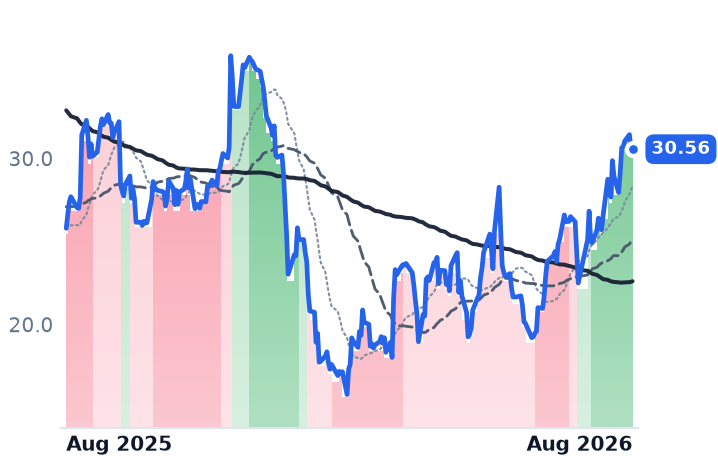
BRZE | Braze | Customer Experience & CRM | 🌱 Emerging Bull | +21.7% | +18.4% |
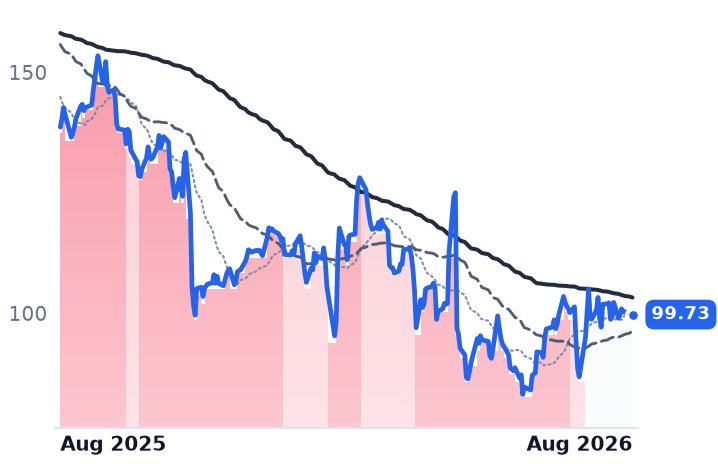
NICE | NICE | Customer Experience & CRM | 🔴 Cont. Bear | +5.0% | −28.1% |
12-month price & trend
| Ticker | Mkt cap | P/E | P/E fwd | P/S | P/S fwd | P/GP | P/GP fwd | EV/EBITDA | FCF yld |
|---|---|---|---|---|---|---|---|---|---|
CRM | $168.4B | 18.7x | 14.5x | 3.8x | 3.7x | 5.0x | 4.7x | 12.4x | 9.0% |
HUBS | $12.1B | 83.8x | 17.8x | 3.5x | 3.3x | 4.2x | 4.0x | 40.2x | 6.3% |
BRZE | $3.5B | n/m | 48.7x | 4.4x | 3.9x | 6.6x | 5.8x | n/m | 1.9% |
| Ticker | Mkt cap | P/E | P/E fwd | P/S | P/S fwd | P/GP | P/GP fwd | EV/EBITDA | FCF yld |
|---|---|---|---|---|---|---|---|---|---|
NICE | $5.9B | 14.5x | 9.0x | 1.9x | 1.9x | 2.9x | 2.9x | 7.0x | 10.6% |
Consensus projections
| Ticker | FY2026E | FY2027E | FY2028E | |
|---|---|---|---|---|
CRM | Revenue | +9.3% | +11.1% | +9.4% |
| EPS | +17.4% | +20.2% | +10.4% | |
HUBS | Revenue | +18.2% | +14.2% | +14.0% |
| EPS | +38.2% | +25.9% | +18.4% | |
BRZE | Revenue | +24.3% | +22.8% | +16.6% |
| EPS | +281.2% | +50.3% | +52.1% | |
NICE | Revenue | +8.3% | +9.1% | +11.8% |
| EPS | −8.9% | +13.7% | +22.2% |
Forward fiscal years only. Blank means no analyst coverage for that year.
Salesforce's July-quarter results, published on 26 August, settle a question its May report left open: whether the company's gross margin could carry the cost of running artificial-intelligence agents at scale. It could not. Gross margin came in at 76.65%, against 78.10% a year earlier and 76.92% in the prior quarter.
The mechanism is unglamorous and now visible at every vendor selling agents into customer-facing software. Inference compute is consumed per interaction and booked in cost of revenue immediately, while the price is billed on outcomes that lag adoption by quarters — HubSpot charges $0.50 per resolved conversation, Salesforce $2 per conversation. Gartner expects at least 40% of enterprise software spending to move to usage-, agent- or outcome-based pricing by 2030, with the seat-based share of the total falling from 21% to 15%. That transition is being financed out of gross margin.
Where the profit came from
Salesforce, which sells the Customer 360 suite of sales, service, marketing and Slack software to large enterprises, grew revenue 10.8% to $11.345bn. Gross profit grew 8.8%. Operating income was $2.331bn, flat against a year earlier, and the operating margin slipped to 20.55% from 22.78%.
General accounting earnings per share nonetheless rose 119%, to $4.29. The arithmetic sits below the operating line: diluted shares fell to 821m from 962m, a 14.7% reduction following the company's $25bn accelerated repurchase, with non-operating items doing the rest. The earnings headline is a capital-structure event dressed as operating leverage.
The demand underneath it is genuine. Current remaining performance obligation — contracted revenue due within twelve months — reached $33.5bn, up 14%, with Agentforce annual recurring revenue above $1.5bn and Agentforce and Data 360 together near $3.9bn. "We just delivered one of our best quarters ever, outperforming across every key metric," chairman and chief executive Marc Benioff said on 26 August. Full-year guidance went up to $46.1bn–$46.4bn, and the shares, which closed at $205.62, rose about 12.7% in extended trading. Salesforce trades at 14.52x forward earnings against 18.69x trailing, and at 4.96x its trailing gross profit, up from about 4.55x three months ago.
The seat erosion nobody disclosed
The story that has hung over this group for a year is that agents delete the seats these vendors bill. The June-quarter disclosures do not show it. HubSpot, whose all-in-one marketing and sales software serves mid-market businesses, ended June with 306,446 customers, up 14%, and average subscription revenue per customer of $11,800, up 4%. Price per customer rose. The damage was in units: 7,000 net additions against an internal expectation of 9,000–10,000, with second-half quarterly adds guided down to 5,000–6,000. Chief executive Yamini Rangan attributed that to HubSpot's own April changes — agent trials, outcome-based pricing, lower entry prices — and to buying committees that now require board sign-off. Net revenue retention was 102%, one point lower. Braze's dollar-based net retention rose to 110%; NICE's cloud retention held at 106%. Nobody reported shrinking installed bases.
Braze, which orchestrates push, email and in-app messaging for consumer brands and bills on message volume and monthly active users, is the cleanest version of the consumption case: April-quarter revenue grew 30.2% to $211.0m, a fourth consecutive quarter of acceleration. Its gross margin still fell, to 65.72% from 68.62%, and full-year guidance implies roughly 22% growth. It is also the dearest of the four at 6.63x trailing gross profit, up from 5.83x in late May on no company disclosure since, and loses money on a general accounting basis.
NICE, the Israeli vendor of the CXone Mpower contact-center platform and, separately, Actimize financial-crime software, is the cheapest at 2.94x gross profit and 9.05x forward earnings. Its cloud revenue grew 12.6% to $609m and its customer-experience artificial-intelligence and self-service annual recurring revenue reached $362m, up 52% — yet general accounting operating income fell 31.5%, and consensus has 2026 earnings per share 8.9% below 2025. "Customers are taking a measured approach as they prepare their data, the governance, [and] the operating models before they scale AI," chief executive Scott Russell told investors on the second-quarter call.
What the businesses earn and what they don't
Over the past month Braze rose 35.8%, Salesforce 18.4%, HubSpot 14.7% and NICE 5.0%; on 27 July investors rotated out of chip stocks into software, lifting Salesforce about 7% on no company news. Over twelve months HubSpot is still down 48.6%, and the price paid for each dollar of its gross profit has more than halved while that gross profit grew.
The honest split: the demand is earned. Bookings, backlog and retention are firm across all four, and the agent narrative is showing up in contracted dollars. What nothing yet explains is the multiple expansion of the past three months, because at every one of these companies gross profit is growing slower than revenue, and at Salesforce — the only one large enough to show the endpoint — that gap has now eaten the entire operating line. Buying gross profit at a higher price while its growth decelerates relative to revenue is a bet that outcome pricing catches inference cost, and none of the four has yet published a quarter where it did.
Braze reports its July quarter in early September, the first of the four to say anything new. Its shares have risen more than a third in a month on nothing at all.