

Coherent and Keysight Named Supply, Not Demand, as the Limit on 1.6-Terabit Optics
Hypothesis Opus 5 · Research Opus 5 · Writing Opus 5 · Prompt v1.6
Two suppliers to the AI network reported record quarters this month, and both told investors the same thing: what they can ship is set by their own supply, not by demand. Coherent's data-center and communications revenue rose 58.6% and now makes up 79% of the company; Keysight's orders reached $2.091bn, its second straight quarter with book-to-bill above 1.1.
Both shares are lower over three months, and both have de-rated against their own gross profit even as that gross profit grew about 30% at each over the past year. Coherent's constraint is indium-phosphide wafer capacity; Keysight's is a supply chain its finance chief called a governor on converting demand into revenue. The results explain the businesses. Nothing in them explains the discount.
| Ticker | Company | Segment | Trend · 13mo | 30D | 1Y |
|---|---|---|---|---|---|
| The subject · what this brief is about | |||||
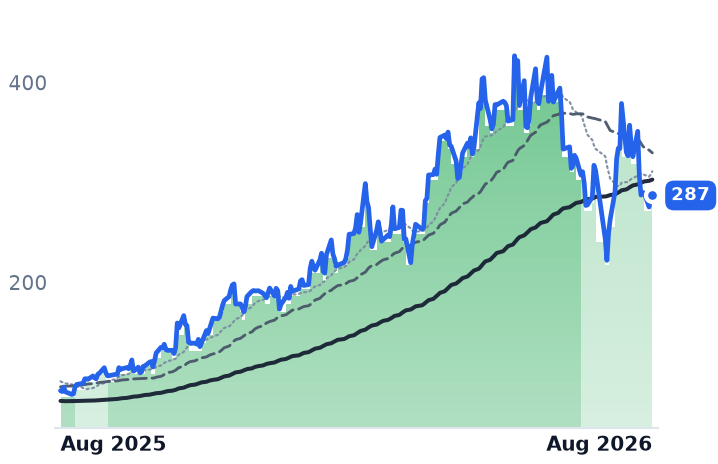
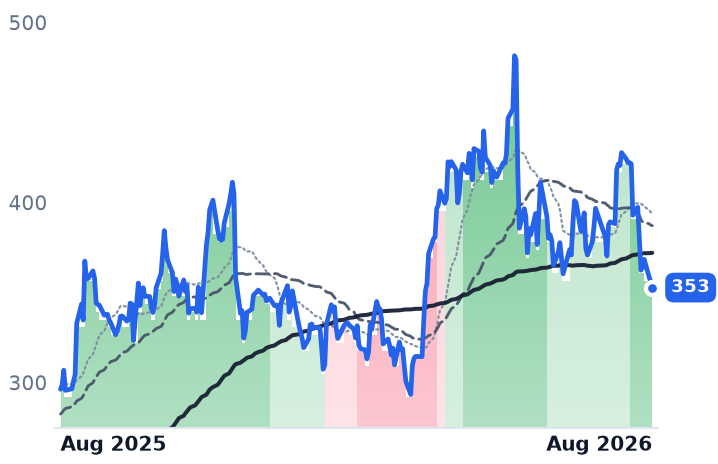
COHR | Coherent | Instrumentation & Test Equipment | 🟢 Cont. Bull | +17.9% | +213.4% |
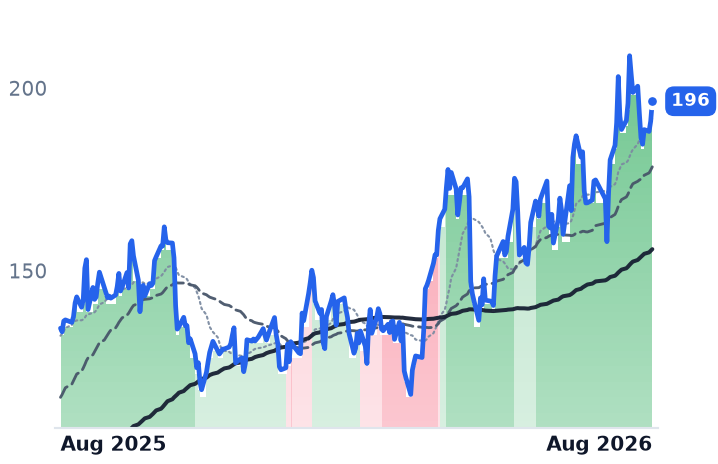
KEYS | Keysight Technologies | Instrumentation & Test Equipment | 🟢 Cont. Bull | +6.4% | +97.5% |
| Compared against · context, not the story | |||||
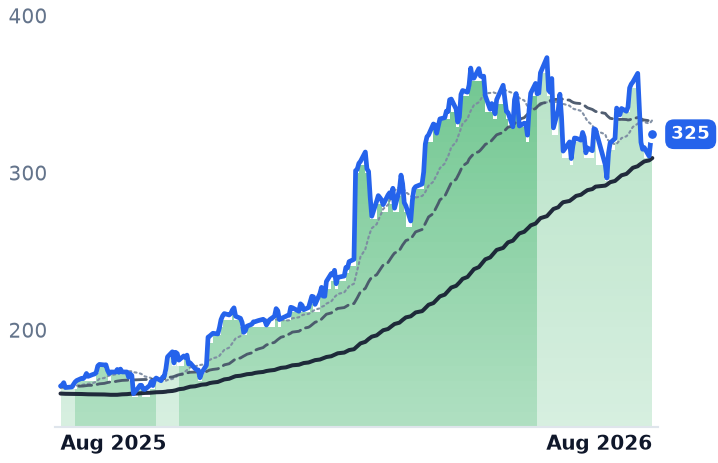
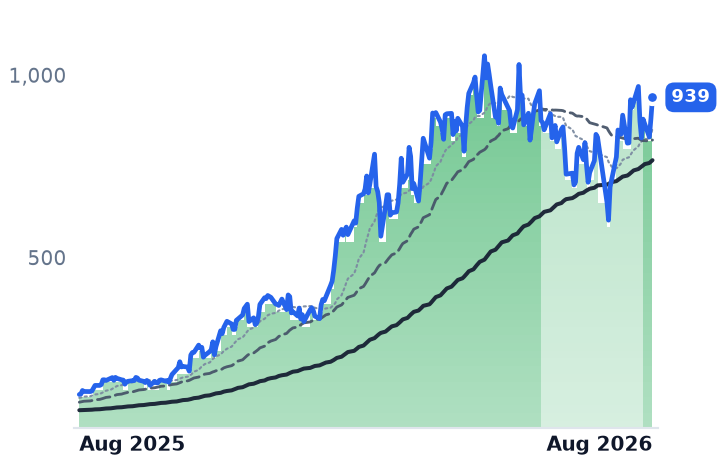
LITE | Lumentum | Optical Transport & Switching | 🟢 Cont. Bull | +44.0% | +653.5% |
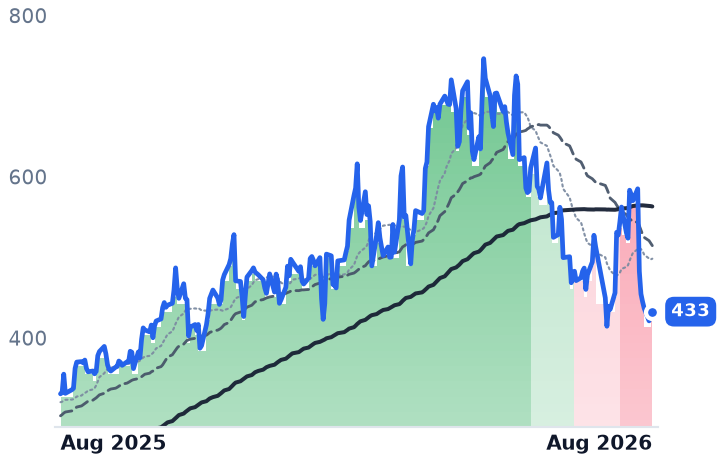
FN | Fabrinet | Specialty Manufacturing & Components | ⚠️ Emerging Bear | −3.8% | +30.8% |
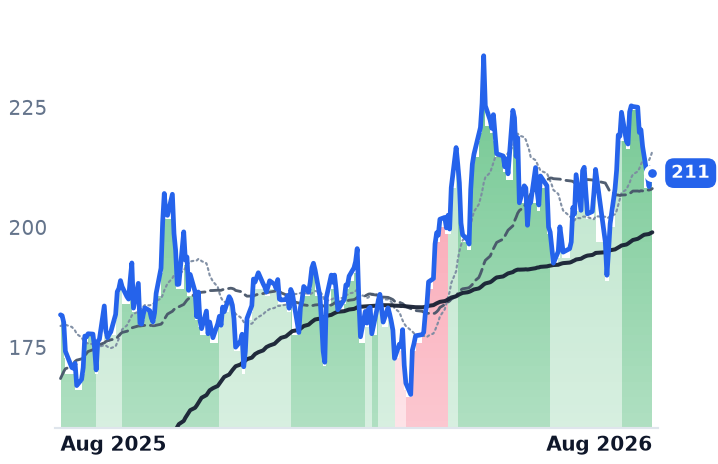
AVGO | Broadcom | Semiconductor Subsystems | 🟢 Cont. Bull | −7.4% | +19.1% |
ANET | Arista Networks | Cloud Networking | 🟢 Cont. Bull | +15.7% | +46.3% |
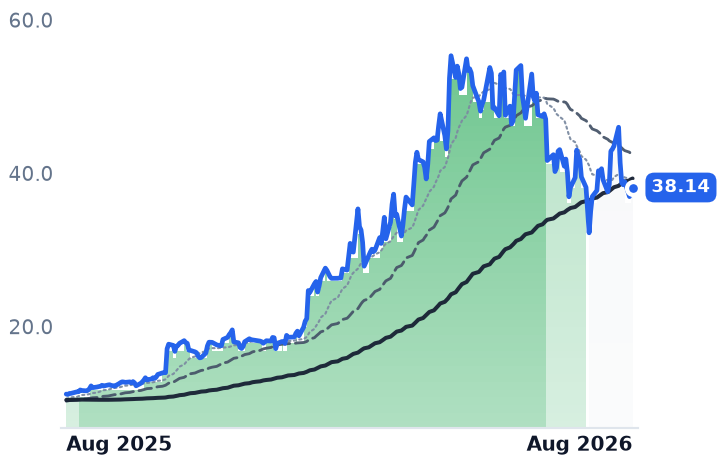
NVDA | NVIDIA | AI & Data Center GPUs | 🟢 Cont. Bull | +7.2% | +16.2% |
VIAV | Viavi Solutions | Other | 🟢 Cont. Bull | −0.1% | +240.8% |
12-month price & trend
| Ticker | Mkt cap | P/E | P/E fwd | P/S | P/S fwd | P/GP | P/GP fwd | EV/EBITDA | FCF yld |
|---|---|---|---|---|---|---|---|---|---|
COHR | $57.6B | 67.7x | 31.2x | 8.1x | 5.4x | 21.6x | 14.5x | 38.5x | -1.8% |
KEYS | $55.0B | 44.3x | 28.4x | 8.4x | 7.8x | 12.9x | 12.0x | 32.2x | 2.7% |
LITE | $75.4B | n/m | 52.1x | 25.0x | 13.3x | 60.0x | 31.9x | n/m | 0.7% |
| Ticker | Mkt cap | P/E | P/E fwd | P/S | P/S fwd | P/GP | P/GP fwd | EV/EBITDA | FCF yld |
|---|---|---|---|---|---|---|---|---|---|
FN | $15.6B | 33.1x | 24.0x | 3.4x | 2.6x | 28.1x | 21.4x | 27.6x | 0.0% |
AVGO | $1.7T | 58.0x | 30.9x | 22.6x | 16.1x | 33.8x | 24.1x | 41.7x | 1.9% |
ANET | $237.5B | 58.8x | 45.9x | 22.5x | 18.7x | 35.8x | 29.8x | 46.1x | 2.2% |
| Ticker | Mkt cap | P/E | P/E fwd | P/S | P/S fwd | P/GP | P/GP fwd | EV/EBITDA | FCF yld |
|---|---|---|---|---|---|---|---|---|---|
NVDA | $5.5T | 34.3x | 25.0x | 21.5x | 13.9x | 29.0x | 18.7x | 28.3x | 2.2% |
VIAV | $12.0B | n/m | 55.0x | 8.8x | 8.0x | 15.8x | 14.3x | 61.2x | 0.4% |
Consensus projections
| Ticker | FY2026E | FY2027E | FY2028E | |
|---|---|---|---|---|
COHR | Revenue | +22.1% | +49.9% | +37.5% |
| EPS | +56.5% | +72.3% | +48.9% | |
KEYS | Revenue | +32.8% | +13.9% | +9.1% |
| EPS | +60.0% | +18.9% | +13.5% | |
LITE | Revenue | +83.9% | +89.0% | +54.6% |
| EPS | +314.0% | +125.9% | +58.9% | |
FN | Revenue | +35.6% | +32.3% | +19.4% |
| EPS | +36.2% | +31.5% | +19.4% | |
AVGO | Revenue | +66.8% | +66.1% | +34.5% |
| EPS | +71.8% | +68.7% | +34.8% | |
ANET | Revenue | +42.4% | +30.0% | +23.9% |
| EPS | +42.4% | +27.2% | +22.5% | |
NVDA | Revenue | +65.1% | +84.2% | +43.2% |
| EPS | +59.0% | +91.7% | +42.0% | |
VIAV | Revenue | +39.8% | +18.6% | +16.1% |
| EPS | +106.8% | +36.3% | +43.6% |
Forward fiscal years only. Blank means no analyst coverage for that year.
Coherent, which makes the indium-phosphide laser chips and the 800-gigabit and 1.6-terabit optical transceivers that move traffic between AI accelerators, produced roughly 80% more of those laser chips in the June quarter than a year earlier — and still told investors that its own wafer capacity, rather than customer orders, sets how much transceiver revenue it can book. It expects to double internal output by the end of the September quarter, one quarter ahead of plan, and to more than double it again by the end of 2027.
Six days later Keysight — which sells the oscilloscopes, bit-error-rate testers and optical modulation analyzers engineers use to prove a link actually runs at speed — reported fiscal third-quarter orders of $2.091bn, up 56%, and said much the same about itself. "Supply situation is likely to be nonlinear and will likely be a governor of our ability to convert demand into revenue for the next several quarters," Neil Dougherty, chief financial officer, told investors on the August 18 call. The rung these two share is scaling fast: LightCounting puts the Ethernet optical-transceiver market at $16.5bn in 2025 and about $26bn in 2026.
The content step, not the port count
Optical ports do not multiply freely. In Nvidia's GB300 NVL72 rack, each of the 72 accelerators is served by a ConnectX-8 network chip carrying 800 gigabits a second of scale-out connectivity, so ports track accelerators one for one. The move from 800G to 1.6T raises the dollars of optics per port instead of adding ports — which is how Coherent's data-center revenue grew 66% year over year while unit volumes grew far less.
Coherent's June-quarter revenue was $2.05bn, up 33.7%, with the combined data-center and communications line at $1.62bn, up 58.6%, and 79% of the company. Non-GAAP gross margin reached 40.2%, up 215 basis points from a year earlier, against a stated target above 42%. The drag is the legacy book: industrial revenue fell $81m, and lasers and materials together are 38% of sales. "AI runs on compute, but it scales on optical connectivity," chief executive Jim Anderson said on the August 12 call. Coherent is not the leader in finished modules: Counterpoint Research puts Zhongji Innolight at roughly 27% of data-center transceiver revenue, first to complete Nvidia's 1.6T qualification, with Coherent second at about 17%.
Test intensity arrives before deployment
Keysight's commercial communications business passed $1bn in a quarter for the first time, at $1.006bn, up 56%, and wireline revenue overtook wireless — with customers ramping 1.6T transceivers and already engaging on 3.2-terabit work. Segment operating margin ran at 33.2%, up 820 basis points. "Design margins are shrinking... customers can no longer guarantee anything by design. They also need to test it in production as well," Kailash Narayanan, president of the Communications Solutions Group, said on the same call.
That growth is homegrown. To clear its Spirent acquisition, the US Department of Justice made Keysight divest Spirent's high-speed Ethernet and network-security test lines, which Viavi bought for $425m, closing October 16, 2025. Nor is this a generic instruments recovery: aerospace, defense and government revenue was $339m, a third the size of commercial communications.
What the shares did
Coherent is down 24.7% over three months and Keysight 8.8%, after twelve-month gains of 213% and 97.5%. Both fell on August 18 with the whole optics complex — Fabrinet dropped 17.5% after reporting datacom revenue down sequentially — and Keysight fell again the next session, following its own record report. On price to trailing gross profit, Coherent now costs 21.58x against 24.97x in early May, and Keysight 12.92x against 16.38x, while trailing gross profit grew 29.7% and 30.2% respectively.
The businesses earned their acceleration; the de-rating is being paid for something else. What the market sold is precisely the sentence both managements volunteered — that capacity, not appetite, will meter the next several quarters, which caps upside surprise and offers no cushion if the ramp slips. The risks are asymmetric between them. Coherent's forward multiple rests on consensus revenue of $10.60bn in fiscal 2027, nearly 50% above what it just reported, and that number lives or dies on six-inch indium-phosphide wafer starts. Keysight's consensus already assumes deceleration to roughly 14% growth, and management flagged tariff benefits in fiscal 2026 that will not repeat.
Coherent said its first co-packaged-optics revenue begins in the December quarter. The evidence for it will arrive as wafer output, not as orders — a company whose ceiling is its own capacity gets no credit for demand it cannot ship.