

The 800-Volt AI Rack Moves Most of Its Power Budget to Chips That Ship in 2027
Hypothesis Opus 5 · Research Opus 5 · Writing Opus 5 · Prompt v1.6
Moving an AI rack from 54-volt distribution to 800 volts of direct current barely raises what the rack spends on power conversion — it rises about 16% — but it moves roughly two-thirds of that spending into gallium-nitride and silicon-carbide devices and high-voltage connectors that previously took almost none of it. The rotation is real. The revenue is dated 2027.
Only Vicor books the content today: 58.0% gross margin in the June quarter, advanced products up 45% sequentially, a one-year backlog of $379.7m. Navitas, the pure-play gallium-nitride and silicon-carbide supplier, sold $10.53m in the same quarter, down 27.3% from a year earlier, and dates its rack-level chips to mid-to-late 2027.
Since 17 August both have fallen again, and so has the whole wide-bandgap chain — while their customer's shares did not.
| Ticker | Company | Segment | Trend · 13mo | 30D | 1Y |
|---|---|---|---|---|---|
| The subject · what this brief is about | |||||
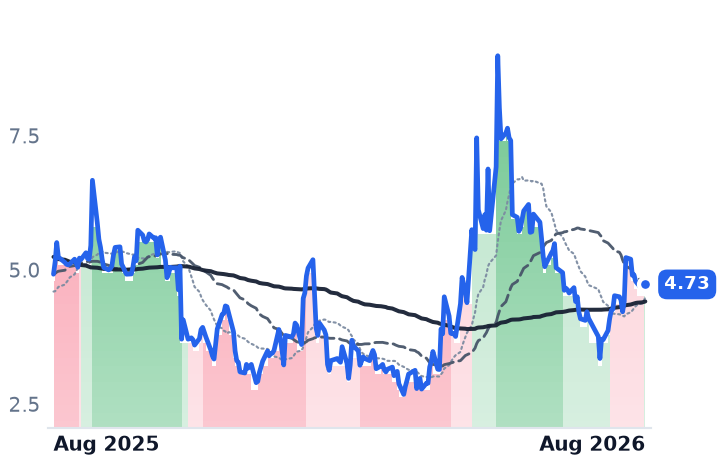
NVTS | Navitas Semiconductor | Other | 🟢 Cont. Bull | +24.8% | +105.1% |
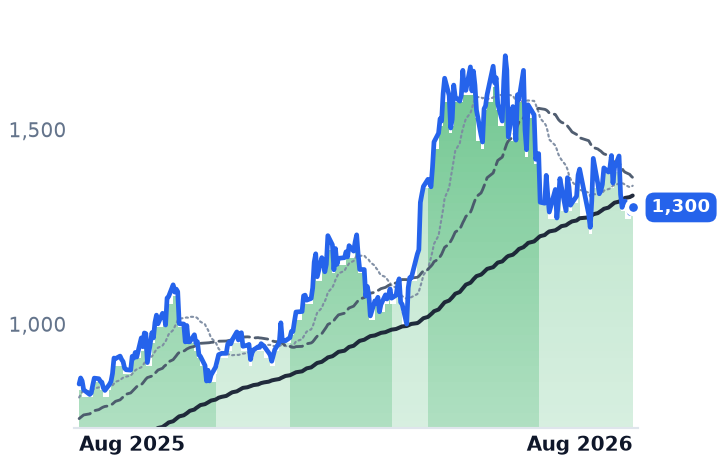
VICR | Vicor | Other | 🟢 Cont. Bull | +2.6% | +282.7% |
| Compared against · context, not the story | |||||
BELFB | Bel Fuse | Connectors & Interconnect Systems | 🟢 Cont. Bull | +2.3% | +84.5% |
ULBI | Ultralife | Electrical Equipment & Parts | 🔴 Cont. Bear | +23.1% | −5.0% |
IPWR | Ideal Power | Semiconductors | 🌱 Emerging Bull | +25.8% | −3.9% |
MPWR | Monolithic Power Systems | Analog & Mixed-Signal | 🟢 Cont. Bull | +1.4% | +53.7% |
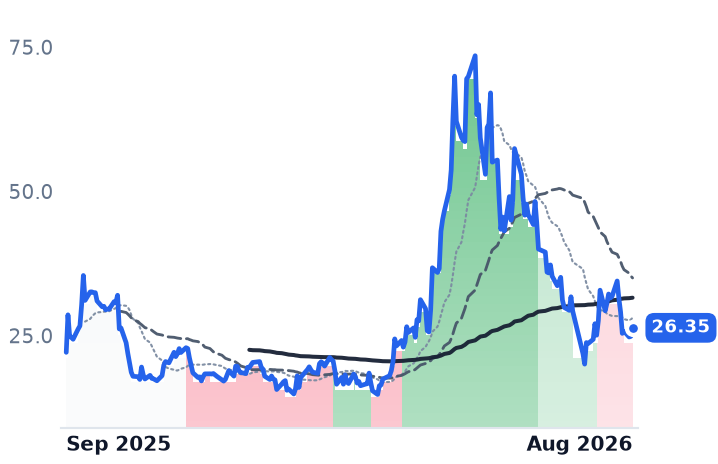
WOLF | Wolfspeed | Discrete & Power | 🌱 Emerging Bull | +20.4% | +19.2% |
ON | ON Semiconductor | Analog & Mixed-Signal | 🟢 Cont. Bull | −13.4% | +43.4% |
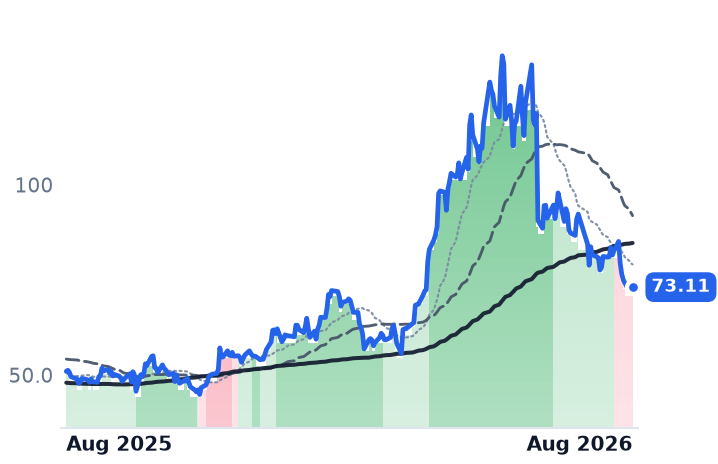
NVDA | NVIDIA | AI & Data Center GPUs | 🟢 Cont. Bull | +7.2% | +16.2% |
12-month price & trend
| Ticker | Mkt cap | P/E | P/E fwd | P/S | P/S fwd | P/GP | P/GP fwd | EV/EBITDA | FCF yld |
|---|---|---|---|---|---|---|---|---|---|
NVTS | $3.3B | n/m | — | 90.5x | 69.4x | — | — | n/m | -2.1% |
VICR | $8.9B | 61.8x | 57.4x | 18.9x | 14.8x | 33.3x | 26.2x | 66.6x | 0.6% |
BELFB | $3.1B | 63.9x | 26.0x | 4.2x | 3.8x | 10.5x | 9.7x | 21.7x | 2.4% |
| Ticker | Mkt cap | P/E | P/E fwd | P/S | P/S fwd | P/GP | P/GP fwd | EV/EBITDA | FCF yld |
|---|---|---|---|---|---|---|---|---|---|
ULBI | $109.3M | n/m | 7.6x | 0.6x | 0.5x | 2.4x | 2.0x | n/m | 1.9% |
IPWR | $80.1M | n/m | — | — | 100.2x | — | — | n/m | -11.8% |
MPWR | $64.7B | 80.3x | 48.0x | 19.8x | 15.6x | 35.8x | 28.2x | 62.9x | 0.9% |
| Ticker | Mkt cap | P/E | P/E fwd | P/S | P/S fwd | P/GP | P/GP fwd | EV/EBITDA | FCF yld |
|---|---|---|---|---|---|---|---|---|---|
WOLF | $1.3B | n/m | — | 2.0x | 2.1x | — | — | n/m | -21.8% |
ON | $32.5B | 52.8x | 26.1x | 5.2x | 5.0x | 14.0x | 13.2x | 26.4x | 5.5% |
NVDA | $5.5T | 34.3x | 25.0x | 21.5x | 13.9x | 29.0x | 18.7x | 28.3x | 2.2% |
Consensus projections
| Ticker | FY2026E | FY2027E | FY2028E | |
|---|---|---|---|---|
NVTS | Revenue | +4.7% | +52.5% | +59.8% |
| EPS | −21.9% | −17.9% | −44.8% | |
VICR | Revenue | +33.1% | +55.6% | +22.2% |
| EPS | +58.9% | +73.2% | +33.0% | |
BELFB | Revenue | +20.7% | +8.3% | +12.9% |
| EPS | +45.5% | +13.6% | +26.3% | |
ULBI | Revenue | +6.2% | — | — |
| EPS | +22.9% | — | — | |
IPWR | Revenue | +1500.0% | +0.0% | +975.0% |
| EPS | −31.5% | −18.8% | −20.3% | |
MPWR | Revenue | +49.2% | +28.7% | +20.3% |
| EPS | +54.8% | +31.0% | +20.0% | |
WOLF | Revenue | +0.7% | −15.2% | +23.7% |
| EPS | +275.2% | −39.2% | −22.4% | |
ON | Revenue | +9.2% | +12.9% | +13.5% |
| EPS | +37.1% | +41.7% | +31.7% | |
NVDA | Revenue | +65.1% | +84.2% | +43.2% |
| EPS | +59.0% | +91.7% | +42.0% |
Forward fiscal years only. Blank means no analyst coverage for that year.
The 800-volt rack does not spend much more on power conversion than the 54-volt rack it replaces. It spends the money on different companies. On SemiAnalysis's rack economics, the total rack-level power bill of materials rises roughly 16% in the shift from 54-volt distribution to 800 volts of direct current — but wide-bandgap silicon and high-voltage connectors go from close to nothing to about 64% of that bill, pulling dollars out of legacy alternating-current gear and uninterruptible power supplies and into power semiconductors, DC racks, protection and connectors.
The physics is not contested. At 800 volts a 600-kilowatt load draws about 750 amperes rather than 12,500, and NVIDIA says its high-voltage architecture cuts copper use by up to 45%, with platforms rolling out in the second half of 2026 behind more than 80 partner firms. What is contested is the date the money arrives — and the answer from the two American companies closest to the socket is 2027, not this year.
One company books it today
Vicor, which makes modular direct-current power converters in Andover, Massachusetts, and sells them to computing, aerospace and industrial equipment makers, is the one already collecting. June-quarter gross margin expanded 280 basis points sequentially to 58.0%. Its advanced products — the newer, higher-density lines that carry the vertical power delivery story — rose 45% sequentially to $94.2m and are now 65.7% of revenue. The one-year backlog grew 26% sequentially and 145% year on year to $379.7m, with book-to-bill above 1.0, growth management attributed to defense, industrial and high-performance-computing customers. Guidance went above $600m for 2026 and the long-term target was lifted from $1bn of revenue at 65% gross margin to $2.5bn at 70%.
Two caveats travel with that. Roughly a fifth of revenue is royalty income — $30.4m collected in the June quarter, including $15m from a new licence structured to pay $60m over two years — compelled by a February 2025 International Trade Commission exclusion order barring unlicensed computing systems containing infringing power modules. And Vicor's second-generation vertical power delivery, at 3 amperes per square millimetre against roughly 1 for competing first-generation parts, is guided to production only late in the fourth quarter of 2027. Chief executive Patrizio Vinciarelli said in May the company was essentially sold out on capacity for the foreseeable future; a second chip fab is being site-selected to fix it.
The die maker is not paid yet
Navitas, the Torrance, California designer of gallium-nitride and silicon-carbide power chips, sold $10.53m in the June quarter — down 27.3% year on year, the fourth consecutive quarter of double-digit decline. On a reported basis gross profit was minus $1.0m; on the company's adjusted basis gross margin was 39.5%, guided to 39.7% for September on $13.5m of revenue. "High-power markets grew more than 50% year-over-year, serving as further evidence of the building momentum in our GaN and high voltage SiC product, especially in our focus area of AI infrastructure," chief executive Chris Allexandre told investors on 27 July. Its own schedule puts silicon carbide in power supply units ramping now, 800-volt sidecar racks in mid-2027, and gallium nitride inside accelerator power delivery from mid-to-late 2027. It has disclosed no dollar-quantified design win and no named customer, and is one of roughly fifteen silicon suppliers on NVIDIA's ecosystem list alongside Infineon, Texas Instruments and onsemi. It also faces patent suits from Wolfspeed and trade-secret claims from Renesas, and countersued Renesas on 10 August.
What the shares did, and what did not move
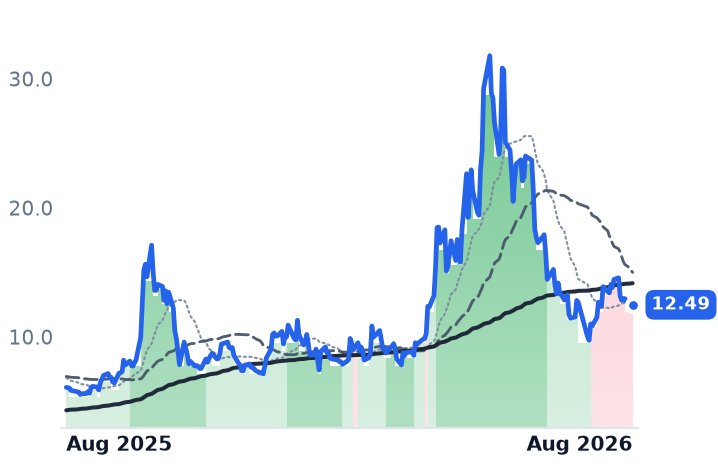
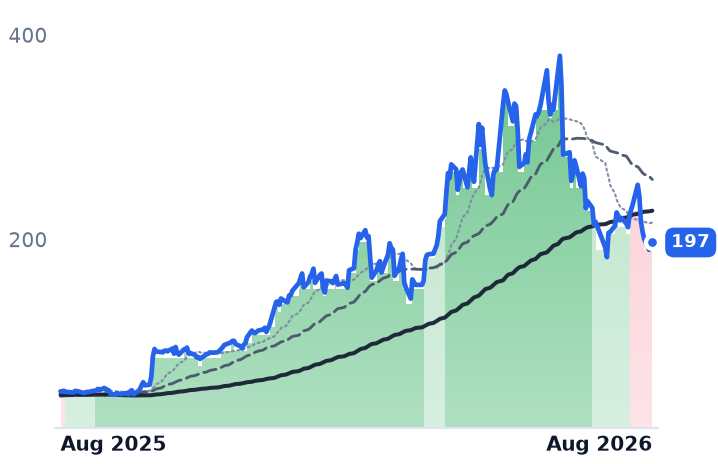
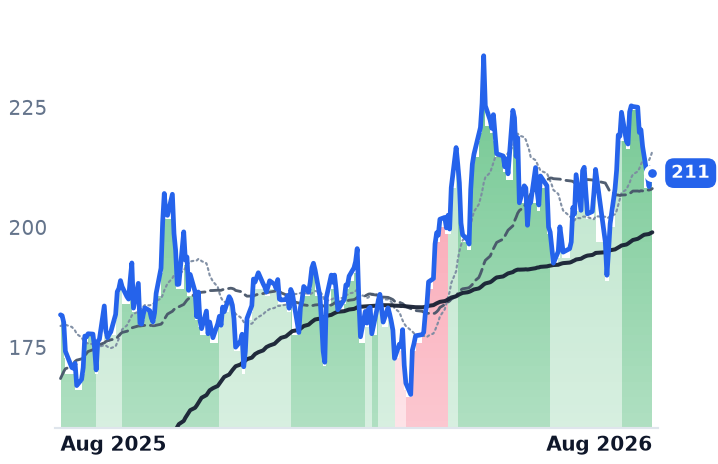
Vicor closed 26 August at $197.11, 48.1% below its 30 June record close, after falling 22.2% in five sessions from 17 August; Navitas at $12.49, 60.7% below its late-May peak, down 14.3% over the same stretch. Both now trade with the shorter moving average below the longer, having held a firm uptrend in May. The de-rating is chain-wide: over three months Wolfspeed fell 64.1%, onsemi 42.4% and Monolithic Power 21.8%, while NVIDIA itself fell 1.7%. The likelier reading is duration repricing rather than demand — the 30-year Treasury yield topped 5.33% on 18 August — since hyperscaler capital spending has not broken.
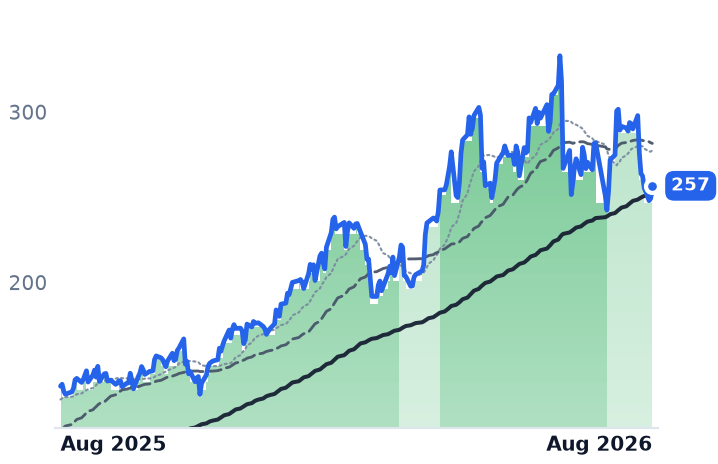
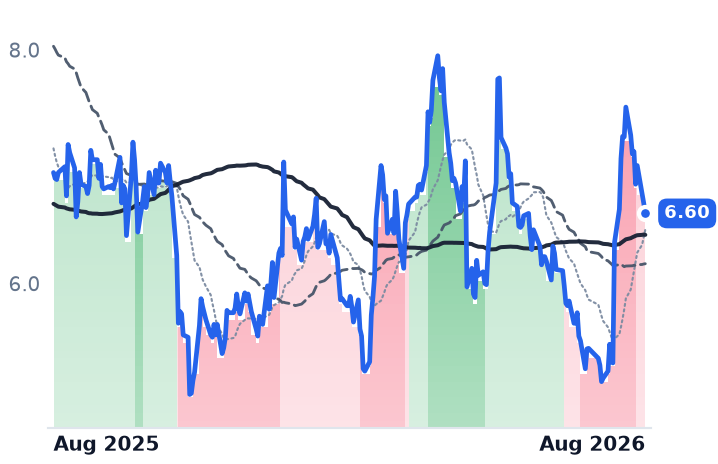
Bel Fuse, which sells magnetics, connectors and hot-pluggable power shelves, is the control that behaved differently: its trailing gross-profit dollars grew 30.8%, roughly half its twelve-month share gain, and its largest growth line was defense at $66.5m, bigger than its data-solutions revenue. Ultralife and Ideal Power, the group's other members, are both slightly down over twelve months.
The verdict
Vicor earned part of its year: trailing gross profit grew 15.4%, but the price paid per dollar of it went from about 10x to 33.3x, so roughly nine-tenths of the move was re-rating. It now sits at 33.3x trailing and 26.2x forward gross profit against the 61.8x trailing recorded in mid-May — cheaper while the order book tripled — though at 57.4x forward earnings it remains the dearest of the three. Navitas earned none of it: trailing revenue fell 46.4% while price-to-sales went from roughly 17.8x to 90.5x, against Bel Fuse at 4.16x, with consensus modelling no profitable year before 2030.
The rotation of power dollars into wide-bandgap silicon is happening. It is being invoiced by the module assembler at 58% gross margin, while the chip maker whose material the architecture is named for still has $557m of cash — raised at $21.89 a share, well above today's price — and a ramp dated to the year after next.