

Nebius's Customers Prepaid for Half of Its 2026 Data-Center Buildout
Hypothesis Opus 5 · Research Opus 5 · Writing Opus 5 · Prompt v1.6
Two companies renting out AI compute are financing identical steel on opposite terms. Nebius sold convertible notes last week whose largest tranche pays a coupon of half a percent, and its customers put cash down on 70% of the deals it closed in the June quarter — management expects more than $9bn of prepayments this year against a capex program guided at $20-25bn. Applied Digital borrows at 9.250% on secured notes and bills its tenants for construction.
The revenue quality differs as much as the funding. Nebius's run-rate revenue reached $3.0bn, up 598%. Applied Digital's May quarter looked like a doubling, but $152.4m of it was tenant fit-out work and only $44.1m was base rent — the reason gross margin fell from 42% to 16%. Nebius's shares are flat over three months and its multiple has compressed by a third; Applied Digital's 41% decline did almost no valuation work.
| Ticker | Company | Segment | Trend · 13mo | 30D | 1Y |
|---|---|---|---|---|---|
| The subject · what this brief is about | |||||
NBIS | Nebius | Cloud Infrastructure & AI | 🟢 Cont. Bull | +29.1% | +213.0% |
APLD | Applied Digital | Data Center & Cloud Infrastructure | ⚠️ Emerging Bear | +2.2% | +70.6% |
| Compared against · context, not the story | |||||
CRWV | CoreWeave | Cloud GPU Computing | 🔴 Cont. Bear | +30.5% | −4.9% |
GDS | GDS | Data Center & Cloud Infrastructure | ⚠️ Emerging Bear | +7.3% | −1.1% |
VNET | VNET | Data Center & Cloud Infrastructure | ⚠️ Emerging Bear | −0.4% | −14.3% |
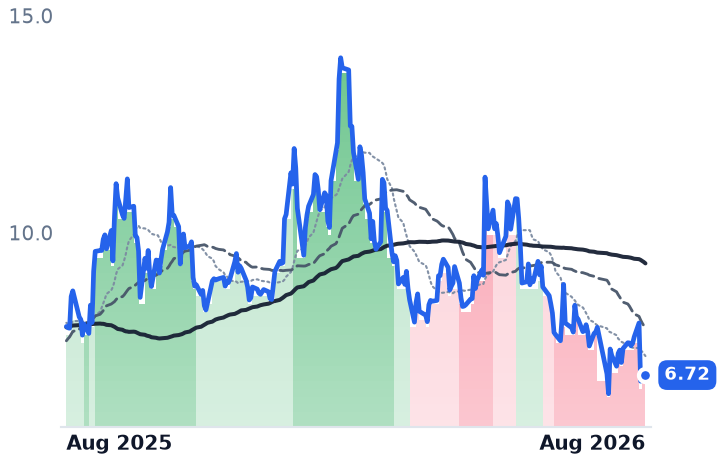
12-month price & trend
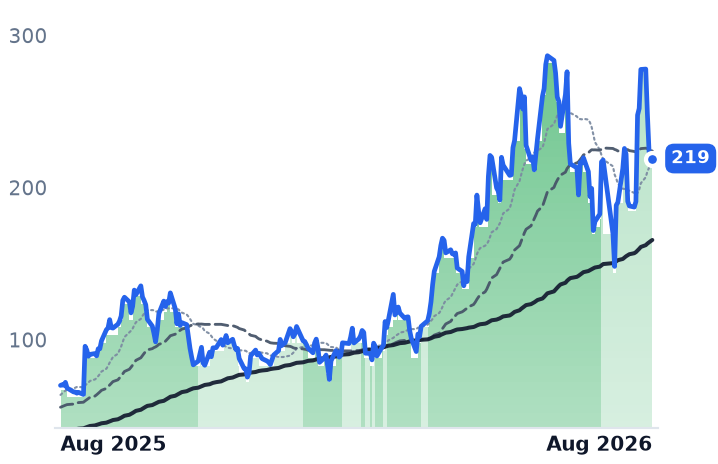
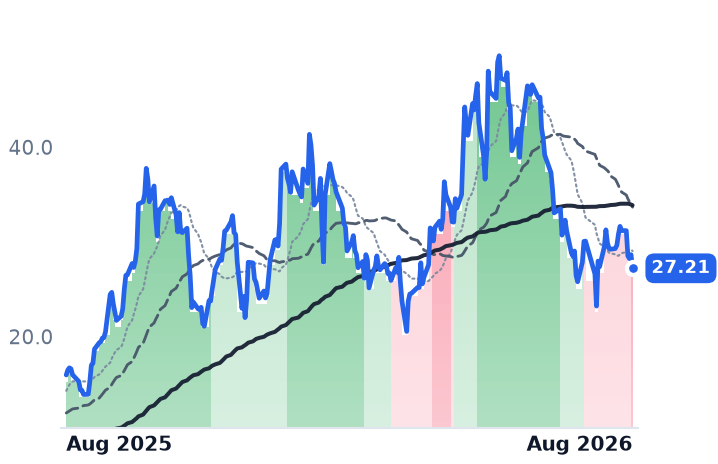
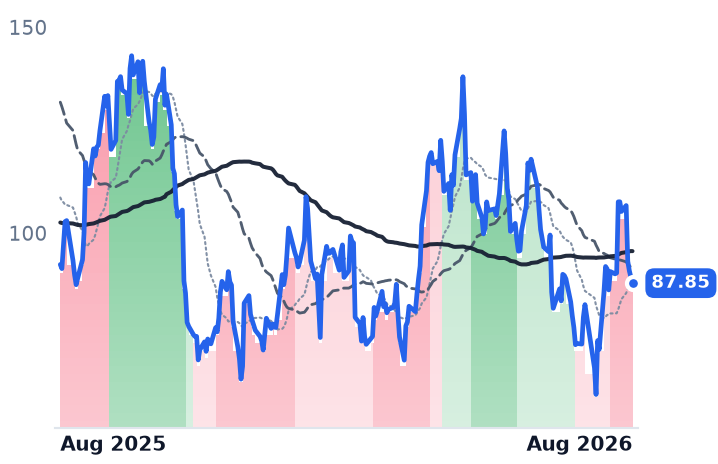
| Ticker | Mkt cap | P/E | P/E fwd | P/S | P/S fwd | P/GP | P/GP fwd | EV/EBITDA | FCF yld |
|---|---|---|---|---|---|---|---|---|---|
NBIS | $52.6B | 842.8x | — | 38.8x | 15.7x | 66.2x | 26.8x | 57.1x | -11.2% |
APLD | $7.8B | n/m | — | 13.6x | 9.6x | 60.7x | 42.7x | n/m | -35.4% |
CRWV | $47.9B | n/m | — | 6.3x | 3.7x | 9.4x | 5.5x | 36.5x | -28.5% |
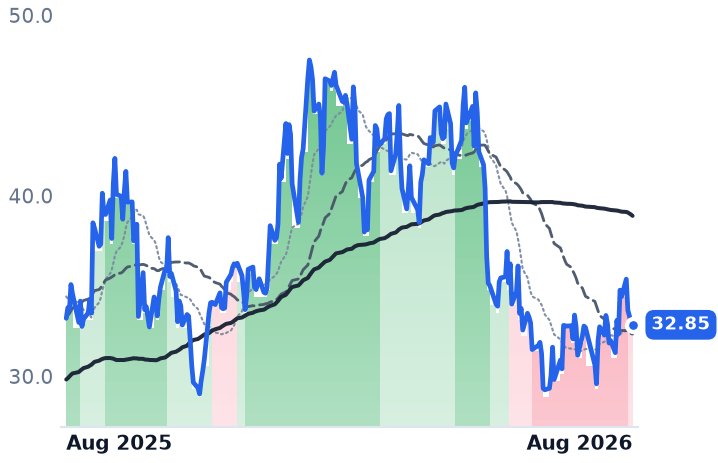
| Ticker | Mkt cap | P/E | P/E fwd | P/S | P/S fwd | P/GP | P/GP fwd | EV/EBITDA | FCF yld |
|---|---|---|---|---|---|---|---|---|---|
GDS | $6.4B | 12.2x | — | 3.6x | — | 14.9x | — | 14.0x | -1.8% |
VNET | $1.9B | n/m | — | 1.2x | — | 5.8x | — | 9.7x | -58.1% |
Consensus projections
| Ticker | FY2026E | FY2027E | FY2028E | |
|---|---|---|---|---|
NBIS | Revenue | +507.8% | +255.9% | +85.7% |
| EPS | +68.3% | +54.1% | −116.9% | |
APLD | Revenue | +98.7% | +92.0% | +149.5% |
| EPS | −24.3% | +9.0% | −74.8% | |
CRWV | Revenue | +152.1% | +105.4% | +58.6% |
| EPS | +199.3% | −54.1% | −134.7% | |
GDS | Revenue | +12.6% | +10.4% | +24.4% |
| EPS | −33.0% | −82.7% | +60.1% | |
VNET | Revenue | +20.5% | +22.0% | +20.8% |
| EPS | −32.3% | −239.3% | +74.3% |
Forward fiscal years only. Blank means no analyst coverage for that year.
Nebius priced $5.0bn of convertible notes on 20 August, and the cash settles Monday. The larger tranche, $3.0bn due 2030, pays a coupon of 0.50%; the $2.0bn due 2034 pays 4.50%, with conversion prices set 40% and 45% above the prior close. It is the cheapest money anyone on this rung of the artificial-intelligence buildout has raised this year, and it is not even the cheapest money Nebius has.
That distinction belongs to its customers. Seventy percent of the deals the Amsterdam-based cloud operator — formerly Yandex N.V. — closed in the June quarter carried an upfront payment, and it expects more than $9bn of such prepayments in 2026, covering 50-60% of a capital program guided at $20-25bn. Compare Applied Digital, the Dallas developer that builds and leases AI data centers and was called Applied Blockchain until 2022: its subsidiary sold $2.35bn of senior secured notes at 9.250%, issued at 97, with amortization starting December 2027. Both companies are pouring concrete for the same tenants. One is being paid to do it; the other is paying to.
What each company calls revenue
Nebius's June-quarter revenue was $582.3m, up 454%, and annualized run-rate revenue hit $3.0bn, up 598% and 58% sequentially. Four deals signed in the quarter each carried more than $1bn of annual contract value — with Reflection, Cohere, an unnamed scaled U.S. AI lab and a large quantitative trading firm — priced at $20-25m per megawatt. Adjusted earnings before interest, taxes, depreciation and amortization reached $236m, a 41% margin. The number that margin excludes is the story: $260m of hardware depreciation in the same three months, more than the adjusted profit it is added back to. Reported operating income was minus $175.9m. Nebius depreciates its accelerators over four years, against six at CoreWeave — a harsher schedule, and one reason the reported loss is as large as it is.
Applied Digital's May quarter looked like a doubling and was mostly a construction bill. Of $258.7m in revenue, the hosting business produced $203m — but $152.4m of that was tenant fit-out services against $44.1m of base rent and $6.5m of recoveries. Gross margin fell from 42% in February to 16%, and the operating loss widened to $117.0m. Strip the pass-through out and the recurring business is small but excellent: net operating income of $39.9m at a 91% margin. The legacy crypto-hosting segment, at $37.3m, is no longer the problem anyone should be watching.
The scale of what has been signed is not in question. Applied Digital has 1.4 gigawatts of contracted load representing roughly $36bn of total lease revenue, about $20bn of it added in the May quarter alone — 4.6 times its market value. It is recognizing base rent at roughly $176m a year, half a percent of the total. Nebius's committed backlog exceeds $40bn, three-quarters of its market value, and it is already converting it at a $3.0bn run rate.
The shares, and what they absorbed
Nebius is up 2% over three months and sits 23.6% below its 18 June high, having given back most of a 29.8% jump on the day of its results. Applied Digital is down 41%. Both fell together on 29 July when credit-default-swap costs on AI cloud borrowers widened and again on 18 August, when the 30-year Treasury yield reached a 19-year high — the same session that has been pressuring every leveraged landlord in the market.
What the two moves accomplished differs entirely. Nebius now trades at 66x trailing gross profit against 98x in early May, while its market value rose from $35.7bn to $52.6bn; the earnings absorbed the whole re-rating, and the forward figure is 27x. Applied Digital's 41% fall took its multiple from 63x to 61x — a de-rating in price that did almost nothing to valuation, with 43x on forward estimates. CoreWeave, the largest comparable operator, trades at 9x trailing gross profit, because its revenue base is already recognized rather than contracted.
The verdict
Nebius's flat shares are not a business problem; every disclosed line accelerated, and the market simply refused to pay more for it. Its risk is arithmetic, not demand: depreciation already exceeds the profit measure management leads with, so the margin case rests on the accelerators earning for four years. Chief financial officer Dado Alonso told investors on 12 August that the company has "visibility into pricing and expect capacity coming online from our own data center to begin improving margins in the second half of next year." Chief executive Arkady Volozh was blunter about the demand side: "We could sell today our entire 2027 capacity on these terms if we wanted to. But we are not doing this."
Applied Digital's decline is better earned. Its growth is real, its tenants are investment-grade, and its rent carries a 91% operating margin — but the revenue it is booking today is construction, its cash burn is the deepest of the three names relative to market value, and it services 9.250% paper through every quarter before the rent starts. Chief executive Wes Cummins called the model "a disciplined, repeatable AI Factory" when announcing a second 300 MW hyperscaler lease in May. Repeatable it may be; self-funding it is not.
Nebius has arranged matters so that the people who want the compute pay first. Applied Digital pays its lenders first and collects rent later. Which model survives depends less on how much AI demand arrives than on how long an accelerator stays worth renting — four years, on Nebius's own books.