

Elastic Guided Its Growth Down to 13%. Its Shares Rose 47% in a Month.
Hypothesis Opus 5 · Research Opus 5 · Writing Opus 5 · Prompt v1.5
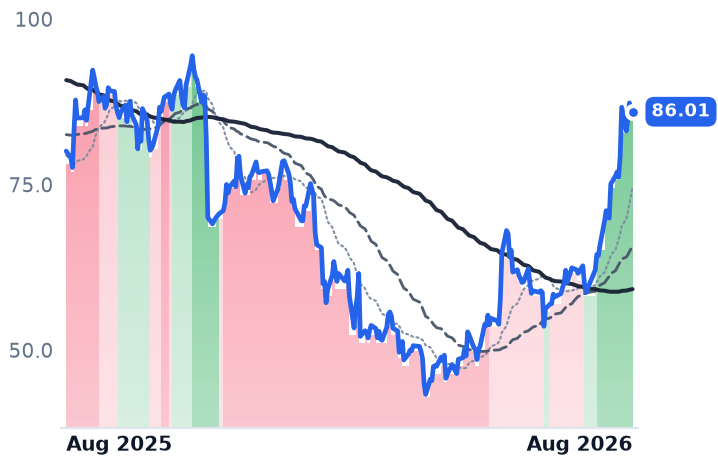
Elastic, whose Elasticsearch engine has become a vector store for retrieval-augmented AI, told investors in May that revenue growth would slow: it guided the quarter it reports on 27 August to roughly 13%, down from the 16% it had just delivered. Since late July the shares have gained 47% anyway, on product launches and broker target raises rather than any new financial statement.
The re-rating is real but unearned so far. Price per dollar of trailing gross profit has gone from 3.85x in early May to 6.75x, while the guided growth rate fell. MongoDB, selling into the same retrieval socket, grew 25.2% last quarter — nine points faster. Snowflake is the opposite case: product revenue accelerated to 34% growth with 126% net retention, and it carries the richest multiple in the layer. Datadog, the only one of the four to have reported since May, fell.
| Ticker | Company | Segment | Trend · 13mo | 30D | 1Y |
|---|---|---|---|---|---|
| The subject · what this brief is about | |||||
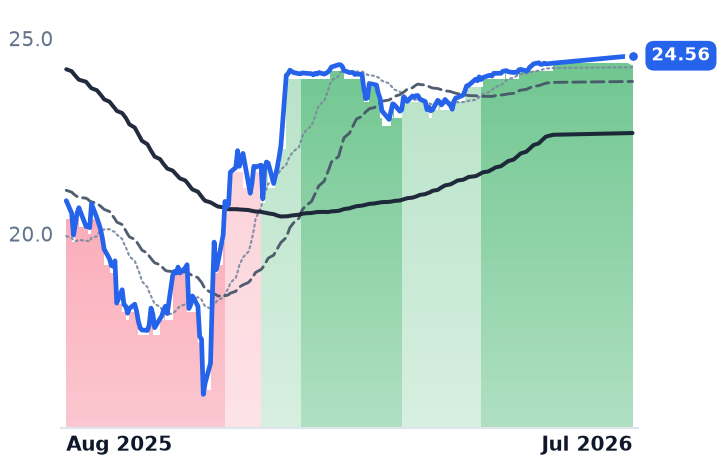
SNOW | Snowflake | Data & Analytics Platforms | 🟢 Cont. Bull | +23.1% | +69.1% |
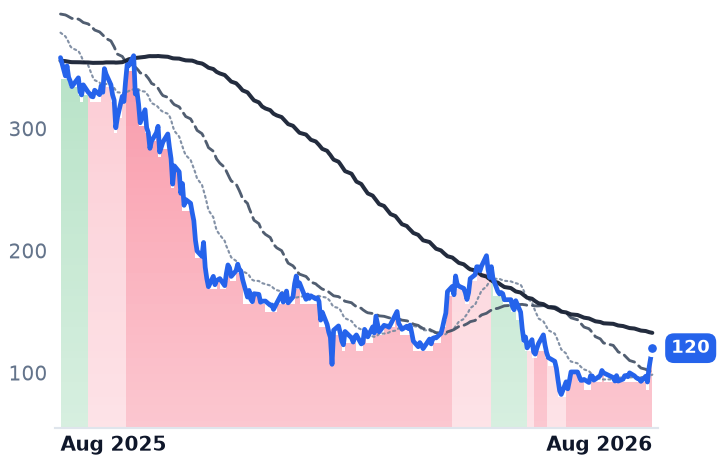
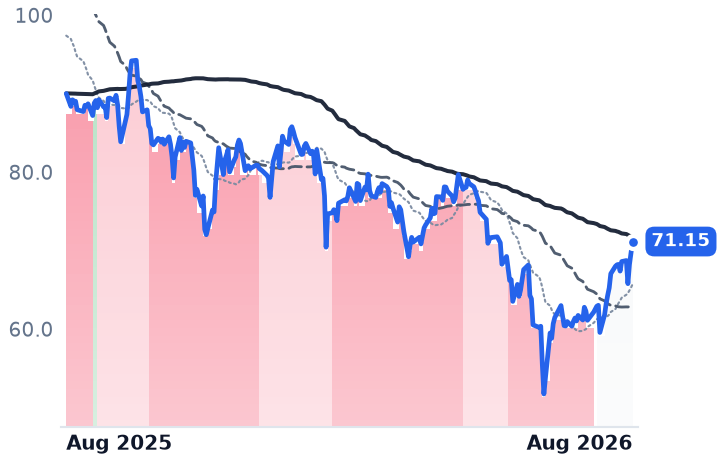
ESTC | Elastic | Data & Analytics Platforms | 🌱 Emerging Bull | +38.4% | +7.3% |
| Compared against · context, not the story | |||||
MDB | MongoDB | Data Management & Analytics | 🟢 Cont. Bull | +38.7% | +96.7% |
DDOG | Datadog | Data & Analytics Platforms | 🟢 Cont. Bull | −6.1% | +79.6% |
MSTR | Strategy | Data & Analytics Platforms | 🔴 Cont. Bear | +25.0% | −66.4% |
STRK | Strategy | Data & Analytics Platforms | 🔴 Cont. Bear | +16.4% | −20.9% |
CWAN | Clearwater Analytics | Data & Analytics Platforms | 🟢 Cont. Bull | — | +17.8% |
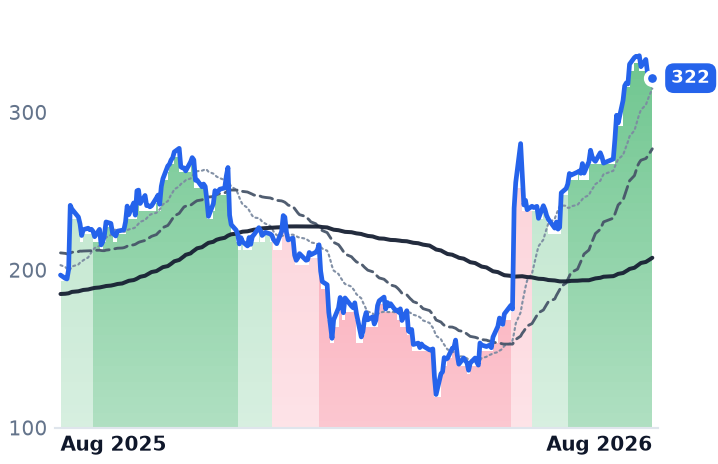
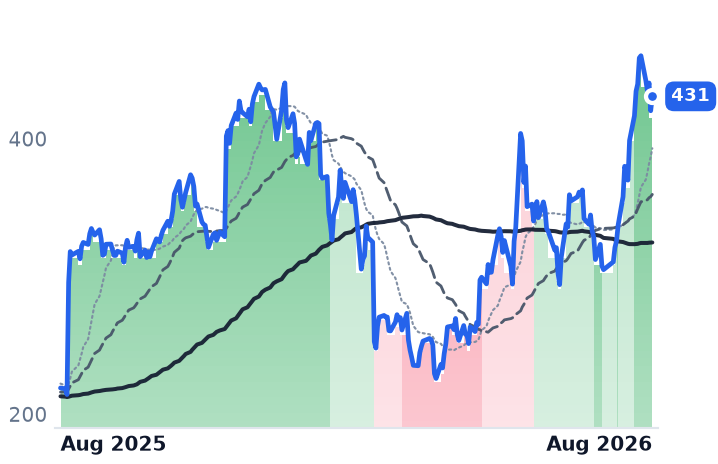
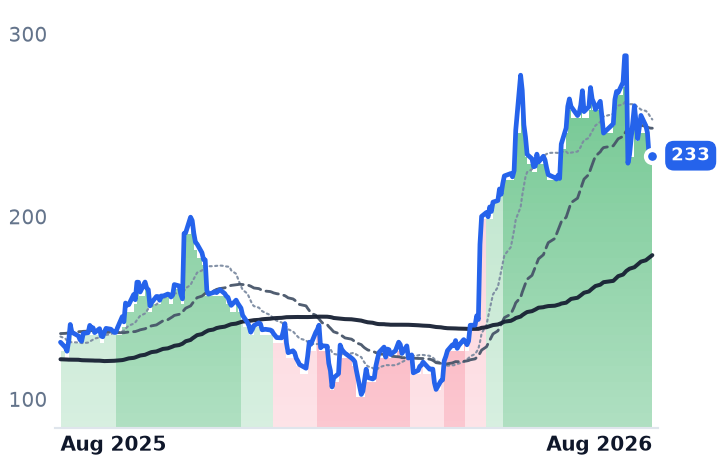
12-month price & trend
| Ticker | Mkt cap | P/E | P/E fwd | P/S | P/S fwd | P/GP | P/GP fwd | EV/EBITDA | FCF yld |
|---|---|---|---|---|---|---|---|---|---|
SNOW | $115.3B | n/m | 172.2x | 22.9x | 18.9x | 34.1x | 28.2x | n/m | 1.0% |
ESTC | $8.9B | 24.2x | 26.5x | 5.1x | 4.5x | 6.8x | 5.9x | 121.4x | 3.6% |
MDB | $34.7B | n/m | 70.4x | 13.3x | 11.7x | 18.5x | 16.2x | — | 1.7% |
| Ticker | Mkt cap | P/E | P/E fwd | P/S | P/S fwd | P/GP | P/GP fwd | EV/EBITDA | FCF yld |
|---|---|---|---|---|---|---|---|---|---|
DDOG | $83.9B | 473.9x | 93.2x | 21.1x | 18.8x | 26.6x | 23.6x | 321.8x | 1.4% |
MSTR | $39.4B | n/m | — | 79.2x | 79.4x | 117.1x | 117.4x | n/m | 28.7% |
STRK | $20.4B | n/m | — | 61.8x | 40.9x | 91.4x | 60.5x | n/m | 36.8% |
| Ticker | Mkt cap | P/E | P/E fwd | P/S | P/S fwd | P/GP | P/GP fwd | EV/EBITDA | FCF yld |
|---|---|---|---|---|---|---|---|---|---|
CWAN | $7.3B | n/m | 36.2x | 8.8x | 7.7x | 13.4x | 11.7x | 75.1x | 2.1% |
Consensus projections
| Ticker | FY2026E | FY2027E | FY2028E | |
|---|---|---|---|---|
SNOW | Revenue | +29.4% | +31.0% | +25.8% |
| EPS | +72.3% | +59.5% | +41.4% | |
ESTC | Revenue | +17.6% | +15.0% | +14.5% |
| EPS | +30.3% | +28.2% | +18.8% | |
MDB | Revenue | +23.1% | +21.6% | +18.0% |
| EPS | +59.1% | +27.0% | +19.7% | |
DDOG | Revenue | +31.7% | +22.3% | +22.9% |
| EPS | +25.3% | +17.0% | +22.2% | |
MSTR | Revenue | +5.0% | +2.0% | +3.8% |
| EPS | −208.6% | −141.3% | +472.7% | |
STRK | Revenue | +5.2% | +1.9% | +2.1% |
| EPS | −145.8% | −125.8% | +2676.7% | |
CWAN | Revenue | +29.8% | +18.1% | +15.4% |
| EPS | +23.6% | +22.1% | +12.3% |
Forward fiscal years only. Blank means no analyst coverage for that year.
Elastic closed its fiscal year in May with revenue of $1.74bn, up 17%, and told investors the pace from here would be slower. Its guide for the quarter it reports on 27 August is $469-470m, about 13% growth at the midpoint, with the full year set at roughly 15%. Since then the company has published no financial statement — and the shares have risen from $58.68 in late July to $85.94.
What Elastic sells into the AI stack
Elastic's product is the Elastic Stack: Elasticsearch, a distributed search and analytics engine, plus the Kibana, Beats and Logstash tools around it, sold for search, logging, observability and security work. Elasticsearch also stores vectors, the numeric representations that let a model retrieve a company's private documents at query time — the technique known as retrieval-augmented generation (RAG). The bull case is that every AI agent needs a retrieval layer, and that this traffic arrives as Elastic Cloud subscription revenue.
The disclosed numbers do not yet show it. Net expansion — what existing customers spend versus a year earlier — was 112%, and gross margin slipped to 75.4% from 76.7%. The April quarter carried a GAAP operating loss of $16.4m. MongoDB, which sells a document database with built-in vector search into the same socket, grew revenue 25.2% to $687.6m in its April quarter, with its Atlas cloud service up 29.4%. Elastic also faces Amazon's OpenSearch, a fork of its own open-source code, sold as a managed service by the largest cloud vendor. On the evidence to date it is following the data layer, not leading it.
What actually moved the shares
The advance was a grind, not a gap: Elastic cleared $62 in late July, $75 by 7 August and peaked at $87.34 on 19 August, its largest single session a 9.5% gain on 14 August. Its 50-day average crossed above its 200-day at the end of July. The proximate catalysts were an upgrade to its security-operations product toward an autonomous, agent-run threat desk, after which Truist, Oppenheimer, Jefferies and Stifel all raised targets, and a broad rotation into enterprise AI software as Wall Street's attention moved from training-cluster spending to inference and agent monetization. MongoDB rose 41% over the same thirty days.
One caution on the headline multiple: Elastic's trailing price/earnings of 24x is an artifact. The April quarter booked net income of $435.9m on revenue of $450.7m — a tax valuation-allowance release, not operations. On gross profit, the honest lens for a company at this margin, Elastic has gone from 3.85x in early May to 4.91x in late July to 6.75x now, 5.89x forward. That is a 75% re-rating while the guided growth rate fell. It is also still the cheapest name in the layer, against MongoDB at 18.5x and Datadog at 26.6x, and the shares sit 9% below their twelve-month high with a twelve-month return of only 11%.
The company where the business agrees
Snowflake, whose Data Cloud consolidates corporate data for analytics and now sells AI credits on top of it, is the mirror image. Product revenue grew 34% in the quarter reported on 27 May, accelerating from 30%, with net retention of 126% and remaining performance obligations up 38%. Gross margin has slipped two quarters running, 67.8% to 66.6%, consistent with the cost of serving AI queries landing in cost of revenue; stock compensation, at 41% of revenue in fiscal 2025, fell to 34% and is guided to 27%. Price to trailing gross profit has moved from 15.66x in early May to 34.13x. Snowflake reports on 2 September, not in August.
Datadog, which monitors software infrastructure and is the only one of the four to have published results since May, is the warning. It grew 35.6% in the June quarter, with more than 750 AI customers and agent tool calls up 22 times against late 2025 — proof the metered traffic exists. Its largest AI account then renewed at reduced usage, guidance for the September quarter came down to 28-29%, and the shares fell 4% over the same thirty days in which Elastic rose 47%. The one company that showed its numbers was the one that got marked down.
The setup
Where it stands — Elastic has re-rated 75% on gross profit since May while its own guidance points to growth slowing to 13%. Would confirm — Cloud revenue growth above 20% on 27 August with net expansion rising above 112%. Would invalidate — Total revenue at or below the $469-470m guide with net expansion flat or lower. Watch next — Elastic reports first-quarter fiscal 2027 after the close on 27 August; Snowflake follows on 2 September. Valuation — 6.75x trailing gross profit, 5.89x forward, against 3.85x in early May and MongoDB's 18.5x.