

Wednesday's Synopsys Print Tests Whether Ansys Pays: Design IP Fell 6% Last Quarter
Hypothesis Opus 5 · Research Opus 5 · Writing Opus 5 · Prompt v1.6
The two companies whose software every AI accelerator is designed in have split, and only one of the splits is earned. Synopsys reports Wednesday after the close — the first scheduled catalyst either name has since late July — and the line to watch is not revenue, which the Ansys acquisition has inflated by design.
Last quarter Synopsys grew sales 41.9% while gross margin fell nearly eight percentage points to 72.3% and the chip-IP segment shrank 6% year on year. Cadence, meanwhile, accelerated to 24.2% growth on a record $8.1bn backlog and held an 84.9% gross margin — and its shares are lower than a year ago. Synopsys's discount looks paid for; Cadence's does not.
| Ticker | Company | Segment | Trend · 13mo | 30D | 1Y |
|---|---|---|---|---|---|
| The subject · what this brief is about | |||||
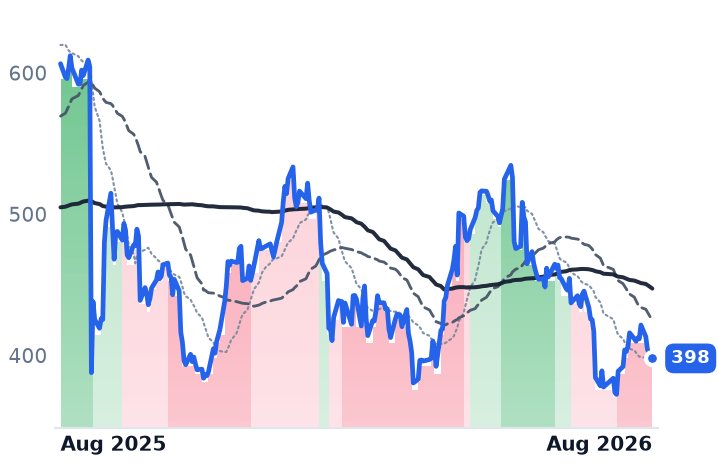
SNPS | Synopsys | EDA & Design Tools | 🔴 Cont. Bear | +3.7% | −34.4% |
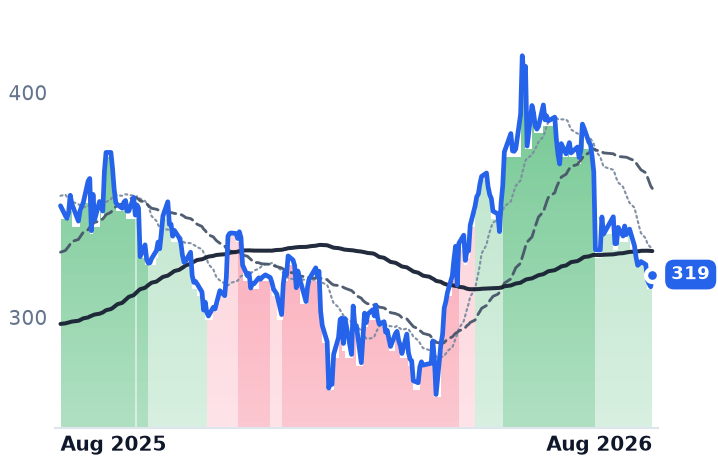
CDNS | Cadence Design Systems | Developer Tools & DevOps | 🌱 Emerging Bull | −7.5% | −8.8% |
| Compared against · context, not the story | |||||
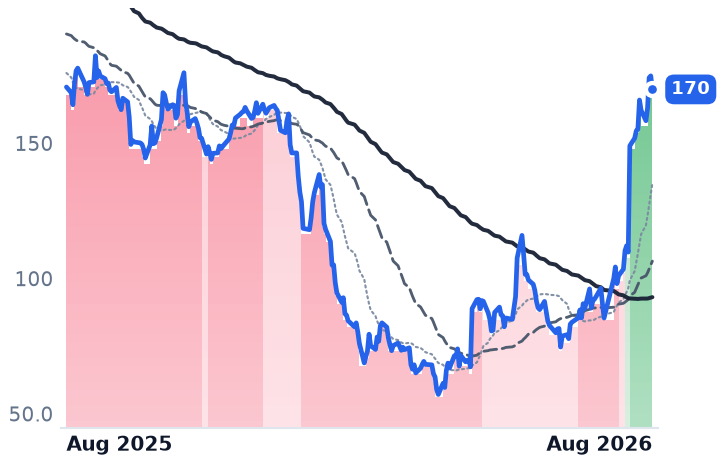
TEAM | Atlassian | Developer Tools & DevOps | 🔴 Cont. Bear | +71.8% | +0.6% |
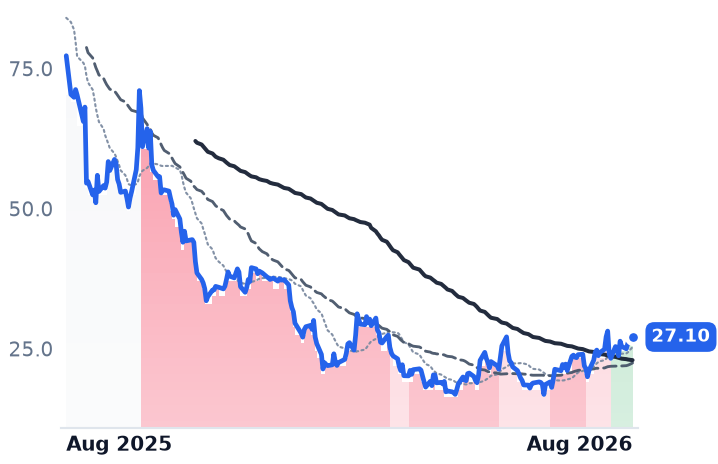
FIG | Figma | Design & Content Creation | 🔴 Cont. Bear | +35.5% | −64.9% |
12-month price & trend
| Ticker | Mkt cap | P/E | P/E fwd | P/S | P/S fwd | P/GP | P/GP fwd | EV/EBITDA | FCF yld |
|---|---|---|---|---|---|---|---|---|---|
SNPS | $76.2B | 90.0x | 26.9x | 8.8x | 7.9x | 11.9x | 10.7x | 31.2x | 3.5% |
CDNS | $87.9B | 63.0x | 39.2x | 15.0x | 13.9x | 17.0x | 15.7x | 40.7x | 1.9% |
TEAM | $45.1B | n/m | 31.3x | 6.9x | 6.0x | 8.1x | 7.1x | 298.8x | 2.9% |
| Ticker | Mkt cap | P/E | P/E fwd | P/S | P/S fwd | P/GP | P/GP fwd | EV/EBITDA | FCF yld |
|---|---|---|---|---|---|---|---|---|---|
FIG | $13.2B | n/m | 94.6x | 10.3x | 9.0x | 13.0x | 11.4x | n/m | 1.7% |
Consensus projections
| Ticker | FY2026E | FY2027E | FY2028E | |
|---|---|---|---|---|
SNPS | Revenue | +37.4% | +10.9% | +11.9% |
| EPS | +15.2% | +17.0% | +18.6% | |
CDNS | Revenue | +19.7% | +13.6% | +11.7% |
| EPS | +15.3% | +17.0% | +14.3% | |
TEAM | Revenue | +24.7% | +15.4% | +14.7% |
| EPS | +55.5% | −0.1% | +21.6% | |
FIG | Revenue | +40.5% | +23.8% | +24.1% |
| EPS | −24.4% | +26.7% | +34.5% |
Forward fiscal years only. Blank means no analyst coverage for that year.
Synopsys reports third-quarter results on Wednesday after the close, and the question is narrower than its revenue line suggests. The company that sells chip designers their software, their pre-built circuit blocks and their verification hardware bought Ansys, a simulation-software maker, and the deal has been adding revenue faster than it adds profit. Wednesday is the first scheduled test of whether that reverses.
The money at issue is visible in the gap between what Synopsys earns now and what it is expected to earn. The stock changes hands at 90 times trailing earnings and 27 times forward — a compression that is not optimism about growth so much as an assumption that purchase-accounting and integration charges wash out. Nothing in the last print confirmed it yet.
The decomposition
In the quarter ended 30 April, Synopsys grew revenue 41.9% to $2.28bn and raised full-year guidance to $9.665bn at the midpoint. Underneath, gross margin fell 783 basis points — nearly eight percentage points — to 72.3%, and reported operating margin went from 23.5% to 10.4%. Design Automation came in at $1,822m with core electronic-design-automation revenue up just over 8%, while Design IP fell about 6% year on year to $454m. Gross profit dollars did rise, up 28.4% over the trailing year — the acquisition is additive in dollars and dilutive in margin, simultaneously.
Chief executive Sassine Ghazi told investors on the 27 May call that the fix is a change in how the IP business charges: "by the end of this fiscal year, we will have few customers with signed agreements with a new business model that provides the opportunity to capture more dollar than the traditional use fee or some level of NRE" — non-recurring engineering fees, the one-time charges that have historically capped what a chip-IP vendor collects when a customer's design ships in volume. Synopsys has also agreed to sell its Processor IP business to GlobalFoundries, closing in the second half of this year, to concentrate on interface and foundation blocks.
The other half of the duopoly
Cadence, which sells the competing tools plus Palladium emulation and Protium prototyping boxes, has had the opposite quarter and the same tape. Revenue growth accelerated for a third straight quarter to 24.2%, gross margin held at 84.9%, and backlog reached a record $8.1bn, up 27%. Core electronic-design-automation revenue rose 18%, design IP more than 40% and system design and analysis 37%, with non-GAAP operating margin at 45.5%; management called the accompanying raise "the highest we have raised annual revenue in a single quarter." Full-year guidance is $6.26–6.34bn, and assumes export rules stay substantially as they are. Cadence shares are down 8.2% over twelve months while trailing gross profit grew 18.6%. It has not yet announced a third-quarter date; its last results filing was 27 July.
Because an 85% gross margin and a 72% one make sales comparisons meaningless, the useful cross-name anchor is price against a dollar of trailing gross profit. Cadence has fallen to 17.0 times from 20.0 in late July and roughly 21.8 a year ago, with no reported deterioration in between. Synopsys sits at 12.0, up from a 10.3 low in late July but well below 14.0 in early May. Cadence remains 42% dearer inside a two-firm market.
What is earned and what is not
Synopsys's de-rating is paid for: a shrinking IP line and eight points of gross margin are exactly the things that ought to cost a stock its rating. Cadence's is not. The one shared shock was 17 July, when a Chinese laboratory showed an open-weight model completing a chip design with no proprietary tools at all and both fell about 9% in a session — on a 45nm library several generations behind where either company competes. The long-bond selloff of mid-August, with the 30-year Treasury at its highest since 2007, hit Synopsys harder than Cadence over that week, the reverse of what duration alone predicts given Cadence's thinner free-cash-flow yield. The likelier reading is that money is paying for margin quality rather than for design activity, and that record backlog at Cadence has so far bought nothing.
Synopsys goes first, on Wednesday, and for once the cheaper name sets the terms.