

TSMC Sold Out Its Wafer Capacity, Hit a 67.7% Gross Margin, and Got Cheaper Anyway
Hypothesis Opus 5 · Research Opus 5 · Writing Opus 5 · Prompt v1.5
Taiwan Semiconductor Manufacturing, the contract fab that builds most of the world's leading-edge AI processors, is earning the best margins in its history and costs less per dollar of gross profit than it did in May. Gross margin reached 67.7% in the June quarter, against 58.6% a year earlier; the price paid for each dollar of trailing gross profit has fallen from roughly 25.7x to 21.9x.
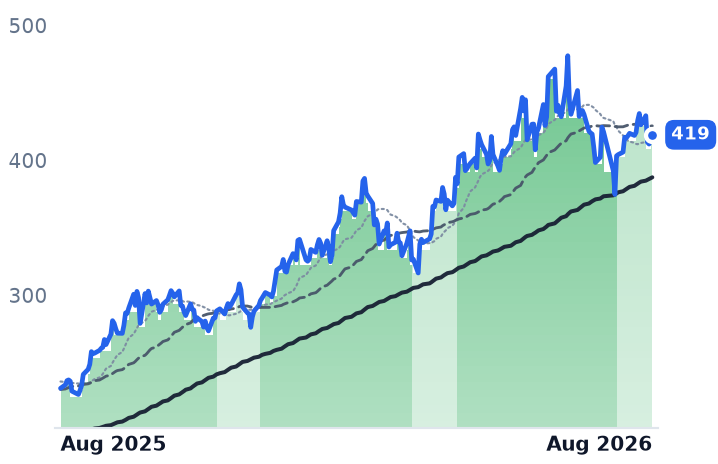
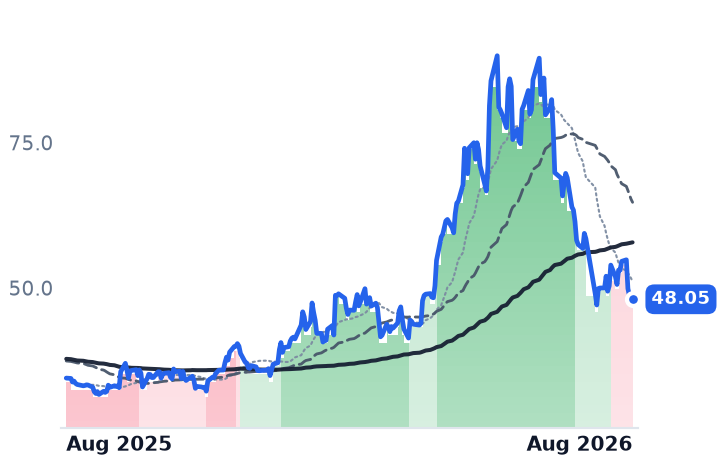
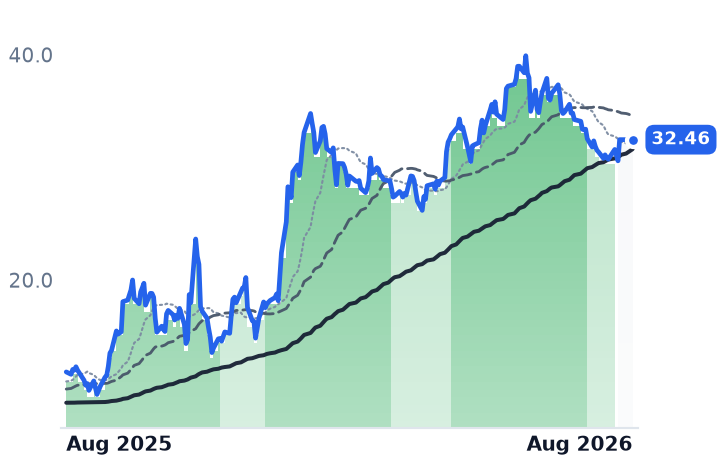
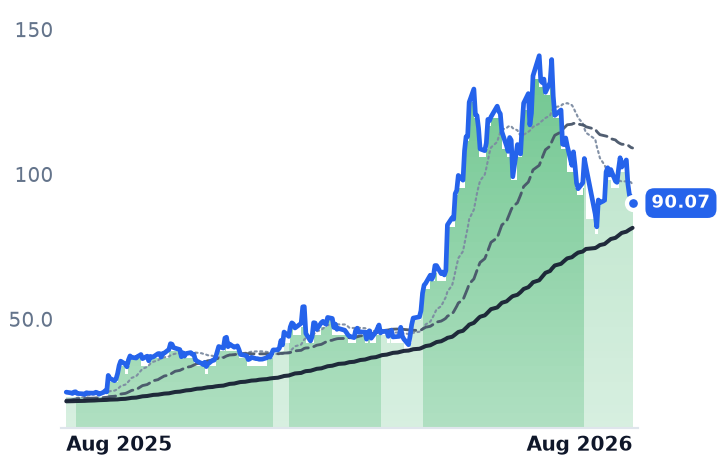
Over twelve months TSMC is also the laggard among foundries, up 84% while United Microelectronics rose 172%. Nothing in the June quarter supports that ranking: revenue grew 36%, July sales set a record, and 2026 capital spending was raised to $60-64bn. The drawdown since late June traces to two external shocks — a chip selloff on doubts about AI capital-spending returns, then a 19-year high in long Treasury yields. GlobalFoundries, whose margin gained the most, fell the hardest.
| Ticker | Company | Segment | Trend · 13mo | 30D | 1Y |
|---|---|---|---|---|---|
| The subject · what this brief is about | |||||
TSM | Taiwan Semiconductor Manufacturing | Logic Foundries | 🟢 Cont. Bull | +6.8% | +81.4% |
GFS | GLOBALFOUNDRIES | Logic Foundries | 🟢 Cont. Bull | −2.0% | +39.3% |
UMC | United Microelectronics | Logic Foundries | 🟢 Cont. Bull | +5.6% | +170.9% |
| Compared against · context, not the story | |||||
TSEM | Tower Semiconductor | Logic Foundries | 🟢 Cont. Bull | +9.7% | +306.7% |
SKYT | SkyWater Technology | Logic Foundries | 🟢 Cont. Bull | +5.7% | +174.2% |
INTC | Intel | Specialty Semiconductors | 🟢 Cont. Bull | +4.4% | +263.2% |
MU | Micron Technology | Memory (DRAM/NAND) | 🟢 Cont. Bull | +17.8% | +722.7% |
NVDA | NVIDIA | AI & Data Center GPUs | 🟢 Cont. Bull | +9.0% | +20.6% |
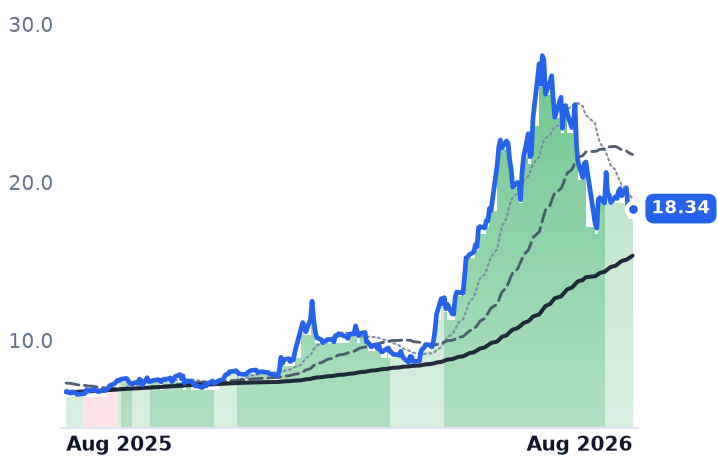
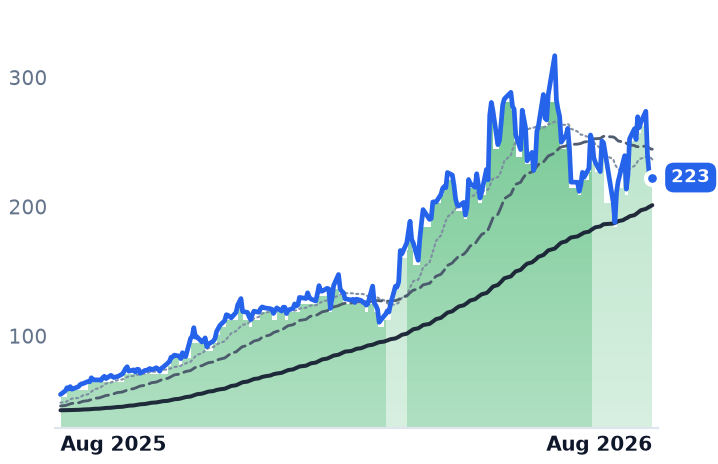
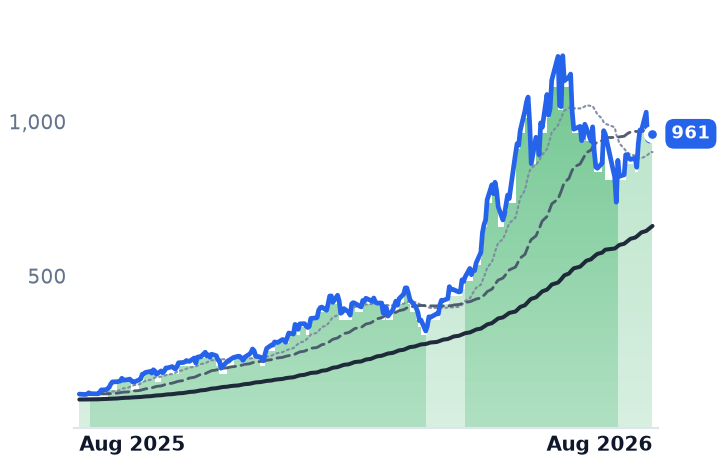
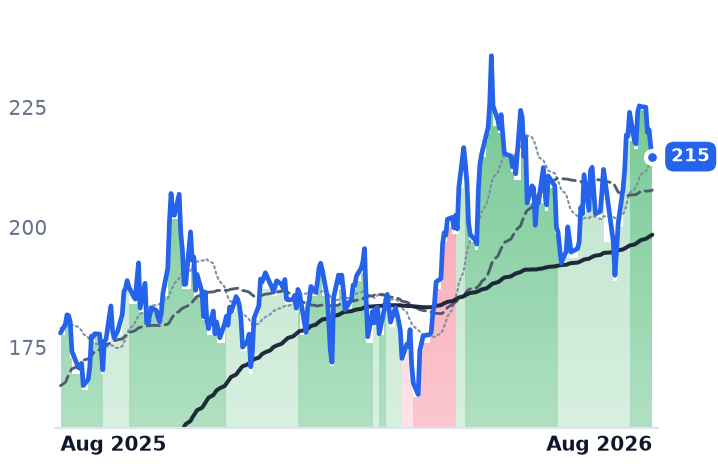
12-month price & trend
| Ticker | Mkt cap | P/E | P/E fwd | P/S | P/S fwd | P/GP | P/GP fwd | EV/EBITDA | FCF yld |
|---|---|---|---|---|---|---|---|---|---|
TSM | $2.2T | 27.9x | — | 14.1x | — | 21.9x | — | 18.5x | 1.8% |
GFS | $26.4B | 37.2x | 24.8x | 3.8x | 3.6x | 13.9x | 13.2x | 12.7x | 3.0% |
UMC | $45.7B | 17.4x | — | 5.8x | — | 19.0x | — | 9.0x | 4.1% |
| Ticker | Mkt cap | P/E | P/E fwd | P/S | P/S fwd | P/GP | P/GP fwd | EV/EBITDA | FCF yld |
|---|---|---|---|---|---|---|---|---|---|
TSEM | $25.1B | 88.0x | 57.7x | 14.8x | 12.7x | 55.3x | 47.4x | 44.6x | 1.2% |
SKYT | $1.7B | 14.9x | — | 3.2x | 2.8x | 16.1x | 14.3x | 12.6x | -4.4% |
INTC | $546.7B | n/m | 101.3x | 10.2x | 9.4x | 28.7x | 26.5x | 50.4x | -0.6% |
| Ticker | Mkt cap | P/E | P/E fwd | P/S | P/S fwd | P/GP | P/GP fwd | EV/EBITDA | FCF yld |
|---|---|---|---|---|---|---|---|---|---|
MU | $1.0T | 19.9x | 12.2x | 11.2x | 7.8x | 15.4x | 10.7x | 14.5x | 2.6% |
NVDA | $5.5T | 34.3x | 25.0x | 21.5x | 13.9x | 29.0x | 18.7x | 28.3x | 2.2% |
Consensus projections
| Ticker | FY2026E | FY2027E | FY2028E | |
|---|---|---|---|---|
TSM | Revenue | +42.0% | +34.4% | +26.0% |
| EPS | +65.5% | +30.7% | +26.5% | |
GFS | Revenue | +8.0% | +12.3% | +14.0% |
| EPS | +17.7% | +30.5% | +33.4% | |
UMC | Revenue | +18.4% | +24.3% | +14.9% |
| EPS | +111.4% | −1.1% | +22.1% | |
TSEM | Revenue | +26.0% | +39.3% | +30.0% |
| EPS | +76.5% | +72.1% | +57.8% | |
SKYT | Revenue | +40.9% | +4.5% | +3.5% |
| EPS | −1120.5% | −60.2% | +284.6% | |
INTC | Revenue | +10.8% | +10.5% | +10.1% |
| EPS | +211.5% | +39.0% | +41.2% | |
MU | Revenue | +248.0% | +92.8% | +11.4% |
| EPS | +804.9% | +111.2% | +7.9% | |
NVDA | Revenue | +65.1% | +84.2% | +43.2% |
| EPS | +59.0% | +91.7% | +42.0% |
Forward fiscal years only. Blank means no analyst coverage for that year.
Taiwan Semiconductor Manufacturing builds the chips that Nvidia, Apple, Broadcom and Qualcomm design and cannot get made competently anywhere else. In the June quarter that position produced a gross margin of 67.7%, up from 58.6% a year earlier, on revenue of NT$1,270bn — growth of 36% year on year, per the company's 6-K filing. Gross profit grew 57% and operating income 65%, both far ahead of sales. July was a record month at NT$467.6bn, up 44.7% from a year earlier, with essentially all available wafer capacity already sold.
What is actually being sold
High-performance computing — accelerators, networking silicon, server processors — rose 20% sequentially to 66% of revenue on the July call. Smartphones fell to 22%. Processes at 7 nanometers and below accounted for 77% of wafer revenue, with 3nm and 5nm together about 63%. Management called the gap between demand and supply "very large" and said rivals face "no shortcuts": five to seven years to develop, build and ramp a competitive node.
The company also spent against that. Capital expenditure for 2026 was lifted 15% to $60-64bn, with a further $100bn committed to roughly four Arizona fabs at 2nm and below. That carries a visible cost: the 2nm ramp dilutes gross margin by three to four points, and overseas fabs by two to three points early on. September-quarter margin was guided to a 66% midpoint. TSMC's long-term target is about 68%, and it has said publicly it will not push through the 4-5x price increases that memory suppliers have taken.
The valuation moved the other way
TSMC now trades at 27.9x trailing earnings and 21.9x trailing gross profit, against roughly 25.7x gross profit three months ago. Its forward multiples are not directly quotable — consensus estimates are published in Taiwan dollars against a US-dollar listing — but analysts expect earnings to rise about 65% this year. The multiple compressed while the earnings base compounded.
It was also the weakest of the large foundries over the past year: up 84%, against 172% at United Microelectronics and 345% at Tower Semiconductor. Every one of them peaked in the second half of June and has fallen since — TSMC 12% from its 30 June high, and it dropped out of its strongest uptrend at the end of July, though its 50-day average remains above its 200-day.
The mature-node half
The two trailing-edge names tell a different story about the same demand. GlobalFoundries, a specialty foundry making radio-frequency, power-management and silicon-photonics chips from Malta, New York, expanded gross margin by 411 basis points to 28.3% and grew communications and data-center revenue 62% year on year — and has fallen 41% in three months, to 13.85x trailing gross profit. United Microelectronics, the Hsinchu contract foundry that dominates 22 and 28nm work, lifted utilization to 85% and guided above 90%, and for the first time quantified AI-linked sales at roughly $300m in 2026; it costs 19.04x trailing gross profit, more than GlobalFoundries, on far less disclosed AI content.
Mature-node pricing has stopped deflating: TrendForce reports foundry prices rose 5-15% between the first and second quarters, with a third round being prepared for 2027. What broke the shares was not the fabs. Chip stocks lost more than $1trn in late July on doubts about the return on AI capital spending, and a second leg came when the 30-year Treasury yield hit 5.33% on 18 August, a 19-year high. Long-duration compounders repriced with the discount rate.
The setup
Where it stands — TSMC's margin and revenue set records in the June quarter while its multiple on trailing gross profit compressed by roughly four turns since May.
Would confirm — September-quarter gross margin printing at or above the 66% guided midpoint despite the 2nm ramp dilution.
Would invalidate — Monthly revenue growth slowing below 30% year on year, or a cut to the $60-64bn capital-spending plan.
Watch next — Monthly revenue for August and September, then third-quarter results and 2027 capital-spending commentary in October.
Valuation — 27.9x trailing earnings, 21.9x trailing gross profit, down from about 25.7x in May; forward estimates are quoted in Taiwan dollars.