

Twilio Now Costs 12 Times Gross Profit; Five9, Growing 10%, Costs Under Four
Hypothesis Opus 5 · Research Opus 5 · Writing Opus 5 · Prompt v1.5
Shares in the companies that carry business phone calls and text messages have all been marked up sharply since February — Five9 by roughly two-thirds on revenue growth of 10%, RingCentral by about as much on 6%. Only Twilio's underlying business actually accelerated, and it is now by far the most expensive of the four.
Twilio's revenue growth rose for four straight quarters, to 22%, and gross profit growth followed at 20.4% — the test Bandwidth failed, its gross margin falling 410 basis points to 35.7% as carrier pass-through fees inflated the top line without adding profit. But investors now pay 12.4 times trailing gross profit for Twilio, against 4.9 for Bandwidth, 3.8 for Five9 and 3.0 for RingCentral, and roughly 7 times for Twilio itself in February. Management has guided next quarter's organic growth down to 11-12%, from 17%.
| Ticker | Company | Segment | Trend · 13mo | 30D | 1Y |
|---|---|---|---|---|---|
| The subject · what this brief is about | |||||
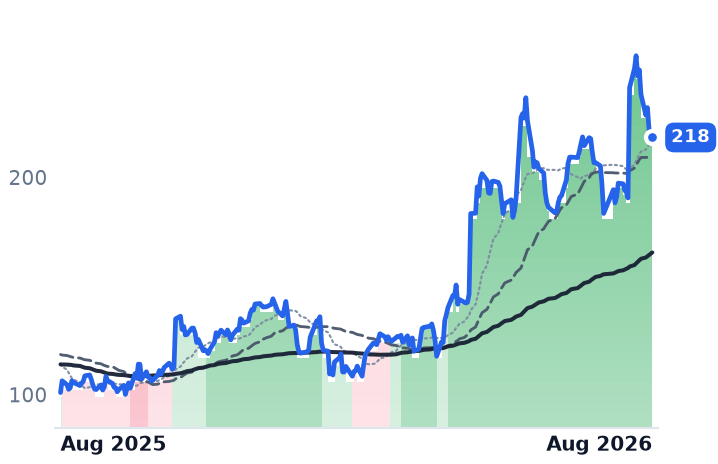
TWLO | Twilio | Communications & Messaging Platforms | 🟢 Cont. Bull | +19.1% | +116.2% |
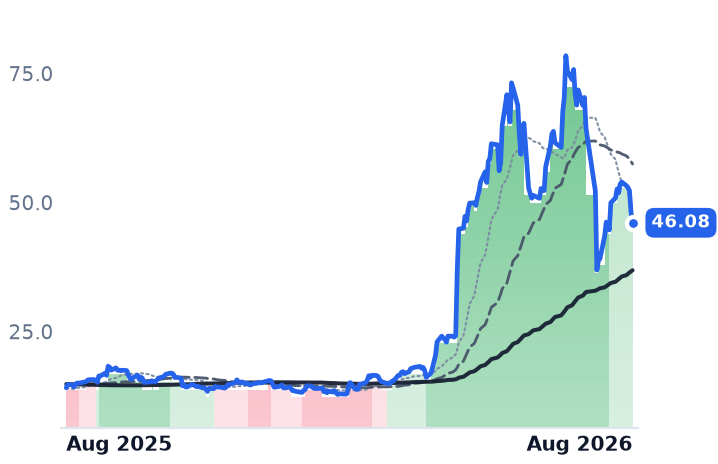
BAND | Bandwidth | Communications & Messaging Platforms | 🌱 Emerging Bull | −28.4% | +226.3% |
| Compared against · context, not the story | |||||
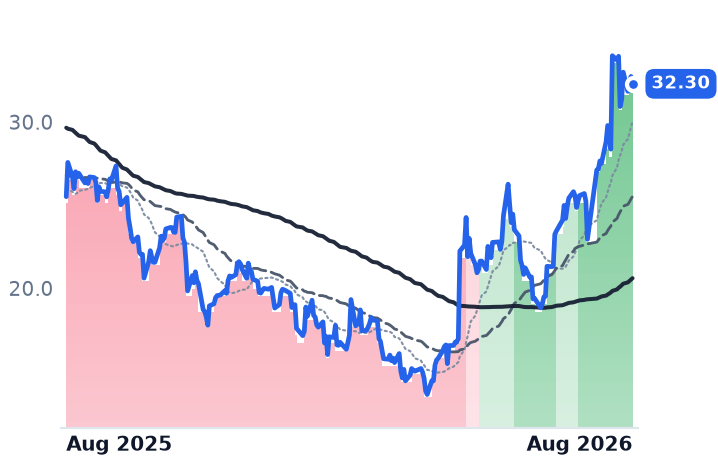
FIVN | Five9 | Communications & Collaboration | 🌱 Emerging Bull | +40.7% | +26.6% |
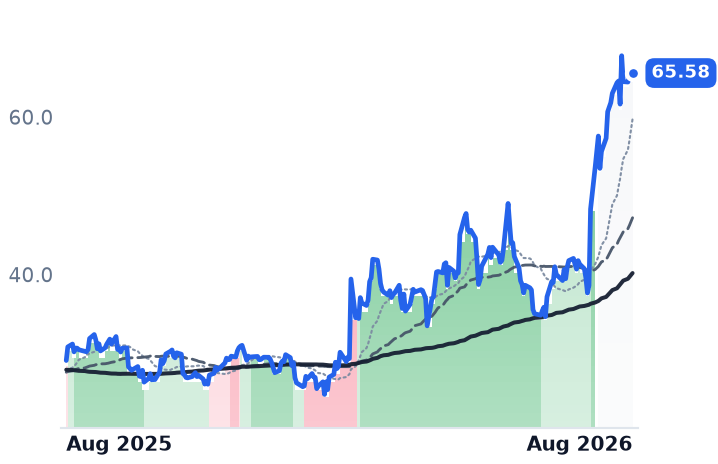
RNG | RingCentral | Communications & Collaboration | 🟢 Cont. Bull | +74.1% | +125.5% |
12-month price & trend
| Ticker | Mkt cap | P/E | P/E fwd | P/S | P/S fwd | P/GP | P/GP fwd | EV/EBITDA | FCF yld |
|---|---|---|---|---|---|---|---|---|---|
TWLO | $33.5B | 29.4x | 37.3x | 6.0x | 5.6x | 12.4x | 11.5x | 92.1x | 3.3% |
BAND | $1.5B | n/m | 26.7x | 1.8x | 1.7x | 4.9x | 4.5x | — | 4.8% |
FIVN | $2.5B | 42.5x | 9.9x | 2.1x | 2.0x | 3.8x | 3.6x | 15.0x | 8.1% |
| Ticker | Mkt cap | P/E | P/E fwd | P/S | P/S fwd | P/GP | P/GP fwd | EV/EBITDA | FCF yld |
|---|---|---|---|---|---|---|---|---|---|
RNG | $5.7B | 50.8x | 13.0x | 2.2x | 2.1x | 3.0x | 3.0x | 20.4x | 11.9% |
Consensus projections
| Ticker | FY2026E | FY2027E | FY2028E | |
|---|---|---|---|---|
TWLO | Revenue | +19.4% | +11.7% | +10.6% |
| EPS | +23.5% | +14.5% | +14.2% | |
BAND | Revenue | +20.0% | +4.3% | +20.2% |
| EPS | +22.2% | +9.9% | +41.0% | |
FIVN | Revenue | +9.5% | +9.9% | +10.6% |
| EPS | +10.5% | +18.0% | +16.6% | |
RNG | Revenue | +5.1% | +4.6% | +4.4% |
| EPS | +16.4% | +11.1% | +10.8% |
Forward fiscal years only. Blank means no analyst coverage for that year.
Every large listed vendor of the plumbing that carries a business phone call, a text message or a one-time passcode has been repriced upward since February. Only one of them has a meter that visibly sped up. That gap between what the shares did and what the businesses did is now wide enough to price.
Four companies, one rerating
Twilio sells application programming interfaces (APIs) that let software developers embed voice, messaging, email and identity verification into their own products, and bills by the message and the minute. Bandwidth does nominally the same job but owns its carrier network and sells enterprise voice and SIP trunking, mostly in the United States; it is about 22 times smaller. Five9 sells cloud contact-center software to companies running customer-service teams, and RingCentral sells cloud phone systems and meetings to businesses replacing on-premise handsets.
Between 20 February and 20 August, Five9 rose 67% and RingCentral 66%. Their businesses did not move that way: Five9 grew revenue 10.3% in its June quarter with gross profit up 7.3% and gross margin slipping to 53.4%, and RingCentral grew 5.9% with gross profit up 7.0%. Whatever lifted this group, growth was not it.
Only Twilio's meter moved
Twilio's reported revenue growth accelerated for four consecutive quarters — 14.7%, 14.3%, 20.0% and 22.0% — to $1.5bn in the June quarter. The harder test is gross profit, which accelerated in parallel to 20.4%, trailing revenue by under two points. Dollar-based net expansion, the spend of existing customers a year on, reached 116%.
That matters because a large slice of the industry's reported growth is not growth at all. US carriers raised their application-to-person messaging surcharges again for 2026, with T-Mobile's revised schedule effective 19 January adding an inbound-message fee and lifting outbound rates. Those fees pass straight through: they add to revenue and an equal amount to cost of revenue. Twilio absorbed $71m of them in the quarter and guides to roughly $250m for the year. Strip them out and messaging grew about 18% rather than 28% — but gross profit still compounded at 20%, because the faster-growing pieces are software, not raw texts. Voice grew above 20%, with identity verification past 30%.
Bandwidth is where the same headline produced the opposite result. Revenue rose 22.2% to $219.9m, gross profit only 9.6%, and GAAP gross margin fell 410 basis points to 35.7%. Its cloud-communications line — the part that is not pass-through — grew 12%, and its owned-network enterprise voice grew 9%, less than half Twilio's rate on the identical product. The shares fell 29.3% on 29 July despite a revenue beat and raised guidance.
Bandwidth is not broken. Its gross-profit growth has accelerated four quarters running off a low base, adjusted EBITDA margin hit a record 18.3%, net leverage is steady at 1.6 times, and it now carries production traffic for Salesforce's Agentforce agent platform — revenue excluded from guidance. What it lacks is a cushion. It issued $316m of zero-coupon convertible notes due 2032 on 18 June at a conversion price near $72.64, about 37% above today's price, and bought back stock this year at an average $57.06. Both were struck against a share price that no longer exists; the stock peaked at $78.44 on 9 July and has fallen 41% since.
What the price now assumes
Twilio's trailing price/earnings ratio of 29 times is meaningless — a one-off $1.07bn net income sits in the quarter, which is why the forward multiple, 37 times, is higher than the trailing one. On price to trailing gross profit, the one lens comparable across four different margin structures, Twilio is at 12.4 times, against 4.9 for Bandwidth, 3.8 for Five9 and 3.0 for RingCentral. Six months ago Twilio itself was near 7 times, and in late May near 11. Free cash flow yield is 3.3%.
The counter-anchor is that on enterprise value to next year's revenue, roughly 4.7 times, Twilio still sits below its own ten-year median near 7.2 times. Nearly all of the advance arrived in three sessions — 1 May, 1 June and 7 August, the last following an 11% earnings beat — and outside those gaps Twilio lagged both Five9 and RingCentral over three months. Management raised full-year guidance twice, then guided September-quarter organic growth to 11-12% from 17% and warned that 5% beats should not be the norm. Consensus has revenue decelerating to 11.7% next year. The business earned its rerating; the multiple has moved further than the guidance.
The setup
Where it stands — Twilio's growth and gross profit both accelerated four quarters running, and it trades at three to four times peer multiples on gross profit.
Would confirm — September-quarter organic revenue growth printing at or above the 11-12% guide with gross profit growth again within two points of revenue.
Would invalidate — Gross-profit growth falling materially behind reported revenue growth, signalling the acceleration was carrier pass-through after all.
Watch next — Twilio's third-quarter results in early November; Bandwidth's, with the Salesforce Agentforce ramp still outside guidance.
Valuation — Twilio at 12.4 times trailing and 11.5 times forward gross profit, versus roughly 7 times in February and 4.9 for Bandwidth.