

Hesai Shipped 80% More Lidars for 21% More Revenue as Its Operating Line Went Negative
Hypothesis Opus 5 · Research Opus 5 · Writing Opus 5 · Prompt v1.5
The best-performing autonomy supplier of the past month is also the one whose unit economics are visibly eroding. Hesai, China's largest maker of automotive laser scanners, shipped more than 628,000 units in the June quarter against roughly 350,000 a year earlier — yet collected only 21.5% more revenue, an implied blended price per sensor down about a third. Gross margin slipped to 40.1% from 42.5%, and reported operating income has now been negative two quarters running, leaving the celebrated profit streak resting on items below the operating line.
Hesai supplied roughly two-thirds of its four-name group's 30-day advance; Autoliv, the airbag maker with no autonomy content, contributed about one point. Mobileye is the mirror image — shipments beating its customers' production, revenue flat, gross profit down 6.7% — and its shares are priced for no gross-profit growth at all. Aeva's spike was a data-center announcement, and it has round-tripped.
| Ticker | Company | Segment | Trend · 13mo | 30D | 1Y |
|---|---|---|---|---|---|
| The subject · what this brief is about | |||||
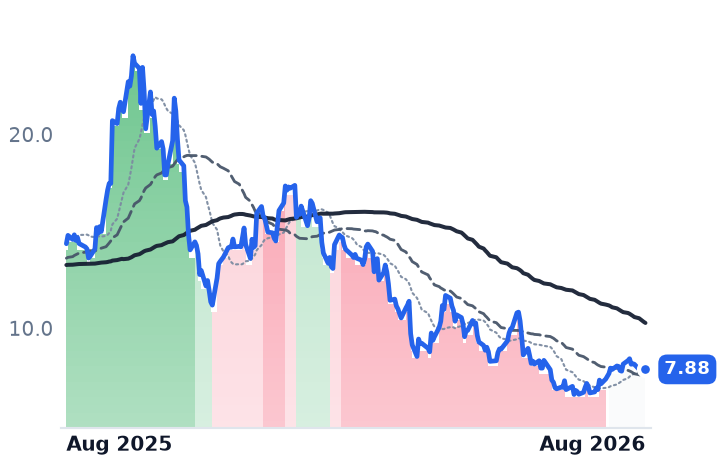
HSAI | Hesai | Advanced Safety & Autonomous Tech | ⚠️ Emerging Bear | +26.7% | −18.3% |
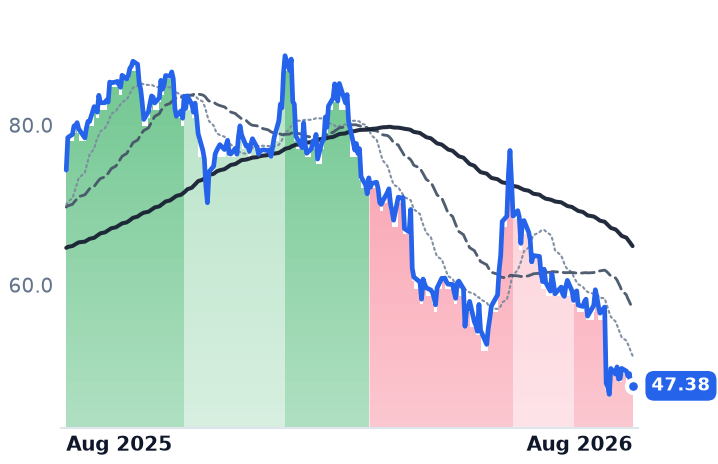
MBLY | Mobileye Global | Advanced Safety & Autonomous Tech | 🔴 Cont. Bear | +3.1% | −34.8% |
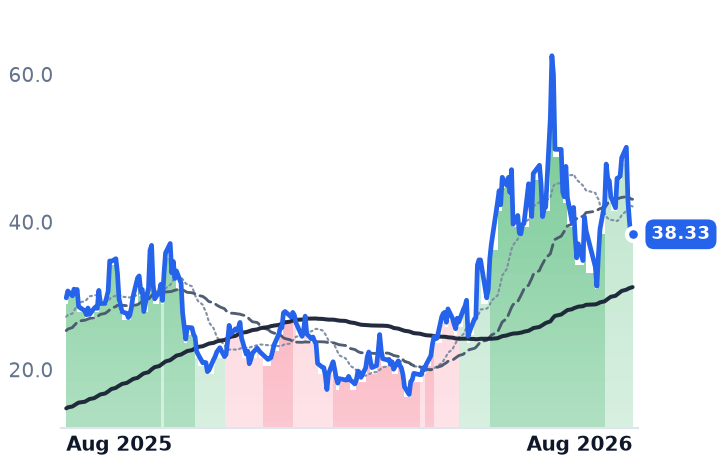
AEVA | Aeva Technologies | Advanced Safety & Autonomous Tech | 🌱 Emerging Bull | +8.7% | +30.9% |
| Compared against · context, not the story | |||||
ALV | Autoliv | Advanced Safety & Autonomous Tech | 🟢 Cont. Bull | +4.5% | +5.1% |
PONY | Pony AI Inc. American Depositary Shares | Autonomous Mobility | 🔴 Cont. Bear | +15.3% | −45.2% |
OUST | Ouster | Specialty Manufacturing & Components | 🌱 Emerging Bull | −1.4% | +29.0% |
APTV | Aptiv | Electrical Architecture & Connectivity | ⚠️ Emerging Bear | −18.6% | −36.3% |
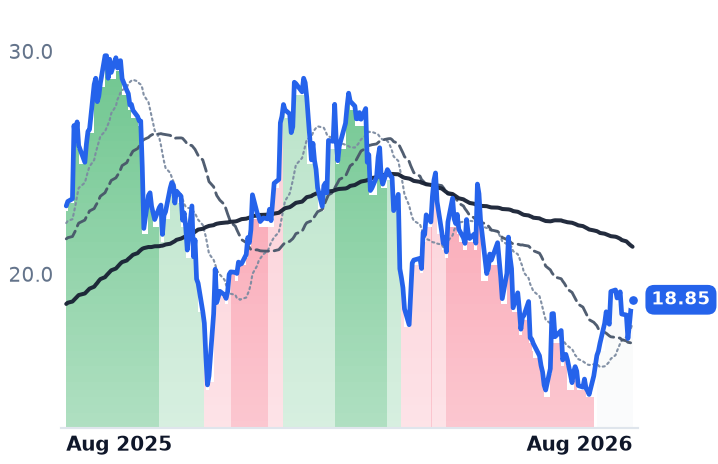
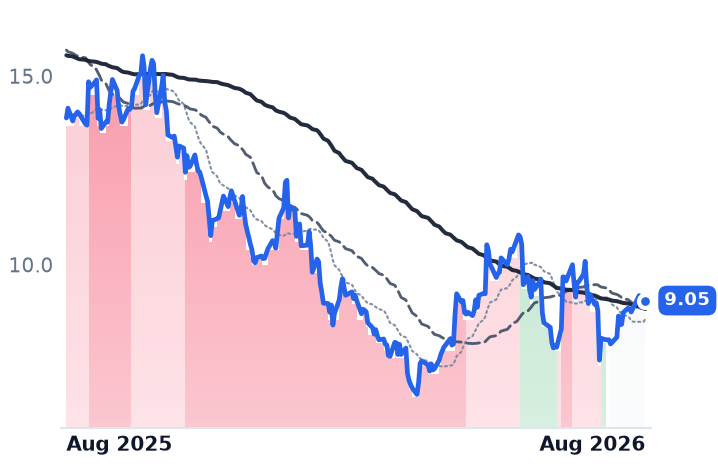
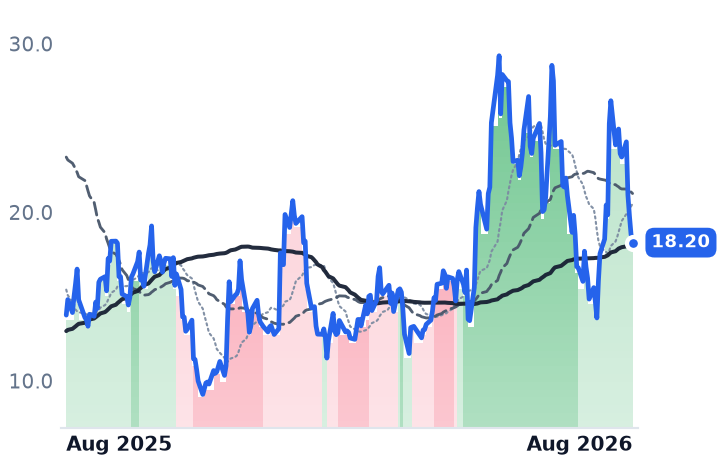
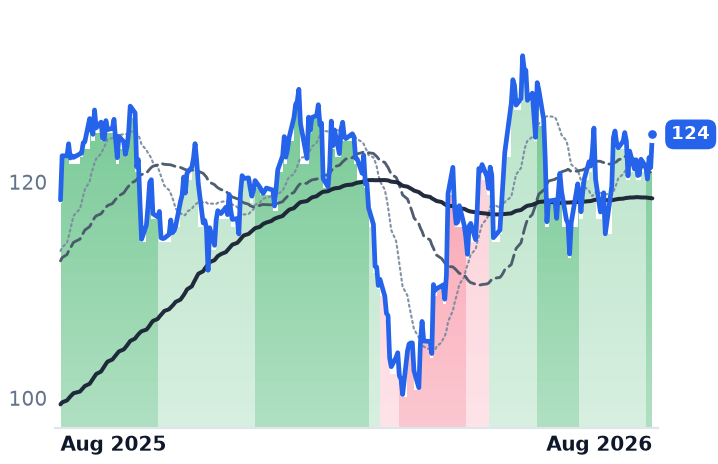
12-month price & trend
| Ticker | Mkt cap | P/E | P/E fwd | P/S | P/S fwd | P/GP | P/GP fwd | EV/EBITDA | FCF yld |
|---|---|---|---|---|---|---|---|---|---|
HSAI | $2.8B | 37.6x | — | 5.6x | — | 13.7x | — | 38.0x | 0.0% |
MBLY | $7.4B | n/m | 18.4x | 3.7x | 3.7x | 7.7x | 7.8x | n/m | 5.3% |
AEVA | $1.2B | n/m | — | 57.4x | 39.5x | 210.9x | 144.9x | 16.5x | -9.4% |
| Ticker | Mkt cap | P/E | P/E fwd | P/S | P/S fwd | P/GP | P/GP fwd | EV/EBITDA | FCF yld |
|---|---|---|---|---|---|---|---|---|---|
ALV | $9.2B | 14.7x | 12.4x | 0.8x | 0.8x | 4.3x | 4.3x | 8.4x | 8.2% |
PONY | $2.9B | n/m | — | 32.4x | 21.8x | 206.1x | 138.4x | n/m | -7.1% |
OUST | $2.2B | n/m | — | 12.0x | 10.1x | 24.4x | 20.5x | n/m | -3.1% |
| Ticker | Mkt cap | P/E | P/E fwd | P/S | P/S fwd | P/GP | P/GP fwd | EV/EBITDA | FCF yld |
|---|---|---|---|---|---|---|---|---|---|
APTV | $11.5B | 31.8x | 8.6x | 0.6x | 0.8x | 2.9x | 4.2x | 8.2x | 9.5% |
Consensus projections
| Ticker | FY2026E | FY2027E | FY2028E | |
|---|---|---|---|---|
HSAI | Revenue | +38.6% | +40.0% | +30.9% |
| EPS | +20.2% | +80.4% | +41.6% | |
MBLY | Revenue | +6.3% | +9.5% | +22.5% |
| EPS | +37.4% | +2.4% | +39.5% | |
AEVA | Revenue | +88.6% | +125.4% | +193.5% |
| EPS | −13.9% | +4.0% | −34.5% | |
ALV | Revenue | +3.1% | +2.9% | +3.7% |
| EPS | +5.4% | +18.1% | +13.8% | |
PONY | Revenue | +54.0% | +119.4% | +132.0% |
| EPS | +40.7% | −3.6% | −40.1% | |
OUST | Revenue | +48.9% | +36.4% | +34.1% |
| EPS | −19.1% | −76.5% | −2236.4% | |
APTV | Revenue | −30.4% | −3.7% | +6.2% |
| EPS | −5.1% | +8.5% | +14.1% |
Forward fiscal years only. Blank means no analyst coverage for that year.
A Chinese sensor maker sold more than 628,000 automotive laser scanners in the three months to June, close to twice the year-earlier count. The revenue it collected for them rose by roughly a fifth. That gap — units compounding, price collapsing — is the single most important fact in autonomous-driving hardware right now, and the market spent the past month paying up for it.
Hesai Group, a Shanghai-based maker of three-dimensional lidar sold to carmakers, robotaxi fleets and warehouse-robot builders, is the reason its corner of the auto-parts market rose over the past 30 days. Equal-weighting the four listed suppliers in advanced safety and autonomy gives a gain of 10.7% from 22 July; Hesai's 26.7% supplies about 6.7 points of it. Autoliv, the Stockholm airbag and seatbelt maker that sells no perception content at all, contributed roughly one. The move is not a passive-safety artifact. It is one company.
The price cut is the strategy
Hesai's June-quarter shipments split into more than 485,000 units for driver-assistance systems, up about 60%, and 142,000 for robotics, up 193%. Revenue rose 21.9% to CN¥860.8m with gross margin down to 40.1% from 42.5%. Gross profit grew 14.6%, well behind sales. Operating income has been negative for two consecutive quarters after running at a 9.7% margin last September; net income stayed positive on non-operating items, which is what the fifth-straight-profitable-quarter framing rests on.
None of this is accidental. Hesai plans to roughly halve the price of its main sensor, pricing the next-generation ATX below $200 against about $400 for today's AT128, betting in-house chips and factory automation make the cut pay. Management's counter-argument is content per car rather than price per unit: Li Auto fits four Hesai units to its L6, L8 and L9, taking sensor content toward $500-$1,000 on a vehicle listing near RMB 250,000. Hesai held 44% of China's long-range driver-assistance lidar market in June and has led for 17 straight months — but RoboSense has been added to Xiaomi's supply base, and its shipments show the same tilt away from cars toward robots. A May supply agreement with Mercedes-Benz, served from Thailand, is the one visible route out of the domestic price war.
On valuation the compression is real and it is not the market's doing this month: price per dollar of trailing gross profit has fallen from roughly 26.9x six months ago to 17.6x three months ago to about 13.9x now, while that gross profit still grew. Trailing earnings are 37.6x, and consensus for this year puts the forward figure near 38x once the renminbi estimates are converted. The shares fell 5.8% on the 18 August print — cost pressure, not upside.
Mobileye is the same trade in reverse
Mobileye, the Jerusalem-based, Intel-controlled supplier of EyeQ perception chips and the SuperVision and Chauffeur driving stacks, shipped 10m EyeQ units in the quarter, up 3% while its ten largest customers' own vehicle production fell 3%. It out-shipped its end market by eight points and still posted revenue of $508m, up 0.4%. Gross margin fell to 46.3% from 49.8%; gross profit declined 6.7%. Per the company's quarterly filing, EyeQ chips were about 90% of revenue and average selling prices fell on higher low-price China and Chinese-export volume. Third-quarter units are guided down 5-6%.
The stock fell about 15% on 23 July despite beating and raising, because founder-chief executive Amnon Shashua said he will step down once a successor is named; Mizuho cut its target to $8, below today's price. The raised profit outlook leans on a new research tax credit worth $180-200m this year, a benefit that roughly halves if Intel ceases to control the company. Against that, the shares sit at 7.75x trailing gross profit and 7.81x forward — no gross-profit growth priced — at 0.90x book after a $3.79bn goodwill write-down and a 5.3% free-cash-flow yield. A 2027 Stellantis program for cloud-enhanced highway assist carries more than twice base-driver-assistance gross profit per unit, but mix-driven price gains are a 2028 story.
The other two are not evidence
Aeva Technologies, a Mountain View developer of frequency-modulated lidar chips, jumped 44.6% over five sessions in early August because it launched an optical-connectivity business selling into AI data centers. The entire move reversed, 24.7% off between 17 and 21 August, in an AI-hardware selloff that also hit Ouster and Symbotic. On $6.1m of quarterly revenue it trades at 57.4x trailing sales with share count up 17.7% year on year. Autoliv, meanwhile, is the honest read on the end market: it cut its light-vehicle production assumption to -2.5% and China domestic to -5%, consistent with S&P Global Mobility's expectation that global output edges lower this year.
The month's one policy event was China's approval on 30 July of GB 44721-2026, its first mandatory safety standard for Level 3 and Level 4 automation, binding from 1 July 2027. The widely repeated claim that it mandates lidar is wrong — the text never names the technology, though its fallback-manoeuvre requirements push toward redundant sensing.
One technical note: Hesai's 50-day average only crossed above its 200-day on 28 July after months below it, and all three autonomy names remain lower over three months. This is a one-month turn inside a longer decline, and at Hesai the operating line is going the other way.
The setup
Where it stands — Hesai's shipments are compounding while price, margin and operating income fall; its shares have risen 26.7% in a month regardless. Would confirm — Q3 revenue of CN¥1.1-1.15bn on 800,000-850,000 units with gross margin holding near 40%. Would invalidate — A third straight quarter of negative operating income, or full-year shipments tracking below the 3m floor. Watch next — Hesai's third-quarter report, when management expects non-driver-assistance lidar to approach half of revenue. Valuation — Hesai at 13.9x trailing gross profit against 26.9x six months ago; Mobileye at 7.75x trailing versus 7.81x forward.