

Range Sells the Same Marcellus Rock as EQT and Gets $3.53 per Mcfe Against $2.65
Hypothesis Opus 5 · Research Opus 5 · Writing Opus 5 · Prompt v1.5
Three Appalachian gas producers trade as a single bet on the Henry Hub price. Their June-quarter results say they are not one business. Range Resources realized $3.53 per thousand cubic feet equivalent; EQT got $2.65 out of the same shale, and Expand Energy $2.42 per thousand cubic feet of gas. The gap is liquids — more than 30% of Range's output is ethane, propane and condensate priced off export docks rather than the domestic gas market. Range grew revenue 19.1% and widened operating margin to 39.1% from 26.8%, while both dry-gas names shrank on every line.
The shares fell together anyway, over three months and into August. What the market has not obviously priced is who captures a colder winter: EQT is essentially unhedged into 2027, Expand has already pre-sold 41% of next year's gas, and Range's hedges are struck above the current forward curve.
| Ticker | Company | Segment | Trend · 13mo | 30D | 1Y |
|---|---|---|---|---|---|
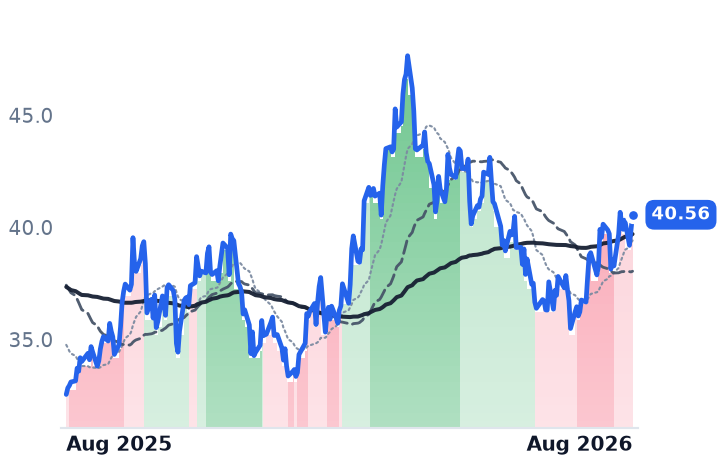
EQT | EQT | Appalachian Shale Gas | ⚠️ Emerging Bear | +9.7% | +7.1% |
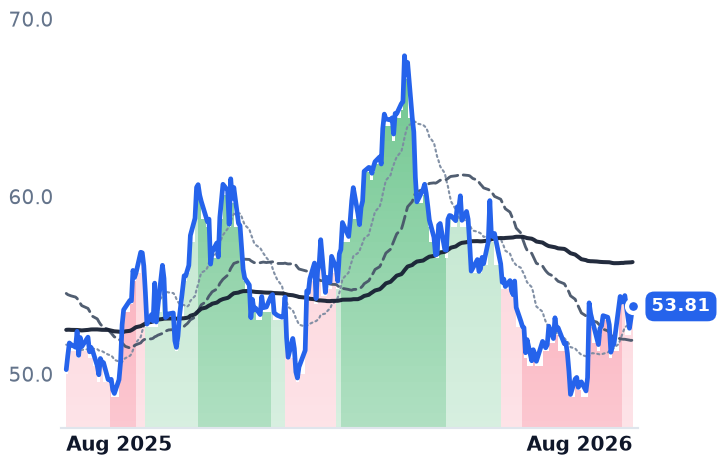
RRC | Range Resources | Appalachian Shale Gas | ⚠️ Emerging Bear | +10.6% | +24.6% |
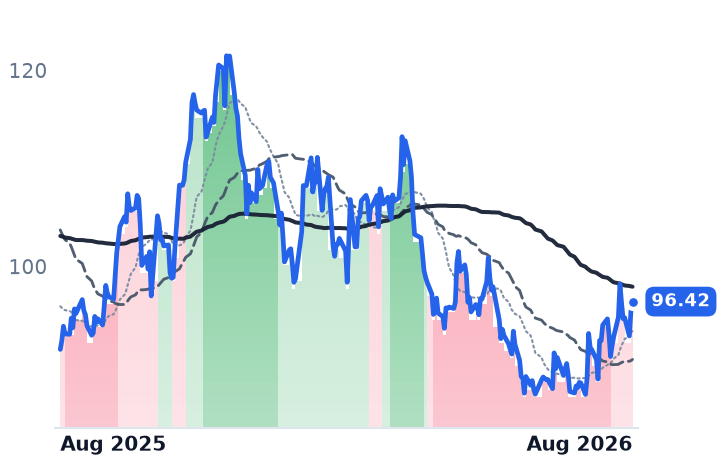
EXE | Expand Energy | Appalachian Shale Gas | ⚠️ Emerging Bear | +10.9% | +5.3% |
12-month price & trend
| Ticker | Mkt cap | P/E | P/E fwd | P/S | P/S fwd | P/GP | P/GP fwd | EV/EBITDA | FCF yld |
|---|---|---|---|---|---|---|---|---|---|
EQT | $33.5B | 11.8x | 12.7x | 3.6x | 3.5x | 5.3x | 5.2x | 6.3x | 11.2% |
RRC | $9.5B | 11.1x | 9.9x | 2.9x | 2.7x | 6.0x | 5.6x | 7.3x | 12.4% |
EXE | $22.3B | 8.2x | 10.5x | 1.7x | 1.6x | 2.6x | 2.6x | 3.8x | 11.4% |
Consensus projections
| Ticker | FY2026E | FY2027E | FY2028E | |
|---|---|---|---|---|
EQT | Revenue | +12.9% | −0.5% | +9.5% |
| EPS | +43.8% | −5.2% | +31.6% | |
RRC | Revenue | +17.7% | +2.8% | +7.2% |
| EPS | +41.8% | −3.5% | +16.8% | |
EXE | Revenue | +17.6% | −3.0% | +4.6% |
| EPS | +52.6% | −4.4% | +15.1% |
Forward fiscal years only. Blank means no analyst coverage for that year.
Range Resources, a Fort Worth company drilling the wet southwestern corner of Pennsylvania's Marcellus shale, does not sell the same product as its neighbors. About a third of what it lifts is ethane, propane, butane and condensate — molecules that leave the United States by ship rather than by pipeline. Its pre-hedge natural gas liquids (NGL) price in the June quarter was $29.10 a barrel, roughly $3.49 above the Mont Belvieu benchmark that normally sets Gulf Coast pricing, according to its second-quarter release. Management then raised full-year guidance to a $2.50 premium over that benchmark.
The premium is not a trading fluke. Waterborne ethane exports from the US averaged 658,000 barrels a day in the quarter, up 40% year over year, with a record near 750,000 barrels a day in June; propane and butane exports rose 30% to 2.6 million barrels a day. Dock capacity, not the domestic gas market, sets Range's marginal barrel, and its East Coast position prices into Europe. A further 360,000 barrels a day of liquefied petroleum gas export capacity is due in early 2027, alongside Range's own Repauno terminal capacity.
What the mix does to the income statement
Range's revenue grew 19.1% to $833.6m and operating income rose 73.9%, lifting operating margin to 39.1% from 26.8%. One caveat belongs beside that: net income fell 17.8% to $195.3m, because derivative marks below the operating line went the other way. The improvement is operational; the bottom line is not clean.
EQT, which produces from about 2.0 million gross acres and is the largest of the three at a $33.5bn market value, went the opposite way. Revenue fell 29.2% to $1.81bn and operating margin collapsed to 25.1% from 44.3%. Its execution was not the problem: it sold 634 billion cubic feet equivalent, above guidance, on capital spending of $666m, held unit operating costs to $1.03 per thousand cubic feet equivalent, and cut net debt to $5.5bn from $7.7bn at year-end. The Equitrans midstream acquisition shows up as that cost advantage rather than as a fee stream insulated from gas prices. Its one genuinely non-gas revenue mechanic — a 10-year, 325,000 dekatherm-a-day supply deal with CPV for a 2-gigawatt West Virginia data-center plant, priced off PJM power markets — does not start until as early as 2031.
Expand Energy, formed from the Chesapeake–Southwestern merger and holding the largest position in Louisiana's Haynesville shale that feeds Gulf Coast liquefied natural gas plants, realized $2.42 per thousand cubic feet, down 17.4%. Revenue fell 19.7% to $2.96bn. It carries the least debt relative to earnings, near 0.5 times, bought back $850m of stock in the quarter, and is adding a $1.25bn gas marketing business, Twin Eagle, to shave $0.15–$0.25 off a roughly $2.70 breakeven. It is also six months into a search for a permanent chief executive.
Who actually owns the winter
The suppressant is shared: working gas in storage reached 3,153 billion cubic feet in early August, 198 billion above the five-year average, and Appalachian basis widened, with the September TETCO M2 contract at a $0.95 discount. The December contract nonetheless trades above $4 per million British thermal units against a summer prompt near $2.80–$3.00, on an Energy Information Administration 2026 average estimate of about $3.67.
That premium accrues unevenly. Expand has hedged 41% of 2027 volumes. Range's 2027 book is 270,000 million British thermal units a day of swaps at $4.05 plus 80,000 in collars floored at $4.00 — about a fifth of gas volumes, struck above today's curve. EQT's disclosed 2027 position is summer collars alone, $3.00 puts against $4.51 calls. The most exposed name to a cold winter is the one whose quarter was worst.
All three fell over the three months to 19 August, bottomed on 21 July and have recovered roughly 8% since, without changing trend. Valuation does not follow the operating results. On trailing enterprise value to EBITDA, Expand is cheapest at 3.81 times, EQT sits at 6.30 and Range — the only one growing — is dearest at 7.33. Range is also the only one whose forward price/earnings multiple, 9.85 times, sits below its trailing 11.12, meaning analysts model earnings up; EQT's forward 12.66 against trailing 11.78 says the reverse. Free cash flow yields are within a point of each other, near 11–12%. The market has paid for part of Range's liquids premium and none of EQT's unhedged optionality.
The setup
Where it stands — Range's realizations and margins are improving on export-linked liquids while its shares track two shrinking dry-gas producers. Would confirm — Range holding an NGL premium at or above $2.50 a barrel over Mont Belvieu in the third quarter. Would invalidate — That premium turning negative as new export capacity slips, collapsing the realization gap toward EQT's $2.65. Watch next — Third-quarter results in late October, plus weekly storage prints against the 198 billion cubic foot surplus. Valuation — Range 7.33x trailing EV/EBITDA and 9.85x forward earnings against 11.12x trailing; EQT 6.30x and 12.66x forward.