

Okta's Multiple Rose 70% on 11% Growth. SailPoint Grew 43% and Got Cheaper
Hypothesis Opus 5 · Research Opus 5 · Writing Opus 5 · Prompt v1.5
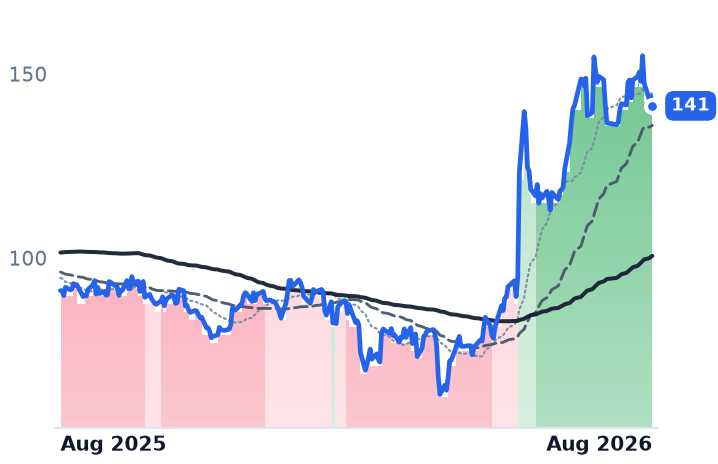
Okta reports fiscal second-quarter results on 26 August, and the guidance it already gave — $790m-794m, roughly 9% growth — would be the slowest of its public life. The market spent the summer paying far more for that slowing business: Okta's shares fetched 5.97 times trailing gross profit on 3 May and 10.29 times by late July, a re-rating of about 70% on growth that has not moved off 11%. Consensus price targets sit near $120, below the $141 quote.
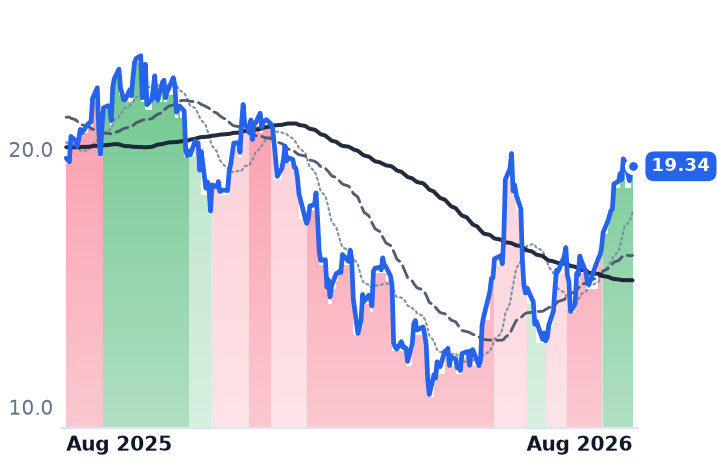
SailPoint, the identity-governance specialist Thoma Bravo returned to the market in February 2025, is the mirror image. Annual recurring revenue has grown about 43% since that listing, to $1.163bn, while the multiple paid on it has fallen roughly a third. Both sell identity software to the same buyers. Only one has been re-rated for it.
| Ticker | Company | Segment | Trend · 13mo | 30D | 1Y |
|---|---|---|---|---|---|
| The subject · what this brief is about | |||||
OKTA | Okta | Identity & Access Management | 🌱 Emerging Bull | −4.8% | +55.1% |
SAIL | SailPoint | Identity & Access Management | 🌱 Emerging Bull | +27.1% | −1.6% |
BB | BlackBerry | Identity & Access Management | 🌱 Emerging Bull | −4.4% | +130.7% |
| Compared against · context, not the story | |||||
PANW | Palo Alto Networks | Cybersecurity & Threat Protection | 🌱 Emerging Bull | +6.1% | +103.8% |
MSFT | Microsoft | Cloud Infrastructure & Platforms | 🔴 Cont. Bear | +19.7% | −5.0% |
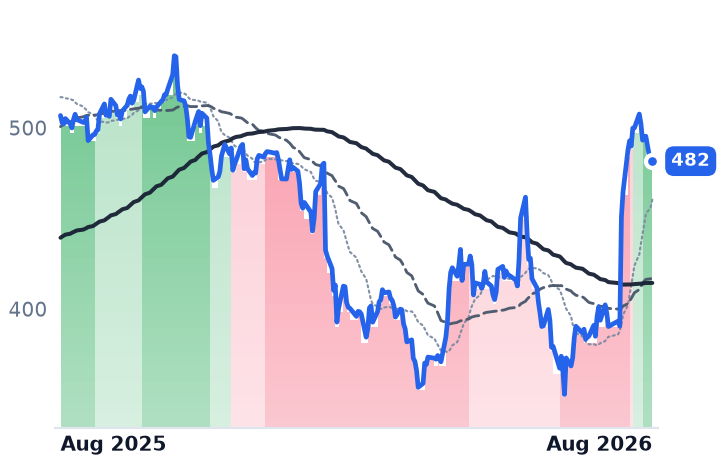
12-month price & trend
| Ticker | Mkt cap | P/E | P/E fwd | P/S | P/S fwd | P/GP | P/GP fwd | EV/EBITDA | FCF yld |
|---|---|---|---|---|---|---|---|---|---|
OKTA | $23.5B | 100.9x | 36.7x | 7.8x | 7.3x | 10.1x | 9.5x | 64.2x | 3.8% |
SAIL | $11.0B | n/m | — | 9.8x | — | 14.7x | — | 840.2x | 1.7% |
BB | $4.9B | 84.5x | 43.9x | 8.5x | 8.0x | 11.1x | 10.4x | 51.1x | 1.3% |
| Ticker | Mkt cap | P/E | P/E fwd | P/S | P/S fwd | P/GP | P/GP fwd | EV/EBITDA | FCF yld |
|---|---|---|---|---|---|---|---|---|---|
PANW | $313.2B | 322.9x | 93.4x | 29.5x | 22.6x | 41.0x | 31.5x | 137.3x | 1.4% |
MSFT | $3.7T | 27.5x | 25.2x | 11.1x | 9.4x | 16.3x | 13.9x | 18.2x | 1.8% |
Consensus projections
| Ticker | FY2026E | FY2027E | FY2028E | |
|---|---|---|---|---|
OKTA | Revenue | +12.0% | +10.0% | +9.5% |
| EPS | +24.3% | +11.7% | +10.8% | |
BB | Revenue | +0.2% | +15.1% | +10.4% |
| EPS | +1183.3% | +29.8% | +20.2% | |
PANW | Revenue | +24.3% | +21.1% | +14.1% |
| EPS | +15.3% | +9.0% | +17.6% | |
MSFT | Revenue | +18.0% | +18.2% | +19.6% |
| EPS | +26.7% | +15.4% | +18.5% |
Forward fiscal years only. Blank means no analyst coverage for that year.
Okta reports fiscal second-quarter results after the close on 26 August, seven days from now, and management has already told the market what to expect: revenue of $790m-794m for the quarter ended 31 July. That is about 9% growth, a step down from the 11.2% it reported in the quarter before. The share price has moved in the opposite direction from the growth rate all year.
The login layer, priced per head
Okta sells the corporate front door — single sign-on, multi-factor authentication, a central user directory — plus Auth0, the developer-facing customer-identity business it bought in 2021. The moat is switching cost rather than technology: moving off Okta means re-plumbing authentication for every application and migrating a user directory with no downtime, a one-to-two-year project most chief information officers will not start. Its neutrality across clouds is what keeps it alive against Microsoft's Entra ID, which arrives bundled inside Microsoft 365 enterprise licences at roughly $6-9 per user per month and is the single largest threat to the franchise.
The first quarter was a good one. Revenue reached $765m and current remaining performance obligations rose 12% to $2.499bn, one point above reported growth — real, but not an inflection. Dollar-based net retention ticked from 106% to 107%. Newer products — identity governance, privileged access, and identity for autonomous AI agents — reached roughly a quarter of bookings and lift deal size about 40% when attached. Chief executive Todd McKinnon called demand for the agent products "bigger than anything we've ever seen". Margins agree: GAAP operating margin went from 5.7% to 7.3% year over year, and free cash flow is guided to $855-885m for the year.
What has not happened is reacceleration. Annual growth has fallen four years running — 42.9%, 21.8%, 15.3%, 11.8% — and consensus models 10.0% this year and 9.5% next. The re-rating happened anyway. Okta fetched 5.97 times trailing gross profit on 3 May and 10.29 times by 29 July; the forward figure is 9.47 times, and forward earnings 36.7 times against roughly 11% earnings growth. Of the 55% twelve-month gain, two sessions around the May print — up 30.1% and 13.4% — supply about 86%. The stock has gained 1.1% since 1 June and slipped 4.8% in the past month. Thirty-one analysts rate it buy, and their mean target of $120 sits 15% under the quote.
The one that got cheaper
SailPoint governs who may access what — the audit-and-entitlement layer above the login — and is the leader in that niche. Its first quarter put annual recurring revenue at $1.163bn, up 26%, with the SaaS portion up 36% and adjusted operating margin 3.3 points wider. Customers above $1m of recurring revenue grew 32%. The stock still fell 11.5% on 9 June, because full-year guidance stepped growth down to 21-22% from 28% delivered.
It is not levered — the term loans were repaid at the IPO — but Thoma Bravo still owns the large majority of it, which caps how much any re-rating can run. On about $11bn of market value, SailPoint trades near 9.4 times recurring revenue, against roughly 14 times at the February 2025 listing on $813m of it. The business is 43% bigger and the multiple a third smaller. Over twelve months the shares are down 1.6%; the 27% gain of the past month came across fifteen unremarkable sessions after it shipped a merged human-and-agent control plane, with second-quarter results due 9 September.
The third name isn't in this business
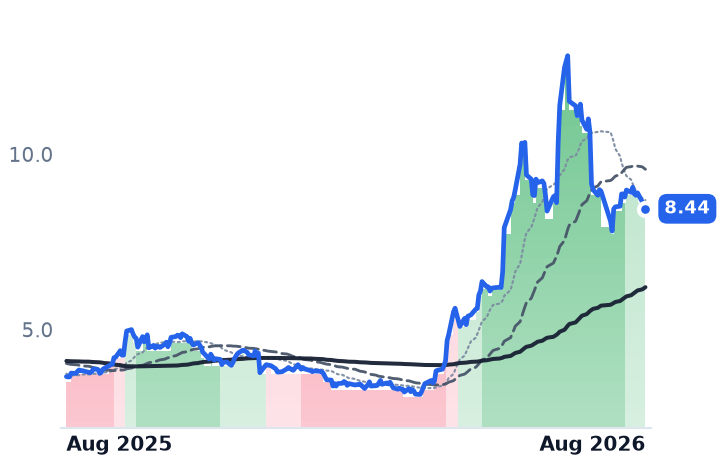
BlackBerry is grouped with them and sells no identity software. Its revenue is QNX, the real-time operating system embedded in cars, plus secure government communications; royalties recognise as vehicles ship, and the QNX backlog is near $950m. The turn is real — revenue up 25.6% and operating margin from 1.6% to 10.1% — but it comes off a base that shrank 29.5% two years ago, and at 43.9 times forward earnings it is dearer than Okta on every line. Its 131% year rests on three gap sessions, and the uptrend broke on 6 August.
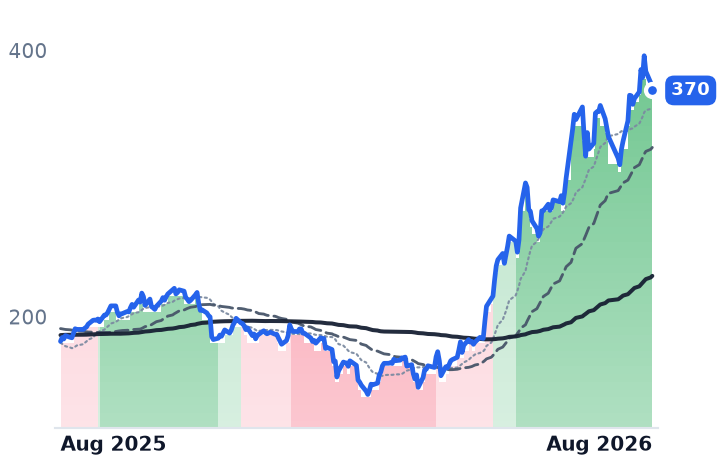
The force underneath all three is a change in the billing unit. Per-seat identity is capped by headcount; governance, privileged access and agent identity are billed per identity, and machine identities already outnumber humans by dozens to one. That is why Palo Alto Networks closed its $25bn purchase of CyberArk in February. The prize is real. Okta's price now assumes it wins the prize; SailPoint's assumes it does not.
The setup
Where it stands — Okta has been re-rated about 70% on gross profit without a change in growth; SailPoint's multiple compressed while its recurring revenue grew 43%. Would confirm — Okta guiding fiscal Q3 revenue growth near 9% on 26 August with net retention flat at 107%. Would invalidate — Okta's cRPO growth stepping into the mid-teens, running several points clear of reported revenue. Watch next — Okta reports 26 August; SailPoint reports fiscal Q2 on 9 September with annual recurring revenue guided to $1.22bn. Valuation — Okta: 36.7x forward earnings, 9.47x forward gross profit, versus 5.97x gross profit on 3 May. SailPoint: 9.4x recurring revenue versus 14x at listing.