

Emerson's Power Orders Grew 37% While Rockwell Just Got Back to Pre-COVID Volumes
Hypothesis Opus 5 · Research Opus 5 · Writing Opus 5 · Prompt v1.5
Three companies automate the physical world, and only one of them is being paid by the electricity buildout. Emerson Electric, a process-control group long treated as an oil-and-gas cyclical, reported orders from power customers up 37% and from semiconductor customers up 53% in its June quarter, lifted its project funnel by $1.2bn to $12.4bn, and raised full-year guidance. Rockwell Automation raised guidance too, on 10% organic growth, yet told investors it is "only getting back to pre-COVID controller unit volumes" — a factory-floor cycle that has finished healing rather than started booming, and its services book-to-bill was 0.97. Symbotic's warehouse robotics business is improving fastest of the three — gross margin has gone from 16.6% to 22.3% in six quarters — and its shares fell 16% in one session when Walmart's store rollout slipped to 2028. Emerson is the one leading; the other two are waiting on schedules.
| Ticker | Company | Segment | Trend · 13mo | 30D | 1Y |
|---|---|---|---|---|---|
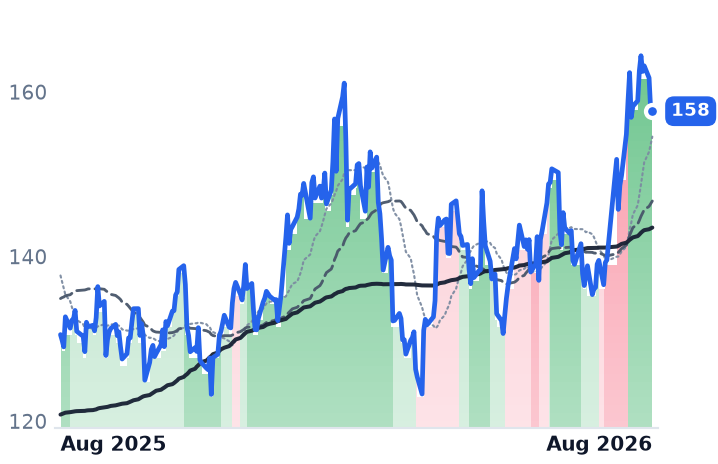
EMR | Emerson Electric | Industrial Automation & Controls | 🟢 Cont. Bull | +15.4% | +20.8% |
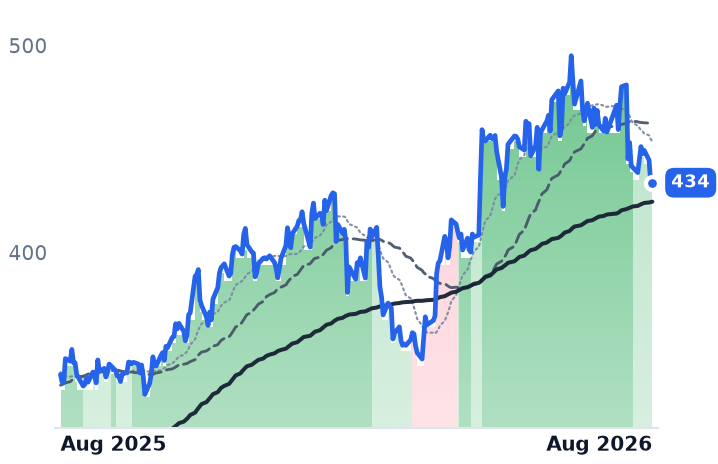
ROK | Rockwell Automation | Industrial Automation & Controls | 🟢 Cont. Bull | −5.5% | +27.2% |
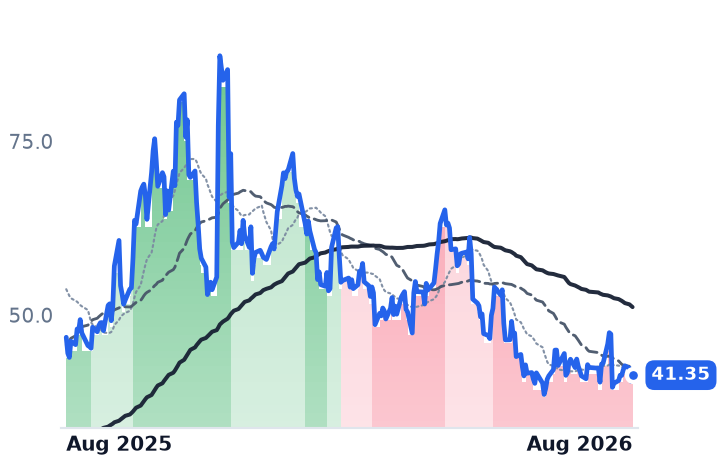
SYM | Symbotic | Industrial Automation & Controls | ⚠️ Emerging Bear | +1.3% | −11.6% |
12-month price & trend
| Ticker | Mkt cap | P/E | P/E fwd | P/S | P/S fwd | P/GP | P/GP fwd | EV/EBITDA | FCF yld |
|---|---|---|---|---|---|---|---|---|---|
EMR | $88.3B | 34.3x | 24.1x | 4.7x | 4.7x | 8.9x | 8.8x | 19.4x | 3.9% |
ROK | $48.2B | 40.5x | 32.8x | 5.4x | 5.3x | 9.9x | 9.8x | 28.9x | 3.1% |
SYM | $27.0B | 438.6x | 77.3x | 10.2x | 9.6x | 47.2x | 44.5x | 416.5x | 2.7% |
Consensus projections
| Ticker | FY2026E | FY2027E | FY2028E | |
|---|---|---|---|---|
EMR | Revenue | +4.4% | +5.5% | +5.3% |
| EPS | +9.0% | +10.7% | +11.1% | |
ROK | Revenue | +10.0% | +5.5% | +6.4% |
| EPS | +31.4% | +12.1% | +12.0% | |
SYM | Revenue | +25.7% | +29.1% | +23.6% |
| EPS | +123.9% | +54.0% | −2.4% |
Forward fiscal years only. Blank means no analyst coverage for that year.
Emerson Electric sells the instruments, valves and control software that keep refineries, liquefied natural gas (LNG) trains and generating stations running. For most of its 136 years that made it a bet on hydrocarbons. Its fiscal third quarter, reported on 4 August, described a different customer.
Underlying orders across the company grew 7%. Inside that number, what management calls its growth verticals grew 27%, led by power orders up 37% and semiconductor orders up 53%. Orders for Ovation, Emerson's distributed control system, rose 31%, and its backlog now stretches into late 2027 and early 2028.
Why the electricity build hits Emerson first
A control system is not a commodity purchase. Ovation and its sister platform DeltaV are embedded in gas plants, pipelines and much of the legacy American nuclear fleet, and replacing one means re-engineering and re-validating the plant. That entrenchment is why new generating capacity converts almost mechanically into Emerson content. Management pointed to fleet modernizations and behind-the-meter data-center opportunities as the source of the power growth, with cybersecurity rules pulling forward retrofit cycles at critical infrastructure. Named wins in the quarter included a 2.1 gigawatt power retrofit for Mexico's CFE and pressurizer valves for a 2.4 gigawatt reactor in China.
The project funnel — work identified but not yet booked — grew $1.2bn in three months to $12.4bn, of which roughly $3bn is power and $2.2bn LNG, most of it greenfield. Backlog reached $8.2bn, up 7%. Revenue growth accelerated through the year, from 4.1% in the first quarter to 7.0% in the third, and gross margin widened to 54.5% from 52.6%. Free cash flow was $1.3bn, up 36%. Emerson raised its full-year outlook to adjusted earnings of $6.55 a share.
Two cautions. The strength is American: sales rose 10% in the United States while Europe fell 1% and China fell 3%. And a Middle East disruption cost roughly $25m of sales in the quarter, with about $100m expected for the year.
The factory floor is only level again
Rockwell Automation sells the programmable controllers, drives and FactoryTalk software that run discrete manufacturing lines, through independent distributors. Its quarter was operationally excellent: revenue of $2.31bn, gross margin of 49.5% against 40.9% a year earlier, and operating income up 68.6%. It lifted full-year organic growth guidance to a 7.5%-9.5% range and earnings to a $13.15 midpoint.
The qualification came from management itself, which described the company as only now getting back to pre-COVID controller unit volumes. The destocking that followed the pandemic has unwound; a new upcycle has not obviously begun. Lifecycle Services, the project and services arm, shrank 2% organically with a book-to-bill of 0.97, and food and beverage capital spending has yet to inflect. E-commerce and warehouse orders, up 30%, are the exception rather than the base. The shares fell 7.4% on the day of the print.
Symbotic's business improved; its schedule slipped
Symbotic builds entire automated warehouse modules — robots, software and structure — for retail and wholesale distributors, with Walmart still dominant among them. Its numbers are improving fastest of the three: revenue of $720.8m grew 21.7% while gross profit grew 49.5%, gross margin has widened from 16.6% to 22.3% over six quarters, and the operating line swung from a $20.2m loss to $32.9m of income.
The shares fell 16.2% the morning after, on 6 August. The reason was time, not demand: conversion of the 400-store Walmart back-of-store contract is not expected until early 2028 and is not in backlog, and of the $22.5bn contracted backlog only about 15% converts to revenue within twelve months. The GreenBox joint venture's Lathrop site is built but still 60 to 90 days from going live.
What the prices already assume
Symbotic trades at 47.2x trailing gross profit — the fair lens here, because gross margins run from 22% to 55% across the three and its price-to-earnings ratio is a meaningless 438x. Rockwell sits at 9.85x that measure and Emerson at 8.91x. Symbotic's own multiple was near 68x in February, when trailing gross profit was about a tenth lower, so the multiple did the falling, not the business.
Emerson carries the widest gap between what it has earned and what it is expected to earn: 34.3x trailing against 24.1x forward, with enterprise value at 19.4x EBITDA and a trailing free cash flow yield of 3.9%. Rockwell's trailing multiple has come down from 45.3x in May to 40.5x, and to 32.8x forward — compression delivered by earnings growth near 25% rather than by a falling share price.
The shares have followed the order books, with a lag. Emerson's 50-day average crossed above its 200-day on its earnings day and it closed at a 52-week high of $164.40 on 12 August. Rockwell's uptrend weakened on 7 August. Symbotic's 50-day has sat below its 200-day since 21 May, though the stock is marginally higher over the past month, its damage done between February and July.
The setup
Where it stands — Emerson is being re-rated on power and semiconductor orders; Rockwell and Symbotic are executing well but waiting on customer schedules. Would confirm — Emerson's fourth-quarter power orders growing at a double-digit rate again, with the project funnel above $12.4bn. Would invalidate — Emerson book-to-bill falling below 1.0, or backlog slipping from $8.2bn. Watch next — Emerson's fiscal fourth-quarter results in early November, guiding fiscal 2027 against $6.55 of adjusted 2026 earnings. Valuation — Emerson at 34.3x trailing and 24.1x forward earnings, against Rockwell's 40.5x and 32.8x.