

Twilio and Bandwidth Both Grew 22%. Only Twilio's Gross Profit Followed
Hypothesis Opus 5 · Research Opus 5 · Writing Opus 5 · Prompt v1.5
Two cloud-communications companies reported June quarters that looked identical at the top line and nothing alike underneath. Twilio and Bandwidth each grew revenue about 22%. Twilio's gross profit rose 20.4%; Bandwidth's rose 9.6%.
The gap is carrier economics. American mobile operators raised the per-message fees they charge on automated text traffic in January, and both companies bill those fees straight through at no markup — revenue in, no profit. At Twilio the effect is cosmetic: organic growth ran 17% and management raised full-year organic guidance to 13-13.5% from 9.5-10.5%. At Bandwidth it is the story: its core cloud communications line grew 12% while pass-through surcharges grew 54%, and gross margin fell 4.1 points to 35.7%.
Bandwidth fell 29% in a single session on the news. Twilio is the one still compounding gross profit — at nearly double the multiple it carried in February.
| Ticker | Company | Segment | Trend · 13mo | 30D | 1Y |
|---|---|---|---|---|---|
| The subject · what this brief is about | |||||
TWLO | Twilio | Communications & Messaging Platforms | 🟢 Cont. Bull | +8.1% | +114.7% |
BAND | Bandwidth | Communications & Messaging Platforms | 🌱 Emerging Bull | −23.9% | +266.0% |
| Compared against · context, not the story | |||||
CRM | Salesforce | Customer Experience & CRM | 🔴 Cont. Bear | +18.6% | −15.7% |
VG | Venture Global | LNG Export & Infrastructure | 🌱 Emerging Bull | −3.3% | +13.4% |
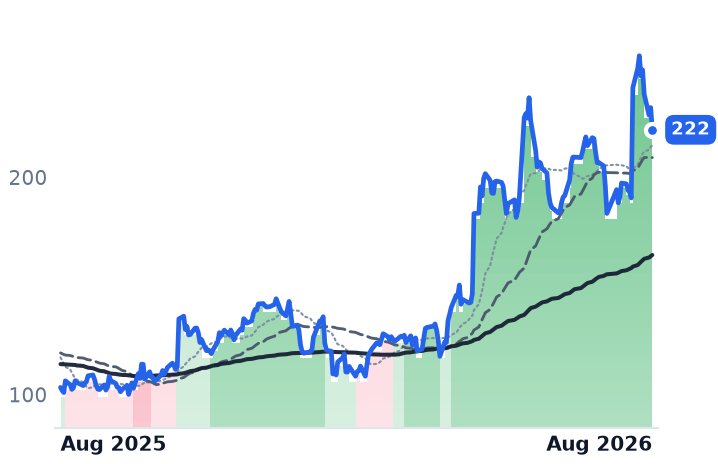
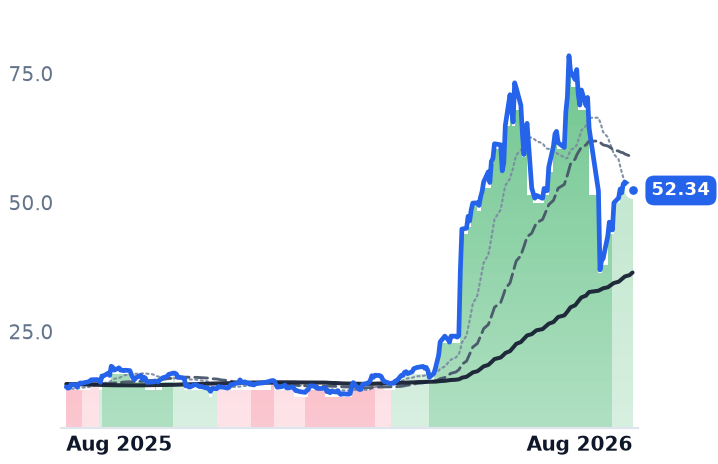
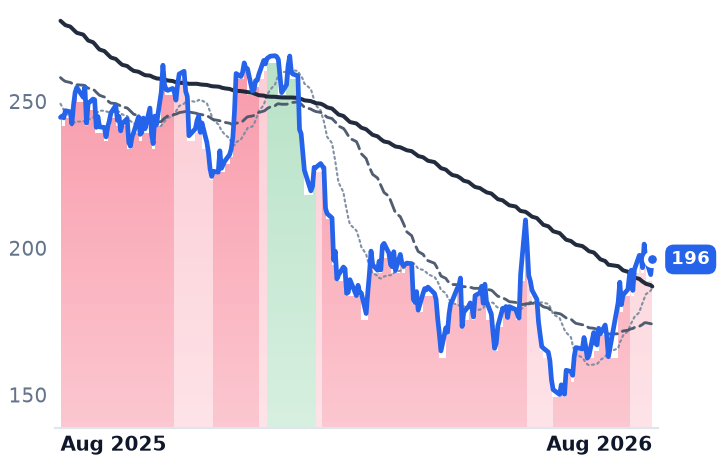
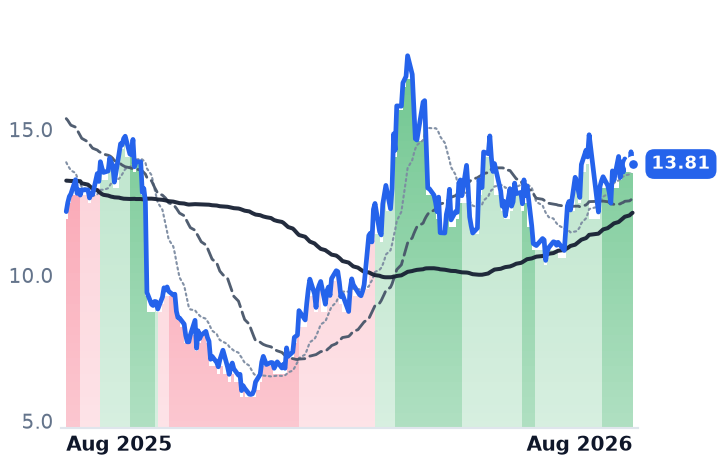
12-month price & trend
| Ticker | Mkt cap | P/E | P/E fwd | P/S | P/S fwd | P/GP | P/GP fwd | EV/EBITDA | FCF yld |
|---|---|---|---|---|---|---|---|---|---|
TWLO | $33.7B | 29.5x | 38.8x | 6.0x | 5.8x | 12.5x | 11.9x | 92.5x | 3.3% |
BAND | $1.7B | n/m | 29.9x | 2.0x | 1.9x | 5.5x | 5.0x | — | 4.3% |
CRM | $160.7B | 22.6x | 13.9x | 3.8x | 3.5x | 4.8x | 4.5x | 13.8x | 9.1% |
| Ticker | Mkt cap | P/E | P/E fwd | P/S | P/S fwd | P/GP | P/GP fwd | EV/EBITDA | FCF yld |
|---|---|---|---|---|---|---|---|---|---|
VG | $34.2B | 10.3x | 9.2x | 2.0x | 1.9x | 4.2x | 3.9x | 4.4x | -27.5% |
Consensus projections
| Ticker | FY2026E | FY2027E | FY2028E | |
|---|---|---|---|---|
TWLO | Revenue | +16.0% | +10.1% | +10.4% |
| EPS | +19.1% | +16.3% | +15.7% | |
BAND | Revenue | +20.0% | +4.0% | +19.3% |
| EPS | +22.0% | +8.3% | +36.1% | |
CRM | Revenue | +9.3% | +11.1% | +9.4% |
| EPS | +17.4% | +20.2% | +10.4% | |
VG | Revenue | +33.3% | −12.6% | +29.6% |
| EPS | +83.8% | −52.8% | +75.1% |
Forward fiscal years only. Blank means no analyst coverage for that year.
Two cloud-communications companies reported June quarters days apart, and both put up revenue growth of roughly 22%. Only one of them grew gross profit at anything close to that rate. The difference is not execution in the ordinary sense. It is a decision by American mobile carriers, made in January, that flows through both income statements the same way and lands very differently depending on what the business underneath is actually doing.
The fee that inflates revenue and nothing else
Twilio, whose programming interfaces let software developers embed text messages, phone calls and email inside their own applications and bills them by the message and the minute, reported revenue of $1.5bn, up 22% reported and 17% organic. Bandwidth, a smaller rival that owns the carrier network its traffic runs across and sells voice and messaging to large enterprises and contact centers, reported $220m, up 22%. Twilio's gross profit rose 20.4% to $725.9m. Bandwidth's rose 9.6% to $78.5m.
The mechanism is application-to-person (A2P) messaging surcharges — per-message fees the carriers levy on automated text traffic. T-Mobile raised them effective 19 January 2026 across short code, 10-digit long code and toll-free routes. Providers collect the money and hand it on. Revenue rises, dollar gross profit does not, and reported gross margin falls. Bandwidth's quarterly filing puts the arithmetic plainly: first-half cost of revenue rose $61m, of which $41m was higher pass-through messaging surcharges. Twilio's carrier fees were $71m in the quarter and are running toward $250m for the year.
At Twilio, optical. At Bandwidth, structural.
Strip the fees out and Twilio's non-GAAP gross margin was up 60 basis points year on year rather than down 160. Its reported GAAP gross margin slipped only 65 basis points. Dollar-based net expansion — what existing customers spend this year against last — reached 116%, and customers spending over $1m grew more than 20%. Operating income more than doubled, to $84.5m from $37.0m. Management raised full-year organic growth guidance to 13-13.5% from 9.5-10.5%.
Bandwidth's core did not keep pace. Cloud communications revenue grew 12% while the surcharges grew 54%. Voice, its largest line, was $121m and grew 9%; management attributed the slowdown to customer deployment timing. Gross margin fell to 35.7% from 39.8%, and has declined every quarter since 41.0% in early 2025. The company remains unprofitable on a GAAP basis, with a $4.6m operating loss in the quarter. Consensus has 2026 revenue growing 20% and 2027 growing 4% — the Street is modeling this year's surge as largely non-repeating.
What each one owns
Twilio held 26.2% of global revenue in communications-platform-as-a-service (CPaaS) in late 2025, ahead of Sinch at 12%. Its defensible asset is direct carrier interconnection across 180-plus countries, built over fifteen years, and no single customer exceeds 10% of revenue. It has positioned frontier model vendors as distribution rather than threat, shipping a native integration with OpenAI's Realtime API. Management cited one artificial-intelligence customer that went from $200,000 to $9m of annual recurring revenue in five quarters.
Bandwidth's asset is the owned network, which won it the communications layer inside Salesforce's Agentforce Contact Center. Its software services ARR rose to $25m from $15m at year-end — real, growing fast, and under 3% of the $900m of revenue guided for this year. Net retention was 107%, with record revenue per customer of $256,000.
The shares agreed, violently
Bandwidth fell 18.8% on 28 July and a further 29.3% the next day, 42.6% across the two sessions around its report. Remove those two days and it would be up roughly 32% over the past month. Twilio gapped 26.6% higher on 7 August; remove that one session and it would be down about 15%. Neither chart is a gradual drift — both are single verdicts on guidance. Twilio's 50-day average has sat above its 200-day since mid-April; Bandwidth's crossed back down on 6 August.
Gross profit is the honest yardstick here, because Twilio's 29.5x trailing earnings multiple is distorted by a $1.07bn one-off gain and Bandwidth barely earns a GAAP profit at all. Twilio trades at 12.45x trailing and 11.91x forward gross profit, against roughly 6.8x in February — the multiple nearly doubled in six months while the business improved considerably less than that. Bandwidth sits at 5.46x trailing and 4.99x forward, down from about 7.2x at its July high but still more than three times its February level, on gross profit growing under 10%. Twilio guides third-quarter organic growth down to 11-12%.
The setup
Where it stands — Twilio is converting its revenue growth into gross profit; Bandwidth's June quarter showed it is not, and its shares repriced accordingly.
Would confirm — Bandwidth's cloud communications growth staying near 12% or below while surcharge revenue keeps outpacing it.
Would invalidate — Bandwidth gross margin recovering toward 39% with voice reaccelerating above 15% in the September quarter.
Watch next — Third-quarter results: Twilio has guided organic growth to 11-12%, Bandwidth to second-half growth slightly below the first half.
Valuation — Twilio 12.45x trailing / 11.91x forward gross profit versus about 6.8x in February; Bandwidth 5.46x / 4.99x versus about 1.6x.