

Rambus's Record Quarter Came From Memory Channels, Not the CXL Pooling It Doesn't Sell
Hypothesis Opus 5 · Research Opus 5 · Writing Opus 5 · Prompt v1.5
Four chipmakers filed together under memory disaggregation share a label but not a business, and the label is wrong about the biggest one. Rambus, whose interface chips sit on server memory modules, told investors on July 27 that Compute Express Link — the standard for pooling DRAM across machines — "remains a fragmented ASIC market" and that it is licensing intellectual property rather than selling controllers. The only member with real disaggregation product revenue is Microchip, at roughly $1bn of data-center sales in fiscal 2026.
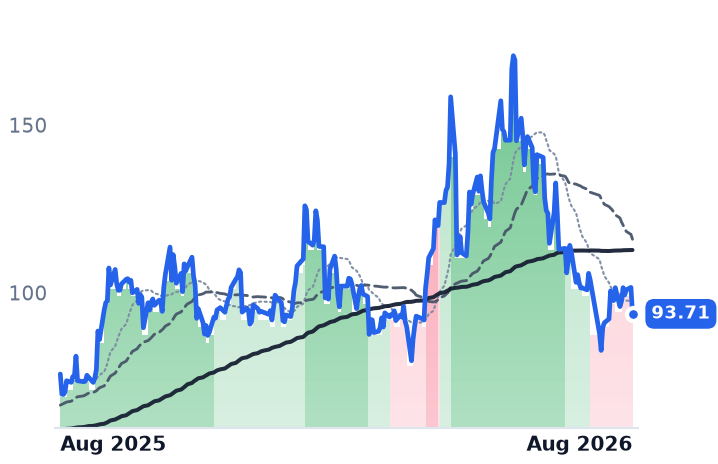
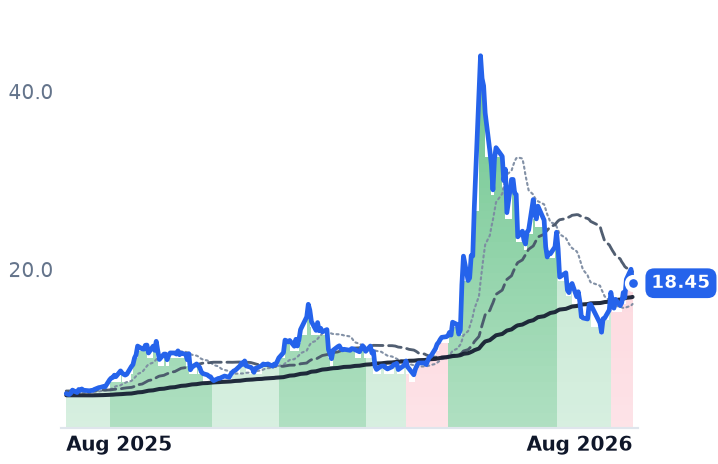
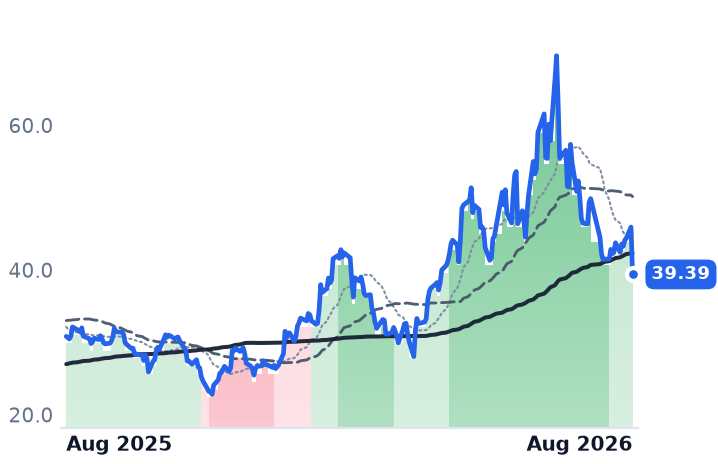
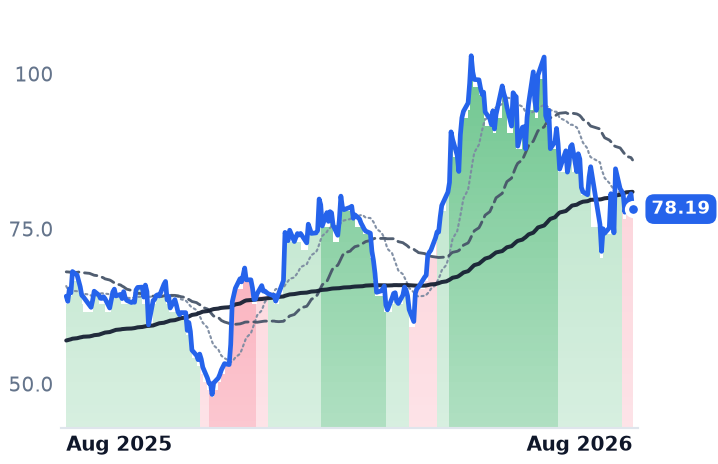
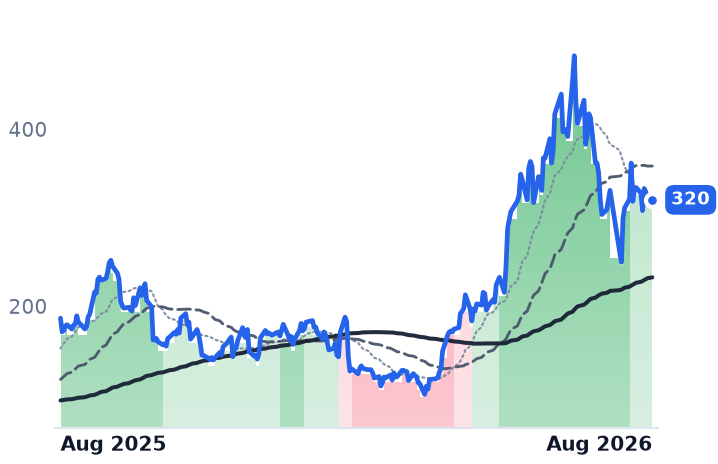
All four accelerated in their June quarters, with revenue growth of 20% to 42% and gross margin up at every one. All four also fell hard: each sits 24% to 58% below highs set in May and June. The group's apparent 9.7% month is Everspin alone, and two of its sessions carry it. Price-to-gross-profit compressed at all four since mid-May — Rambus from about 24.4x to 17.2x.
| Ticker | Company | Segment | Trend · 13mo | 30D | 1Y |
|---|---|---|---|---|---|
| The subject · what this brief is about | |||||
RMBS | Rambus | Interconnect & Storage IP | 🟢 Cont. Bull | −7.1% | +23.7% |
MRAM | Everspin Technologies | Memory (DRAM/NAND) | 🟢 Cont. Bull | +27.9% | +204.5% |
ALGM | Allegro MicroSystems | Other | 🟢 Cont. Bull | −15.0% | +27.8% |
MCHP | Microchip Technology Incorporated | Analog & Mixed-Signal | 🟢 Cont. Bull | −2.9% | +21.9% |
| Compared against · context, not the story | |||||
ALAB | Astera Labs | Specialty Semiconductors | 🟢 Cont. Bull | +3.6% | +71.7% |
MU | Micron Technology | Memory (DRAM/NAND) | 🟢 Cont. Bull | +19.1% | +735.4% |
SNDK | Sandisk | Specialty Manufacturing & Components | 🟢 Cont. Bull | +29.6% | +3860.8% |
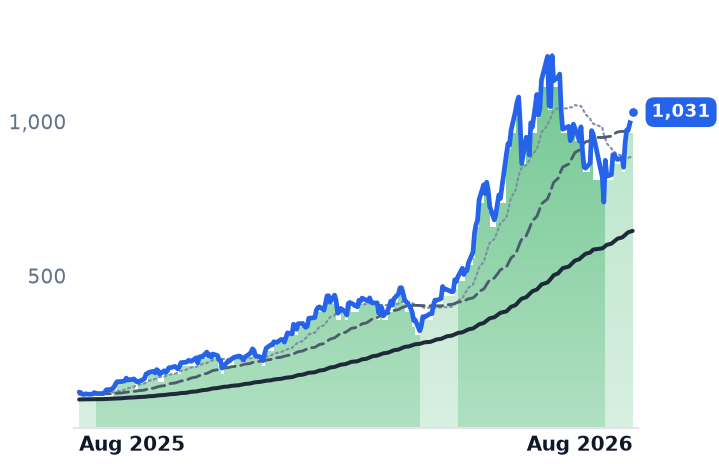
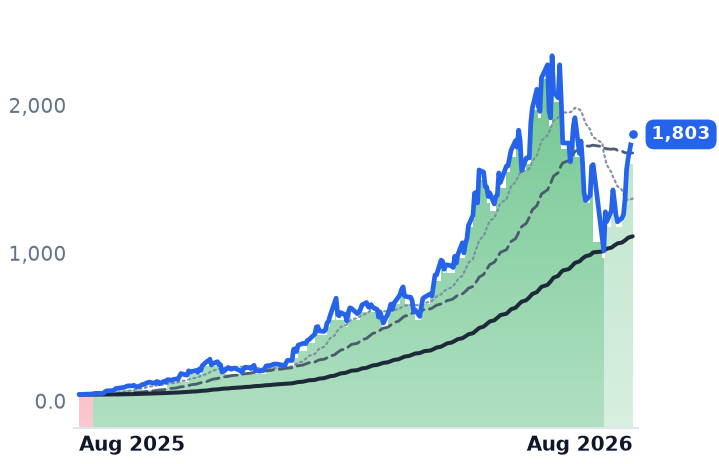
12-month price & trend
| Ticker | Mkt cap | P/E | P/E fwd | P/S | P/S fwd | P/GP | P/GP fwd | EV/EBITDA | FCF yld |
|---|---|---|---|---|---|---|---|---|---|
RMBS | $10.2B | 42.2x | 30.9x | 13.4x | 12.3x | 17.2x | 15.7x | 31.6x | 2.9% |
MRAM | $432.6M | n/m | — | 6.9x | 5.9x | 13.2x | 11.3x | 939.0x | -1.2% |
ALGM | $7.3B | 486.3x | 38.2x | 7.8x | 6.7x | 16.4x | 14.1x | 71.8x | 1.2% |
| Ticker | Mkt cap | P/E | P/E fwd | P/S | P/S fwd | P/GP | P/GP fwd | EV/EBITDA | FCF yld |
|---|---|---|---|---|---|---|---|---|---|
MCHP | $42.5B | 108.3x | 24.5x | 8.3x | 6.8x | 13.8x | 11.3x | 28.2x | 2.6% |
ALAB | $54.9B | 147.5x | 81.4x | 45.7x | 29.5x | 60.8x | 39.3x | 164.0x | 0.5% |
MU | $1.0T | 19.9x | 12.2x | 11.2x | 7.8x | 15.4x | 10.7x | 14.5x | 2.6% |
| Ticker | Mkt cap | P/E | P/E fwd | P/S | P/S fwd | P/GP | P/GP fwd | EV/EBITDA | FCF yld |
|---|---|---|---|---|---|---|---|---|---|
SNDK | $208.5B | 46.2x | 21.8x | 15.8x | 10.6x | 28.2x | 19.0x | 37.1x | 2.1% |
Consensus projections
| Ticker | FY2026E | FY2027E | FY2028E | |
|---|---|---|---|---|
RMBS | Revenue | +17.3% | +19.6% | +24.8% |
| EPS | +21.5% | +23.6% | +25.3% | |
MRAM | Revenue | +33.0% | +14.6% | +4.2% |
| EPS | +340.0% | −218.2% | +161.5% | |
ALGM | Revenue | +23.0% | +24.5% | +17.2% |
| EPS | +131.1% | +93.9% | +45.5% | |
MCHP | Revenue | +6.2% | +33.3% | +16.1% |
| EPS | +20.7% | +103.7% | +31.1% | |
ALAB | Revenue | +123.4% | +59.4% | +26.8% |
| EPS | +121.0% | +61.4% | +25.0% | |
MU | Revenue | +248.0% | +92.8% | +11.4% |
| EPS | +804.9% | +111.2% | +7.9% | |
SNDK | Revenue | +169.2% | +113.5% | +7.0% |
| EPS | +2283.0% | +167.8% | +5.6% |
Forward fiscal years only. Blank means no analyst coverage for that year.
Rambus makes the small chips that sit on a server memory module and keep signals clean at speed: register clock drivers (RCDs), power-management chips and serial-presence-detect hubs, sold to the module makers who assemble DIMMs. It also licenses the underlying memory-interface and security designs, a royalty stream that carries no cost of goods. On its July 27 call, management described Compute Express Link — the interconnect standard that lets processors reach pooled DRAM outside the server — as a "fragmented ASIC market," and said Rambus is doing enablement work for other people's chips rather than building CXL products of its own.
That matters because Rambus anchors a group of four semiconductor names grouped around memory disaggregation, and the growth it is actually reporting comes from somewhere else entirely. Server processors are adding memory channels: AMD is at 12 per socket, Intel is moving from 8 to 12, and the next generation goes to 16. Every channel populates another DIMM, and every DIMM needs another RCD and its companion chips. That is content per socket rising by arithmetic, not by architecture.
What each of the four actually sells
Rambus posted June-quarter revenue of $207.4m, up 20.4% year over year and accelerating from 8.1% in the prior quarter. Product revenue set a record at $99.2m, and third-quarter guidance puts product growth ahead of royalties. Gross margin reached 79.8%, against 74.9% a year earlier. Management said memory lead times are lengthening and expects tightness through 2027 — the consequence of DRAM makers reallocating wafers to high-bandwidth memory, which consumes roughly three times the wafer capacity per bit of standard DDR5.
Microchip, an embedded-control vendor selling microcontrollers, analog and interface parts, is the one member with disaggregation silicon that ships. Its data-center business reached about $1bn in fiscal 2026, up 69%, with 14 PCIe Generation 6 design wins — 12 switches and two retimers — entering production at the end of June. June-quarter revenue was $1.485bn, up 38%, with gross margin of 63.2% against 53.6% a year earlier.
Allegro MicroSystems makes magnetic sensor and analog power chips for cars and factories and has no memory-interface product at all. Its data-center exposure is current sensing in 800-volt direct-current racks. June-quarter revenue came in at $259m, up 27%, a sixth straight quarter of growth, with data center a record 17% of sales.
Everspin, a $433m Arizona maker of magnetoresistive memory for industrial, medical and defense sockets, grew 42% to a record $18.7m — but $3.4m was non-product revenue from a $40m, two-and-a-half-year subcontract with prime contractor Amentum under a U.S. government microelectronics program. Everspin still lost $4.4m at the operating line. Its CXL work is a September proof-of-concept demo and a memorandum of understanding with MaxLinear, with no revenue attached.
The month is one micro-cap and two sessions
From mid-July to August 17, Rambus was flat, Allegro fell 1.2% and Microchip fell 0.4%. Everspin rose 37.6%, and it carries the entire group. Strip its two best days — August 4 and August 14 — and its gain falls to 8.8%. The August 4 jump came the session before the earnings print, alongside a broad semiconductor rally; the print itself was sold, down 5.7% and then 4.7%. Everspin's twelve-month gain of 204% likewise dates to the April defense contract, which is worth roughly 72% of trailing annual revenue.
On a three-month view the group is down 22% equal-weight, and each name sits well below spring highs — Rambus 45% below its June 3 close, Everspin 58% below May. Three of the four have had their 50-day average slip below the 200-day since late July. Rambus fell about 20% after its record quarter despite beating consensus. The August 18 leg was macro: a semiconductor gauge fell 5.5% as Treasury yields pressed higher and a report of roughly $3trn in off-balance-sheet artificial-intelligence commitments circulated.
Cheaper on every lens that works
Gross margins here run from 48% to 80%, and two members have no usable earnings — Allegro's trailing price-to-earnings ratio of 486x is noise, Everspin's is negative. Price to gross profit is the comparable measure, and it compressed at all four since mid-May while trailing gross profit rose at all four:
- Rambus: about 24.4x → 17.2x trailing, 15.7x forward
- Everspin: about 26.3x → 13.2x
- Microchip: about 18.7x → 13.8x, 11.3x forward
- Allegro: about 18.6x → 16.4x
Astera Labs, which sells the standard and custom controllers that actually occupy the CXL socket and expects volume ramps at two U.S. hyperscalers in 2027, trades at 39.3x forward gross profit — roughly two and a half times Rambus.
The discount is not free. Rambus's blended margin dilutes as low-margin product outgrows the 100%-margin royalty annuity, and its RCD position is contested: the market is a three-way oligopoly with Montage and Renesas, and Renesas claimed the first sixth-generation part at the same 9,600 MT/s speed grade. Microchip's margin guide leans on lumpy licensing and a price increase management called "one and done." And the deployments the group's label describes are running elsewhere — Marvell's Structera parts are shipping and Meta has re-attached retired DDR4 over CXL as expansion memory in production.
The setup
Where it stands — Four accelerating businesses, one shared label that describes only Microchip's product line, and multiples below May at all four.
Would confirm — Rambus third-quarter product revenue landing in the guided $110-116m range with gross margin holding above 60% non-GAAP.
Would invalidate — Rambus product revenue missing guidance, or Microchip's September quarter falling short of the ~$1.603bn implied by its +8% sequential guide.
Watch next — Everspin's September proof-of-concept demonstration, and Rambus's third-quarter report in late October.
Valuation — Rambus at 17.2x trailing and 15.7x forward price-to-gross-profit, against about 24.4x in mid-May and Astera Labs' 39.3x forward.