

Nvidia's Gross Profit Grew 80% and Its Multiple Fell a Third — Only Alphabet Re-Rated
Hypothesis Opus 5 · Research Opus 5 · Writing Opus 5 · Prompt v1.4
The standard worry about America's seven biggest technology companies is that a year of gains was bought with a higher price tag rather than higher profits. The arithmetic says the reverse. Their combined trailing gross profit grew about 29.5% over twelve months, while the average price paid per dollar of that profit shrank roughly 8%. The equal-weighted gain of about 16% was earned.
Nvidia is the clearest case: gross profit up 80.5%, and its price-to-gross-profit multiple down from 42.9x to 29.0x. Microsoft, whose shares gapped 15.5% the morning after finance chief Amy Hood said capital spending would not rise, still trades below where it did a year ago on the same measure.
Alphabet is the only one whose year came from re-rating. Meta is the only one whose multiple collapsed — but its June-quarter operating income fell 8.2%, so the discount is not free.
| Ticker | Company | Segment | Trend · 13mo | 30D | 1Y |
|---|---|---|---|---|---|
| The subject · what this brief is about | |||||
AAPL | Apple | Smartphones & Tablets | 🟢 Cont. Bull | −8.2% | +32.4% |
NVDA | NVIDIA | AI & Data Center GPUs | 🟢 Cont. Bull | +8.6% | +24.8% |
AMZN | Amazon.com | Online Marketplaces | 🟢 Cont. Bull | +5.1% | +13.7% |
META | Meta Platforms | Social Media & Messaging | 🔴 Cont. Bear | −11.2% | −24.7% |
TSLA | Tesla | EV Startups & Luxury | ⚠️ Emerging Bear | −12.5% | +3.5% |
GOOGL | Alphabet | Search & Advertising | 🟢 Cont. Bull | −2.4% | +69.6% |
MSFT | Microsoft | Cloud Infrastructure & Platforms | 🔴 Cont. Bear | +23.5% | −4.2% |
| Compared against · context, not the story | |||||
ORCL | Oracle | Cloud Infrastructure & Platforms | 🔴 Cont. Bear | +21.2% | −38.9% |
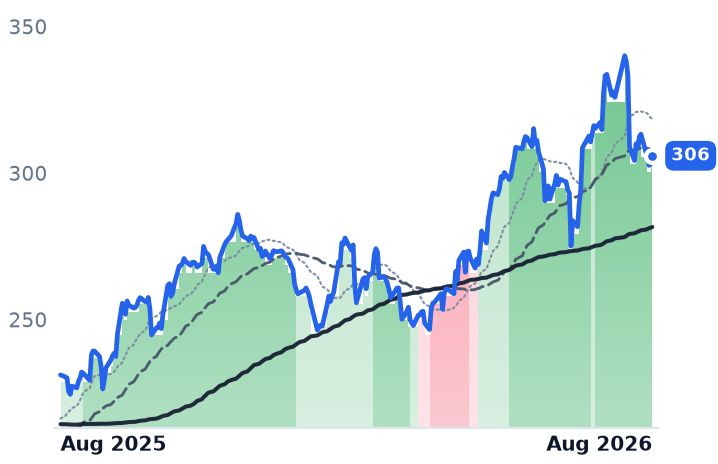
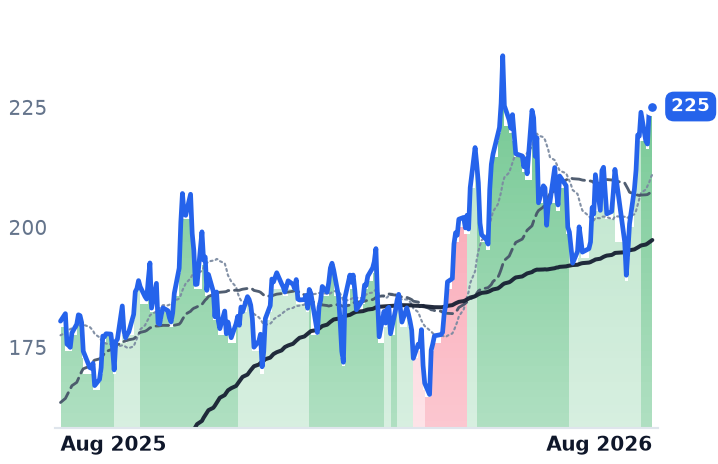
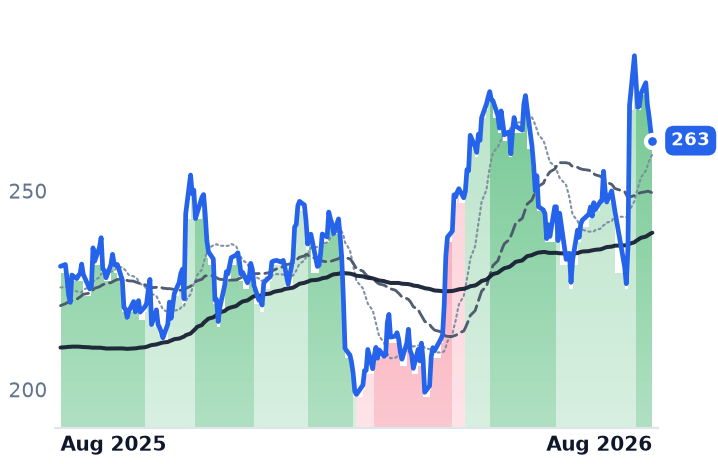
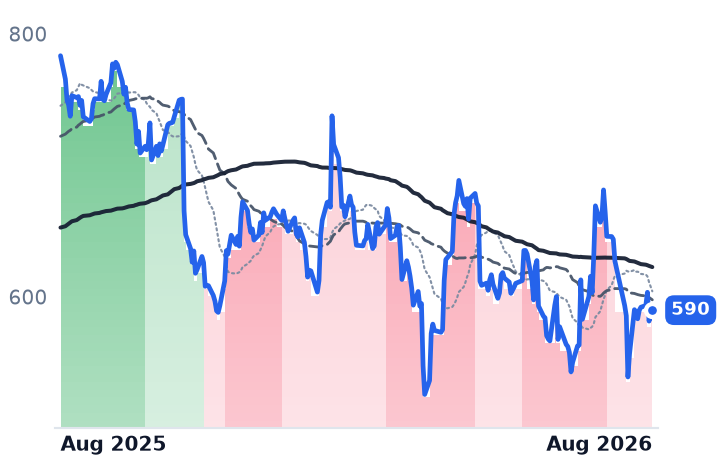
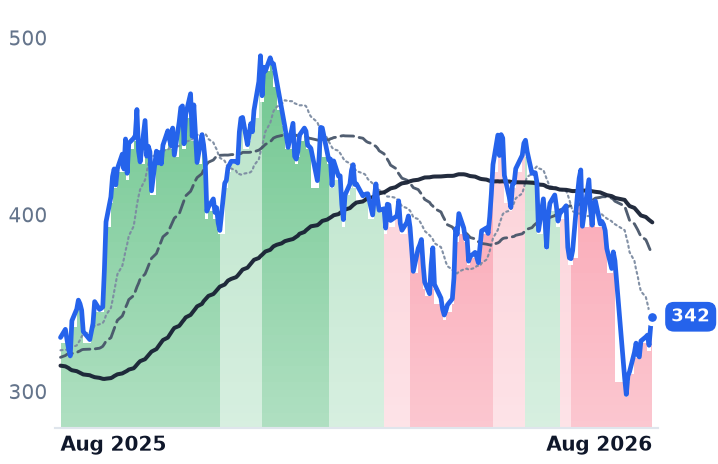
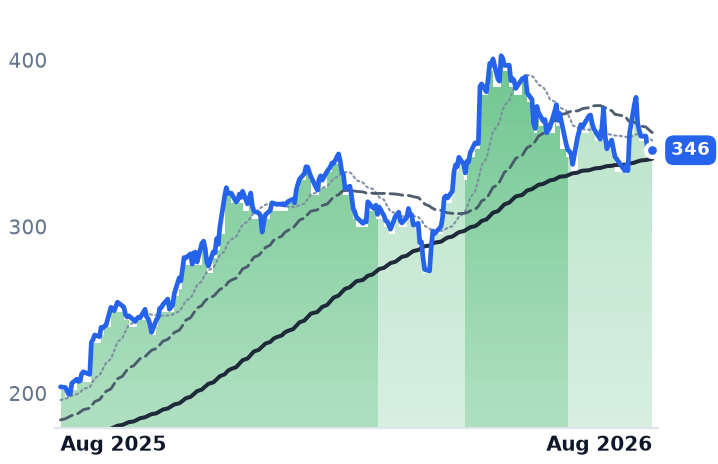
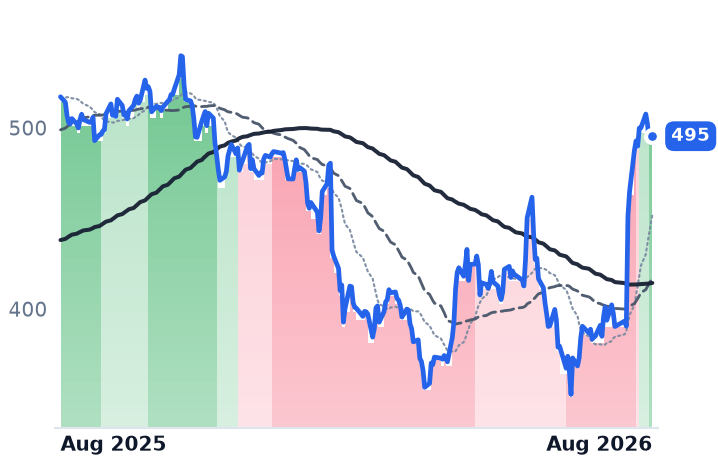
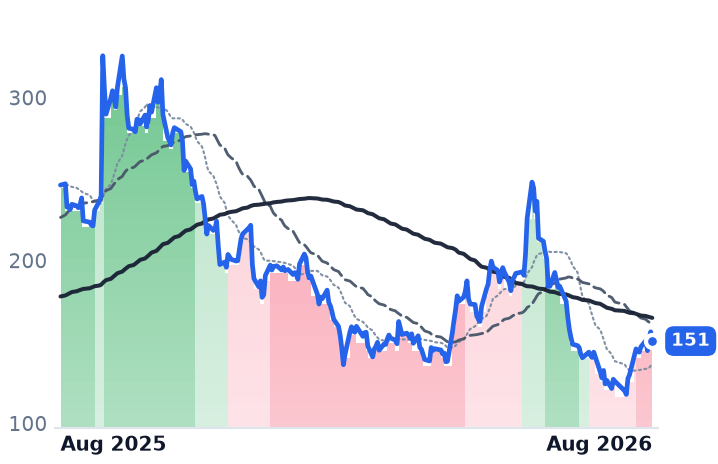
12-month price & trend
| Ticker | Mkt cap | P/E | P/E fwd | P/S | P/S fwd | P/GP | P/GP fwd | EV/EBITDA | FCF yld |
|---|---|---|---|---|---|---|---|---|---|
AAPL | $4.5T | 34.9x | 34.7x | 9.6x | 9.4x | 19.8x | 19.4x | 26.9x | 3.0% |
NVDA | $5.5T | 34.3x | 25.0x | 21.5x | 13.9x | 29.0x | 18.7x | 28.3x | 2.2% |
AMZN | $2.8T | 20.8x | 22.4x | 3.6x | 3.4x | 7.2x | 6.7x | 11.7x | -0.4% |
| Ticker | Mkt cap | P/E | P/E fwd | P/S | P/S fwd | P/GP | P/GP fwd | EV/EBITDA | FCF yld |
|---|---|---|---|---|---|---|---|---|---|
META | $1.5T | 21.9x | 18.4x | 6.6x | 5.9x | 8.1x | 7.2x | 14.9x | 2.7% |
TSLA | $1.4T | 290.1x | 202.4x | 13.0x | 12.7x | 69.2x | 67.6x | 111.9x | 0.4% |
GOOGL | $4.2T | 17.2x | 17.1x | 9.4x | 8.5x | 15.4x | 13.9x | 13.0x | 1.3% |
| Ticker | Mkt cap | P/E | P/E fwd | P/S | P/S fwd | P/GP | P/GP fwd | EV/EBITDA | FCF yld |
|---|---|---|---|---|---|---|---|---|---|
MSFT | $3.7T | 27.5x | 25.2x | 11.1x | 9.4x | 16.3x | 13.9x | 18.2x | 1.8% |
ORCL | $433.0B | 25.3x | 18.7x | 6.4x | 4.8x | 9.8x | 7.3x | 17.4x | -5.5% |
Consensus projections
| Ticker | FY2026E | FY2027E | FY2028E | |
|---|---|---|---|---|
AAPL | Revenue | +14.9% | +8.8% | +7.4% |
| EPS | +19.5% | +8.0% | +11.1% | |
NVDA | Revenue | +65.1% | +84.2% | +43.2% |
| EPS | +59.0% | +91.7% | +42.0% | |
AMZN | Revenue | +15.7% | +14.0% | +15.9% |
| EPS | +63.6% | −10.9% | +30.2% | |
META | Revenue | +27.3% | +19.9% | +17.9% |
| EPS | +39.6% | +7.2% | +15.8% | |
TSLA | Revenue | +11.8% | +13.1% | +18.0% |
| EPS | +2.2% | +32.7% | +39.2% | |
GOOGL | Revenue | +23.7% | +22.5% | +19.0% |
| EPS | +90.3% | −25.8% | +18.1% | |
MSFT | Revenue | +18.0% | +18.2% | +19.6% |
| EPS | +26.7% | +15.4% | +18.5% | |
ORCL | Revenue | +17.8% | +33.2% | +45.5% |
| EPS | +25.3% | +7.6% | +35.6% |
Forward fiscal years only. Blank means no analyst coverage for that year.
The seven largest listed American companies got substantially more profitable over the past year, and investors ended up paying less for each dollar of that profit. Combined trailing gross profit across Nvidia, Apple, Alphabet, Microsoft, Amazon, Meta and Tesla rose close to 30%. The average multiple applied to it contracted about 8%. Equal-weighted, the shares gained roughly 16% — a year underwritten by the income statement rather than by enthusiasm.
Gross profit is the honest yardstick here because reported net income has become unreliable. Alphabet booked $112.2bn of net income in the June quarter on $119.8bn of revenue — a 93.7% net margin against a 34.0% operating margin — on a large non-operating gain. Price-to-earnings ratios built on figures like that describe an accounting event, not a business.
The three that grew into their prices
Nvidia, which designs the graphics processors and networking gear that data centers use to train artificial-intelligence models, is the extreme case. Its trailing gross profit rose 80.5% to $187.95bn while the multiple on it fell from 42.9x to 29.0x. The shares still rose 23.7%. Consensus expects the growth to continue: forward price-to-earnings is 25.0x against 34.3x trailing, the widest such gap in the group. The counterweight is concentration — roughly 61% of revenue comes from a handful of buyers, and Nvidia's share of AI accelerators is expected to ease from about 80% toward 75% by year-end as those same customers build their own chips.
Microsoft, which sells Office and Windows alongside the Azure cloud platform, is the sharpest recent example of price catching up to profit. Its trailing earnings per share rose 31.6% to $17.95 over the year while its trailing multiple compressed from about 38x to 27.5x. On July 29 it reported June-quarter revenue of $90.0bn, up 18%, with Azure accelerating to 43% growth and contracted future revenue of $678bn. The shares rose about 3% on the beat and extended toward 8% only when Hood said the calendar-2026 capital-expenditure forecast was unchanged. The stock gapped 15.5% the next session on four times normal volume and has added a quarter of its value in a month. It is still cheaper on gross profit than a year ago.
Amazon carries the lowest multiple in the group at 7.2x trailing gross profit, having got marginally cheaper as gross profit grew 18.5%. Its cloud arm grew 36.7% to $42.2bn in the June quarter, a fifth consecutive quarter of acceleration, with backlog at $496bn — and 2026 capital spending raised to $220bn from $200bn on memory-price inflation.
The one that re-rated
Alphabet, the owner of Google Search, YouTube and Google Cloud, is the exception that proves the point. Its shares rose 70.4% on gross-profit growth of 24.0%; the multiple went from 11.3x to 15.4x. The business is genuinely accelerating — cloud revenue up 82% to $24.8bn with operating margin widening from 20.7% to 35.6% — but free cash flow was minus $5.9bn in the quarter, capital-spending guidance rose to $195-205bn, and long-term debt went from roughly $16bn to $98.2bn in a year. Consensus 2027 earnings per share of $15.01 sits 26% below the $20.24 modelled for 2026, which puts the shares near 23x on those numbers rather than the 17x the screens display.
The one that de-rated
Meta, owner of Facebook, Instagram and WhatsApp, is now the smallest company in the group by market value at $1.50tn. Its shares fell 24.6% over the year while gross profit rose 27.3%; the multiple on gross profit fell from 13.7x to 8.1x. Advertising revenue grew 27% to $59.4bn in the June quarter. But GAAP operating income fell 8.2% to $18.78bn and operating margin went from 43.0% to 30.9%, against capital spending guided to $130-145bn. The de-rating came in two steps tied to spending, not to advertising: shares slid when Meta lifted its 2026 capex outlook toward $145bn in April, and fell about 10% after hours on July 29 on guidance and shrinking free cash flow. Forward price-to-earnings of 18.4x sits below 21.9x trailing on consensus 2026 earnings of $32.00 a share, and the analyst target averages near $754 against a $589.85 close. The market is repricing an advertising business as a capital-spending business.
The two that fit neither box
Apple is the only member whose multiple expanded while it was being marked higher: 18.2x to 19.8x gross profit on 19.1% growth. Its forward multiple of 34.7x is indistinguishable from its 34.9x trailing, meaning consensus prices in no earnings relief at all. June-quarter revenue grew 16.4% to $109.42bn at a 50.1% gross margin, but September guidance is for 9-11% growth and 47-48% margin. Tim Cook, on his final earnings call, called it a "100-year flood on memory pricing"; TechInsights puts the memory bill in an iPhone 18 Pro at roughly $145 against about $39 a generation earlier. John Ternus becomes chief executive on September 1.
Tesla is the only one of the seven where earnings fell and the multiple rose. Trailing earnings per share dropped 37.5% to $1.08 while the trailing multiple went from about 194x to 290x. June-quarter operating income fell 56.9% to $398m — a 1.4% operating margin on revenue up 25.5% — and the shares fell 14.5% on the print to an eleven-month low. Capital spending is guided above $25bn with a $30bn debt facility behind it. Cheapness is not the issue; there are no earnings to be cheap against.
The common thread is how the spending is funded. Hyperscalers and Nvidia have issued $225bn of bonds so far in 2026, a nearly ten-fold jump, and credit spreads on Alphabet, Amazon and Meta have widened. Microsoft's premium this month was awarded for the one thing none of the others offered: a capex number that did not go up.
The setup
Where it stands — The group's year came from profit growth, not a higher price tag; Alphabet alone re-rated, and Meta alone collapsed. Would confirm — Meta's operating margin stabilizing above 31% in the September quarter while advertising revenue growth stays above 20%. Would invalidate — Nvidia's gross profit decelerating below 30% growth, which would make its lower multiple a warning rather than a discount. Watch next — Nvidia reports on August 26; Apple's first quarter under John Ternus begins September 1. Valuation — Meta trades at 8.1x trailing gross profit against 13.7x a year ago; Nvidia 29.0x trailing, 18.7x forward, from 42.9x.