

Three 'Optical Materials' Stocks Sold Off Together, But for Three Different Reasons
Hypothesis Opus 5 · Research Sonnet 5 · Writing Sonnet 5 · Prompt v1.1
Corning, LightPath and Universal Display are grouped as one optical-materials cohort down 18.6% in a month, but the data shows a violent one-day guidance selloff, a dilution-driven micro-cap slide, and a genuinely shrinking OLED royalty business — three unrelated stories, not one gradual cooldown.
| Ticker | Company | Segment | Trend | 30D | 1Y |
|---|---|---|---|---|---|
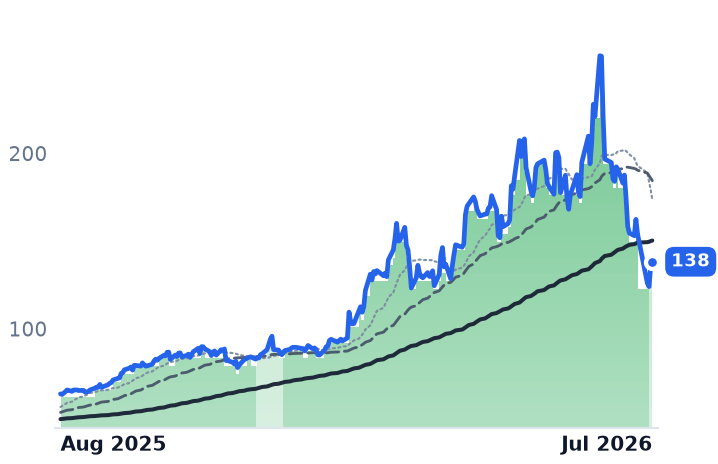
GLW | Corning | Display & Optical Materials | 🟢 Cont. Bull | −29.0% | +119.8% |
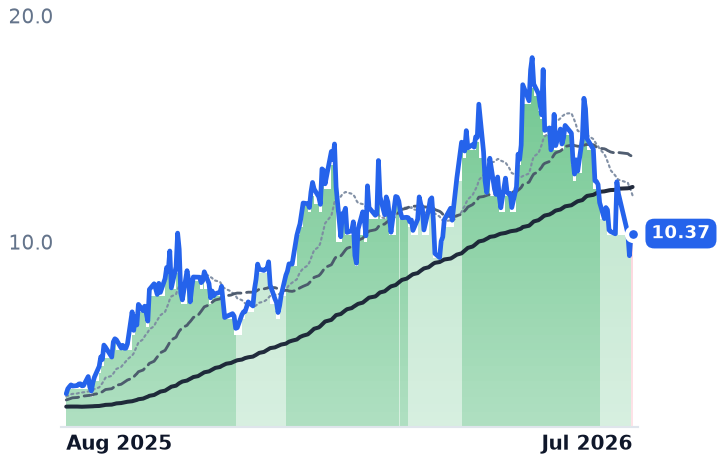
LPTH | LightPath Technologies | Display & Optical Materials | 🟢 Cont. Bull | −26.5% | +215.2% |
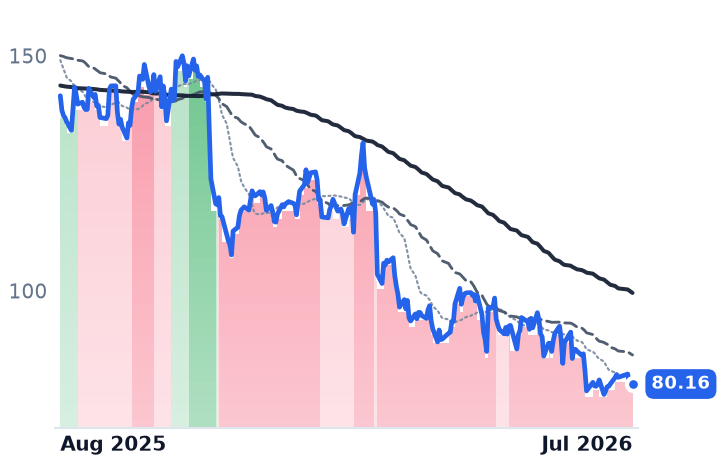
OLED | Universal Display | Display & Optical Materials | 🔴 Cont. Bear | −0.4% | −43.3% |
12-month price & trend
Valuation & fundamentals
| Ticker | Mkt cap | P/E | P/E fwd | P/S | P/S fwd | P/GP | P/GP fwd | EV/EBITDA | FCF yld |
|---|---|---|---|---|---|---|---|---|---|
GLW | $119.0B | 62.6x | 42.5x | 7.0x | 6.2x | 19.3x | 17.1x | 35.9x | 2.0% |
LPTH | $496.5M | n/m | 377.1x | 7.9x | 4.7x | 24.6x | 14.6x | n/m | -2.1% |
OLED | $3.7B | 19.3x | 19.0x | 6.1x | 5.8x | 8.1x | 7.7x | 13.9x | 4.6% |
Consensus projections
| Ticker | FY2026E | FY2027E | FY2028E | |
|---|---|---|---|---|
GLW | Revenue | +17.6% | +18.6% | +20.7% |
| EPS | +29.1% | +32.1% | +36.1% | |
LPTH | Revenue | +91.2% | +47.8% | +32.5% |
| EPS | −7.6% | −113.3% | +1754.5% | |
OLED | Revenue | −2.7% | +7.4% | +11.7% |
| EPS | −14.8% | +12.9% | +21.0% |
Forward fiscal years only. Blank means no analyst coverage for that year.
A category built from three companies that make glass, lenses and display chemicals is showing a tidy-looking 18.6% pullback over the past month. But averaging these three names together erases the actual news: Corning Incorporated (GLW), the dominant U.S. maker of optical fiber and specialty glass for telecom networks, AI data centers and smartphone screens, crashed 46% from a June peak in a single earnings reaction; LightPath Technologies (LPTH), a micro-cap maker of infrared lenses and optical assemblies for defense and thermal-imaging customers, sold off after diluting shareholders even as its order book surged; and Universal Display Corporation (OLED), which licenses OLED (organic light-emitting diode) materials and collects royalties from Samsung Display and LG Display, has simply kept shrinking for months, with its stock never leaving bear territory to begin with.
Corning: real growth, a guidance miss, and a sector-wide reflex. Corning's Optical Communications segment — the part of the business selling fiber and connectors into AI data centers — grew sales 32% year-over-year in the second quarter of 2026, with segment net income up 77% to $438 million, and the company has signed multi-year fiber agreements with Meta, Apple, Nvidia and Amazon, according to Yahoo Finance's earnings recap. That's the business case, and it's real, not manufactured. But the stock fell more than 15% on July 28 not because results were bad — they beat — but because third-quarter guidance of $4.9–5.0 billion in core sales merely met, rather than exceeded, expectations that had been bid up alongside every other AI-optics supplier; CNBC reported the selloff also hit Coherent, Lumentum, Marvell and AXT, and Benzinga tied it to fresh doubts about hyperscaler AI capex after Alphabet's quarter showed capital spending doubling while free cash flow went negative. Corning traded at roughly 87–106x trailing earnings and 52–59x forward earnings before the drop; even after a 46% retreat from its peak, the multiple remains rich against its own history. This is a sector-wide AI-optics de-rating, not a gradual, company-specific band cut — the internal trend rating only marked the downgrade a day after the price had already collapsed.
LightPath: business accelerating, stock diluted. LightPath's fiscal third-quarter revenue (ended March 2026) rose 109% year-over-year to $19.1 million with backlog up 196% to $110.6 million, the company reported — a genuine acceleration in infrared-optics demand. The stock's ~30% July slide traces instead to a $100 million stock offering priced at $14 that diluted holders to shore up a thin $11.5 million cash balance, plus a broader semiconductor selloff in late July, per reporting on the offering and the sector pullback. With no meaningful trailing earnings, price-to-sales near 12.7x is the relevant yardstick — a premium that reflects growth expectations, funded now by more shares outstanding.
Universal Display: the business really is shrinking. Unlike the other two, OLED's stock decline matches its fundamentals. Second-quarter 2026 revenue fell 11.6% year-over-year to $152 million, material sales dropped 26%, and royalty revenue fell 26% in the first quarter, according to Gurufocus's earnings recap and an SEC filing. Management narrowed full-year guidance to the low end of $630–670 million, citing weak consumer-electronics visibility, per Biggo Finance, and would not commit to a 2027 date for commercializing blue phosphorescent emitters — the technology underpinning its entire long-term growth case. Revenue is concentrated with Samsung Display and LG Display, exposing it to Asian trade and demand swings, per Biggo. The stock has held a persistent bear rating since at least March, never breaking down because it never rallied — trailing earnings multiples near 17–19x are cheap only against OLED's own history as a premium growth licensor, not against a business that's still contracting.
The setup
Where it stands — Corning's AI-fiber growth is real but priced richly; LightPath's demand is real but diluted; OLED's decline is real and ongoing. Would confirm — Corning's Optical Communications revenue growth stays above 25% y/y and LightPath's backlog keeps converting to revenue without further share issuance. Would invalidate — Universal Display's royalty revenue stabilizes or grows sequentially, or Corning's Q3 core sales miss the $4.9–5.0 billion guided range. Watch next — Corning's Q3 2026 earnings report and any dated 2027 blue-emitter commercialization announcement from Universal Display. Valuation — GLW ~52-59x forward earnings versus its own multi-year range; LPTH ~12.7x sales; OLED ~17-19x trailing earnings, near a multi-year low.