

AI Data-Center Stocks Slide Together, But Signed Leases Set Two Apart From Four
Hypothesis Opus 5 · Research Sonnet 5 · Writing Sonnet 5 · Prompt v1.1
Six companies that build and lease the racks and megawatts AI computing runs on pulled back together over the past month after a huge run, but their disclosures diverge sharply: two Chinese wholesale hosts show accelerating revenue at a steep discount to U.S. peers, a U.S. leasing operator already re-rated cheaper through real contract growth, and three smaller newcomers range from a credible growth story to a disputed $1.25 billion contract under litigation.
| Ticker | Company | Segment | Trend | 30D | 1Y |
|---|---|---|---|---|---|
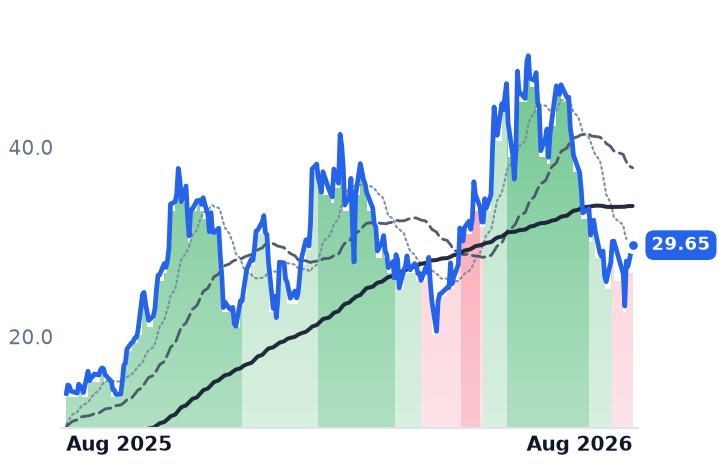
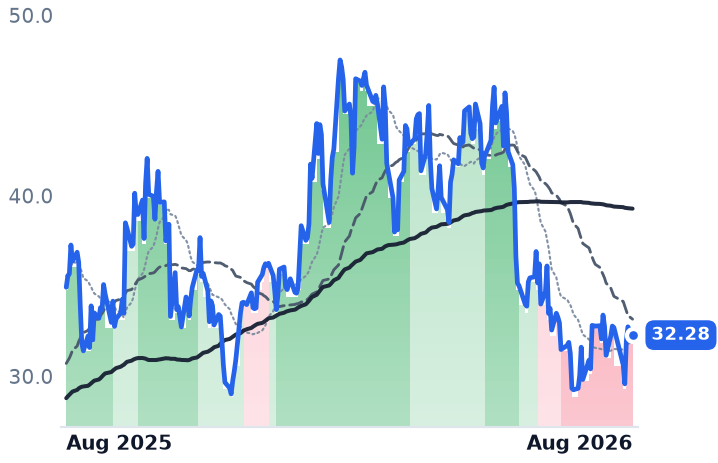
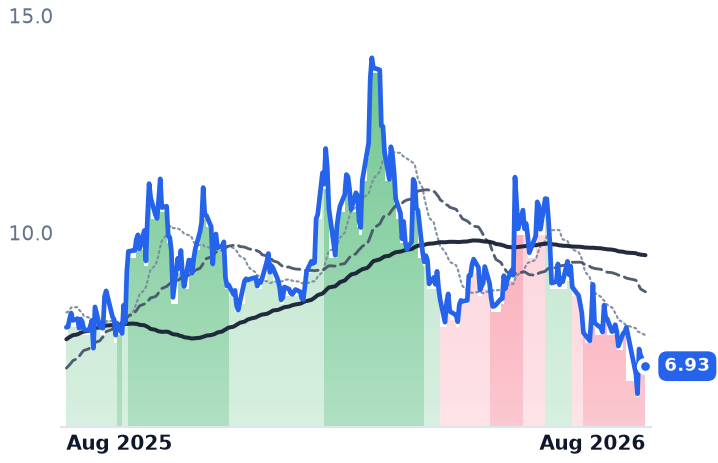
APLD | Applied Digital | Data Center & Cloud Infrastructure | 🟢 Cont. Bull | −11.5% | +112.5% |
GDS | GDS | Data Center & Cloud Infrastructure | ⚠️ Emerging Bear | +4.5% | −7.6% |
VNET | VNET | Data Center & Cloud Infrastructure | ⚠️ Emerging Bear | −11.3% | −11.4% |
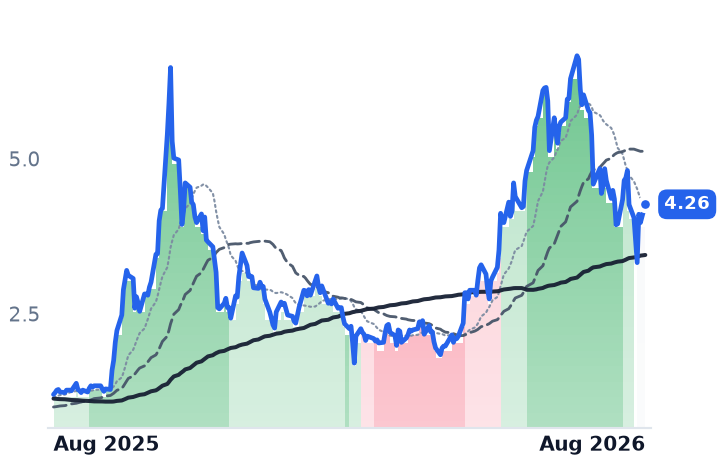
KEEL | Keel Infrastructure | Data Center & Cloud Infrastructure | 🟢 Cont. Bull | −11.9% | +255.4% |
SHAZ | SharonAI | Data Center & Cloud Infrastructure | 🌱 Emerging Bull | −34.7% | +64.7% |
WYFI | WhiteFiber, Inc. Ordinary Shares | Data Center & Cloud Infrastructure | 🌱 Emerging Bull | −27.4% | +59.1% |
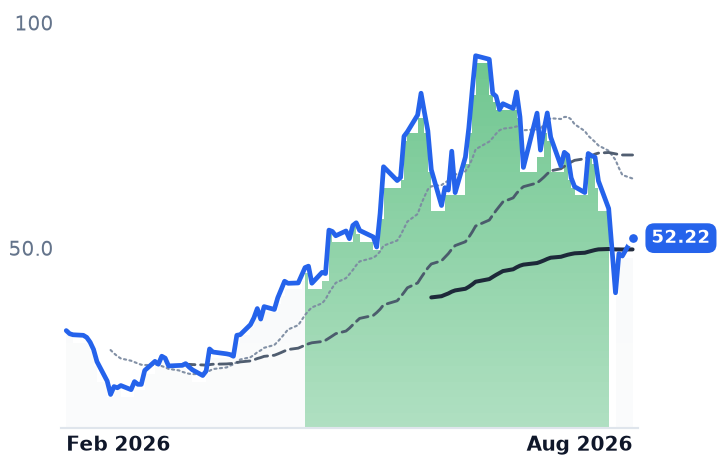
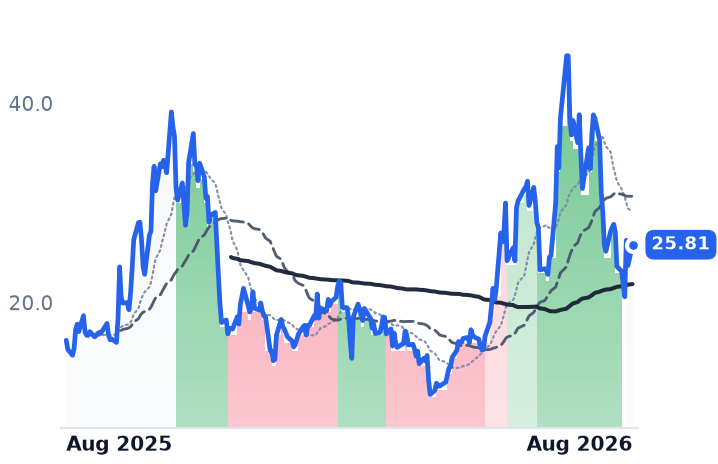
12-month price & trend
| Ticker | Mkt cap | P/E | P/E fwd | P/S | P/S fwd | P/GP | P/GP fwd | EV/EBITDA | FCF yld |
|---|---|---|---|---|---|---|---|---|---|
APLD | $7.8B | n/m | — | 12.8x | 9.6x | 57.2x | 42.9x | n/m | -35.5% |
GDS | $6.3B | 15.6x | 4.7x | 3.6x | 0.5x | 14.2x | 2.0x | 13.8x | -3.1% |
VNET | $1.9B | n/m | — | 1.3x | 0.2x | 6.0x | 0.9x | 9.6x | -45.5% |
| Ticker | Mkt cap | P/E | P/E fwd | P/S | P/S fwd | P/GP | P/GP fwd | EV/EBITDA | FCF yld |
|---|---|---|---|---|---|---|---|---|---|
KEEL | $2.5B | n/m | — | 12.7x | 22.5x | — | — | n/m | -13.2% |
SHAZ | $512.9M | n/m | — | 334.0x | 3.4x | — | 52.8x | n/m | -12.0% |
WYFI | $1.0B | n/m | — | 11.9x | 7.9x | 27.6x | 18.3x | n/m | 6.0% |
Valuation & fundamentals
Consensus projections
| Ticker | FY2026E | FY2027E | FY2028E | |
|---|---|---|---|---|
APLD | Revenue | +98.7% | +90.3% | +154.7% |
| EPS | −24.3% | +1.2% | −145.0% | |
GDS | Revenue | +11.2% | +11.0% | +18.0% |
| EPS | −13.3% | −75.5% | +48.9% | |
VNET | Revenue | +19.9% | +21.0% | +18.6% |
| EPS | −37.9% | −261.0% | +74.7% | |
KEEL | Revenue | −59.1% | +12.9% | +81.9% |
| EPS | +59.7% | −46.8% | +71.4% | |
SHAZ | Revenue | +9846.3% | +823.7% | +76.6% |
| EPS | −44.7% | +7.9% | +24.6% | |
WYFI | Revenue | +63.5% | +110.2% | +54.2% |
| EPS | +2.2% | −134.8% | +157.8% |
Forward fiscal years only. Blank means no analyst coverage for that year.
The six companies that build, lease and power the physical data centers AI computing providers rent by the megawatt have fallen together over the past month, giving back a chunk of a run that made this corner of the market one of the best-performing over the past year. But their actual leases, revenue and balance sheets tell three separate stories: two Chinese wholesale hosts trading at a steep discount to U.S. peers while revenue accelerates, one U.S. operator that already worked off its richest multiple through real contract growth rather than a falling stock price, and three much smaller, newer companies ranging from a credible growth story to a disputed contract under litigation.
Applied Digital (APLD), which builds and leases high-performance-computing data centers to AI companies in North America after abandoning crypto mining in 2022, is the group's largest by market value at roughly $7.8 billion. Fiscal 2026 revenue tripled to $611.3 million as leases with CoreWeave and an undisclosed investment-grade hyperscale customer began paying off — a 150-megawatt lease expansion finalized this year brought total CoreWeave-related capacity to 400 megawatts and roughly $11 billion of contracted revenue across three roughly 15-year leases, with the first 100 megawatts reaching full service in November 2025, on schedule rather than delayed. That growth cut the trailing price-to-sales multiple from 28.7x three months ago to 12.8x today (9.6x forward) — the stock's 30-day, 17% pullback looks more like a re-entry into an already-cheaper name than a re-rating of an expensive one. The company still lost $244 million on an operating basis funding that buildout, and convertible notes priced in 2024 carry dilution protection capped at $14.72 a share — no cushion now that the stock trades at $27.39, a real dilution risk if shares stay above that level into conversion.
GDS Holdings (GDS) and VNET Group (VNET), which build and operate wholesale and colocation data centers across China for cloud providers, internet firms and banks, are the clearest case of a business outrunning its stock. GDS revenue growth reaccelerated to 23.6% year over year in the first quarter after three quarters of near-flat growth, with area utilization rising to 75.5%; VNET revenue has grown 18%-24% every quarter for more than a year. Both trade at 1x-3x sales versus roughly 10.5x for U.S. data-center REITs, a gap tied to audit-compliance and delisting overhang on their China listings rather than operating weakness. GDS also pushed a $550 million convertible note's maturity from 2029 to 2032, reducing near-term refinancing risk, and both stocks rallied roughly 8% in early July on reports China is weighing a five-year, roughly $295 billion data-center investment program — a sector catalyst, not a company-specific one.
The three smaller names are far less alike than their grouping suggests. KEEL Infrastructure, the renamed and U.S.-redomiciled parent of former crypto miner Bitfarms, is pivoting toward a 2.2-gigawatt power pipeline across Pennsylvania, Washington and Quebec, but first-quarter revenue fell 44.7% year over year with a $145 million net loss, and consensus expects a further 59% revenue decline in fiscal 2026 even as its forward price-to-sales multiple rises to 22.5x from 12.7x trailing — a shrinking business getting more expensive, not less. SharonAI Holdings (SHAZ), a GPU-cloud company that went public via SPAC merger in December, generated just $294,000 of revenue in the first quarter against a $513 million market value; its forward multiple only looks reasonable if a disputed $1.25 billion contract materializes, and an April short-seller report alleges the counterparty earned just $5.8 million in its own last fiscal year while separately flagging litigation accusing the CEO of self-dealing at his prior company. WhiteFiber (WYFI), spun off from Bit Digital last August, is the exception: revenue grew 66% to $79.2 million in fiscal 2025 at a 62% gross margin, with consensus projecting a 45% EBITDA margin in fiscal 2026 — a credible path to profit, though only a year of trading history leaves no multi-year range to judge its 7.9x forward sales multiple against.
Financing conditions across this industry are genuinely tightening — short-term, GPU-collateralized debt now carries interest above 12% industry-wide, with roughly $7.5 billion maturing within an 18-month window in 2026, prompting Nvidia to introduce backstop financing. That risk lands unevenly: Applied Digital's dilution cushion is gone at current prices while GDS just extended its own maturity wall by three years.
On the tape, the pullback isn't uniform: five of six names are down over the past 30 days, but GDS's price is actually up 8.2% even as its trend indicator has read bearish continuously since late June — a case where the momentum signal and the fundamentals disagree, and the fundamentals here (accelerating revenue, an extended debt maturity) are the more persuasive read.
The setup
Where it stands — The group is down for 30 days after a divergent 12-month run; GDS and VNET show accelerating revenue at low multiples while APLD, KEEL and SHAZ diverge on credibility and dilution risk. Would confirm — GDS/VNET quarterly revenue growth stays above 20% for two more quarters while their price-to-sales multiples remain below 3x versus ~10.5x U.S. peers. Would invalidate — SharonAI's disputed $1.25 billion contract fails to show up as billed, disclosed revenue by year-end, or Applied Digital's shares trigger convert dilution above $14.72. Watch next — Next quarterly reports for GDS, VNET and Applied Digital, due within roughly eight to ten weeks, for updated utilization and lease disclosures. Valuation — GDS trades at 13.75x trailing EV/EBITDA and ~2.7x sales versus ~10.5x for U.S. REIT peers; Applied Digital's trailing P/S has fallen to 12.8x from 28.7x three months ago.