

Space Stations & Tourism's "Emerging Bull" Read Is Already Stale
Prompt v1.0
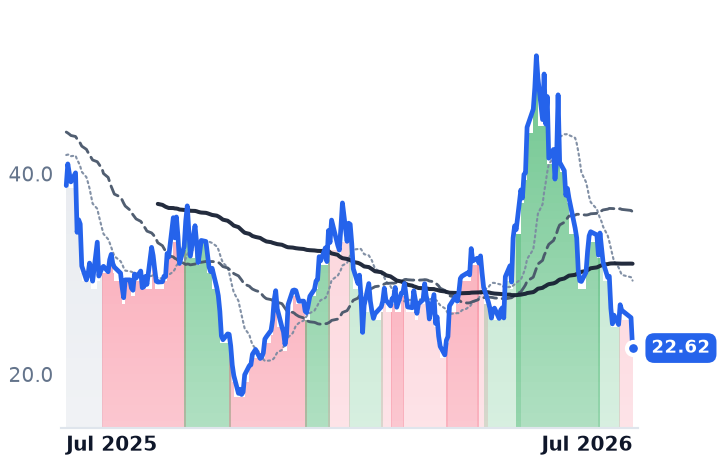
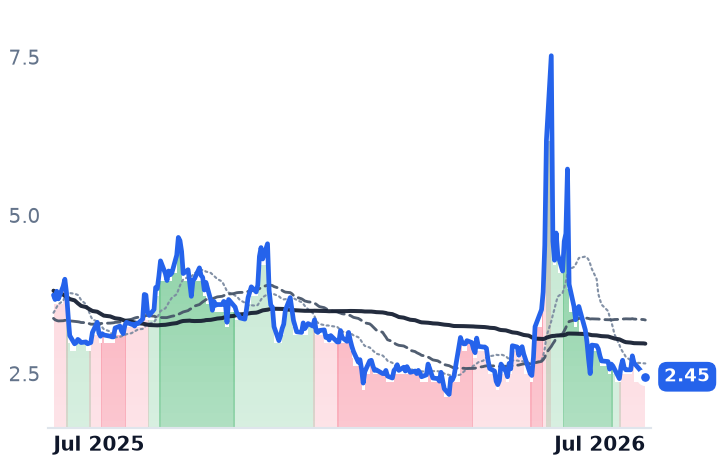
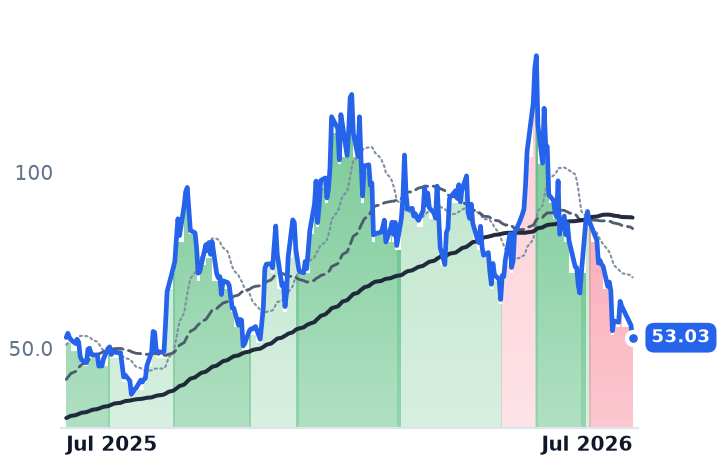
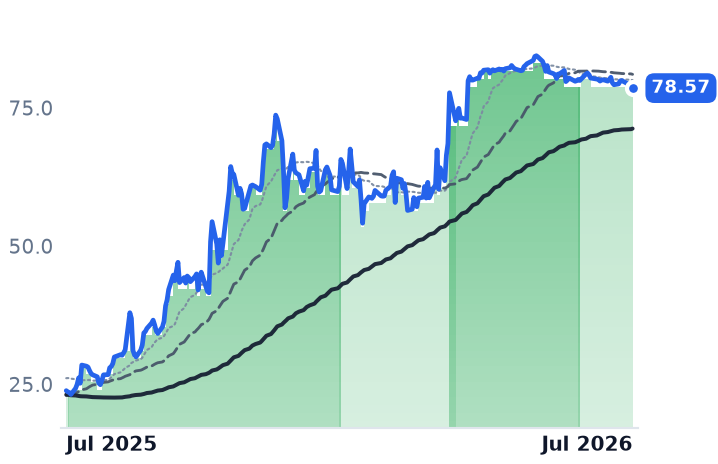
VOYG and SPCE did exit strongly bearish together in April–May 2026 and rallied hard into strongly bullish by early July, but both have since round-tripped back to mildly bearish as of 2026-07-28 — the bullish inflection the category label implies has already come and gone. Meanwhile the adjacent Direct-to-Device leg isn't moving as one trade either: ASTS cratered into strongly bearish on fundamentals while GSAT stays propped up by deal-arb mechanics, not sector sentiment.
| Ticker | Company | Segment | Trend · 13mo | 30D | 1Y |
|---|---|---|---|---|---|
VOYG | Voyager Technologies | Space Systems & Launch | 🌱 Emerging Bull | −25.0% | −41.7% |
SPCE | Virgin Galactic | Aerospace & Defense | 🌱 Emerging Bull | −16.7% | −34.5% |
ASTS | AST SpaceMobile | Satellite Communications | ⚠️ Emerging Bear | −38.9% | −0.1% |
GSAT | Globalstar | Satellite Communications | 🟢 Cont. Bull | −3.2% | +229.6% |
12-month price & trend
| Ticker | Mkt cap | P/E | P/E fwd | P/S | P/S fwd | P/GP | P/GP fwd | EV/EBITDA | FCF yld |
|---|---|---|---|---|---|---|---|---|---|
VOYG | $1.4B | n/m | — | 6.0x | 4.6x | 87.1x | 66.1x | n/m | -21.6% |
SPCE | $182.0M | n/m | — | 139.0x | 4.6x | — | — | n/m | -225.0% |
ASTS | $23.7B | n/m | — | 205.7x | 147.8x | — | — | n/m | -6.9% |
| Ticker | Mkt cap | P/E | P/E fwd | P/S | P/S fwd | P/GP | P/GP fwd | EV/EBITDA | FCF yld |
|---|---|---|---|---|---|---|---|---|---|
GSAT | $10.8B | n/m | — | 38.3x | 37.7x | 78.0x | 76.6x | 172.7x | 1.7% |
Consensus projections
| Ticker | FY2026E | FY2027E | FY2028E | |
|---|---|---|---|---|
VOYG | Revenue | +75.4% | +71.2% | +86.7% |
| EPS | +44.1% | −55.4% | −69.4% | |
SPCE | Revenue | +2035.8% | +762.0% | +57.7% |
| EPS | −49.9% | −92.9% | −439.0% | |
ASTS | Revenue | +174.7% | +344.1% | +146.7% |
| EPS | +98.2% | −45.8% | −119.7% | |
GSAT | Revenue | +4.9% | +21.3% | +48.7% |
| EPS | −1748.3% | −83.3% | −399.0% |
Forward fiscal years only. Blank means no analyst coverage for that year.
What the bands actually show
Trend-band history for the two names in this bucket tells a cleaner story than the current "turning bullish" tag suggests. VOYG flipped out of strongly bearish/mildly bearish into mildly bullish on 2026-04-24 and ran to strongly bullish by mid-May, holding that band through 2026-07-06 before sliding to mildly bullish and then mildly bearish since 2026-07-20. SPCE followed a similar arc — mildly bearish from 2026-04-13, a brief re-test of strongly bearish in late May, mildly bullish from 2026-05-29, strongly bullish from 2026-06-08 through early July, then a drop to mildly bearish by 2026-07-13. As of the latest data available (2026-07-28), both names sit in mildly bearish, not neutral or mildly bullish. The bull leg was real for roughly six to eight weeks; it has already fully unwound.
Price action backs this up: VOYG fell from $34.57 (2026-06-22) to $25.65 (2026-07-28), a ~26% decline, while SPCE slid from $2.95 to $2.49 over a similar window, about 15.6% — both consistent with the roughly -15% 30-day category average cited in the hypothesis, though VOYG's leg down is the sharper of the two.
The catalysts have turned into headwinds
The binary catalyst underpinning Starlab/VOYG — NASA's Commercial LEO Destinations Phase 2 award — was placed on hold on January 28, 2026 as NASA restructured its acquisition approach, and a March 2026 strategy shift now points toward private modules feeding a government-anchored hub rather than fully independent stations, with awards still pending sometime in 2026. Competing bidders are moving on their own clocks: Vast's Haven-1 has completed cleanroom integration for a 2027 launch and Axiom targets a two-module station by 2028, while Starlab's own target launch of 2029 trails both. Layered on top, Morgan Stanley downgraded VOYG to Underweight on July 15, assigning only about a 33% probability to the Starlab joint venture's DCF-implied value — a downgrade that drove a 7.3% single-day drop that lines up with the band's rollover.
SPCE's Delta-class program is progressing on schedule — structural assembly is complete and glide tests are targeted for Q3 2026 with rocket-powered flight in Q4 — but the company is funding that progress through dilution, having completed a $30.5M debt-for-equity swap and filed a $40.21M shelf while guiding to negative $87-92M quarterly free cash flow. Curated notes flag Virgin Galactic's runway as roughly three to four quarters against ~$338M cash and burn near $90-95M/quarter — a gap the recent financing only partially closes.
Not one space trade, but two divergent ones
The adjacent Direct-to-Device & Spectrum leg underscores that "space" isn't a single cohort right now. ASTS collapsed from strongly bullish to strongly bearish within days at the end of June, falling roughly 22.7% from $73.19 to $56.55 after a botched New Glenn satellite insertion and heavy insider selling. GSAT, by contrast, has held mildly bullish/strongly bullish nearly continuously and was essentially flat (-1.0%) over the same window — but that stability reflects Amazon's pending $90-cash/0.3210-share acquisition spread compressing, not sector fundamentals reasserting themselves.
Taken together, the Space Stations & Tourism "turning bullish" tag reads as a lagging snapshot of a completed round-trip rather than a live inflection, and the fundamental catalysts that drove the spring rally — CLD Phase 2 timing and Delta-class flight progress — currently sit closer to headwind than tailwind for both names.