

IAM's "Emerging Bull" Label Hides a Split: OKTA Turned, SAIL Hasn't
Hypothesis Opus 5 · Research Sonnet 5 · Writing Sonnet 5 · Prompt v1.0
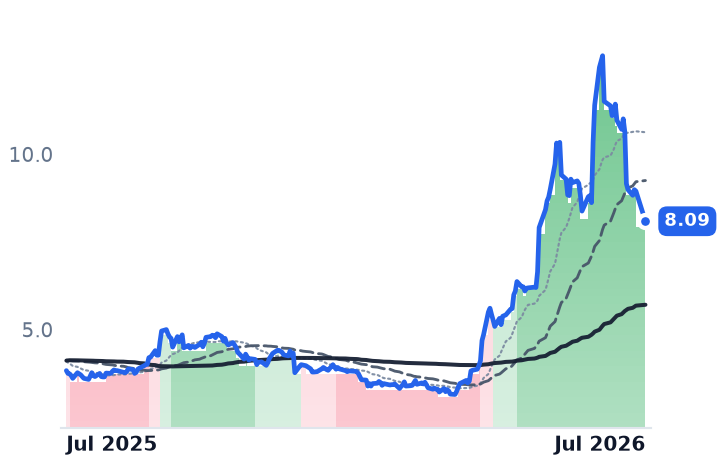
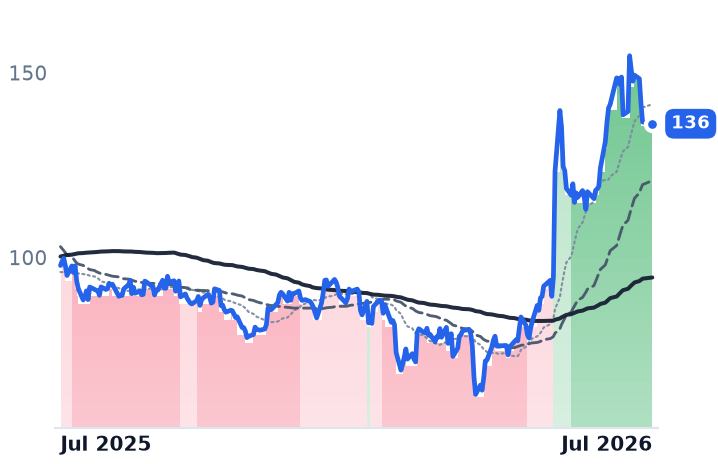
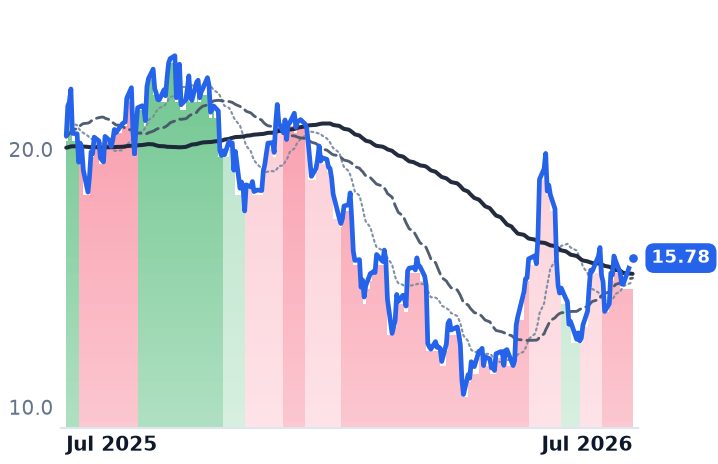
BlackBerry and Okta have both genuinely flipped from strongly bearish to strongly bullish trend bands within the past 90 days, but SailPoint — arguably the purest identity-governance play of the three — briefly touched bull territory in June before reverting to strongly bearish, leaving the category's bullish label resting on two names whose rallies trace mostly to QNX/automotive and AI-agent narratives rather than a unified identity re-rating.
| Ticker | Company | Segment | Trend · 13mo | 30D | 1Y |
|---|---|---|---|---|---|
BB | BlackBerry | Identity & Access Management | 🌱 Emerging Bull | −35.2% | +111.2% |
OKTA | Okta | Identity & Access Management | 🌱 Emerging Bull | +3.7% | +39.2% |
SAIL | SailPoint | Identity & Access Management | 🔴 Cont. Bear | +15.0% | −23.1% |
12-month price & trend
| Ticker | Mkt cap | P/E | P/E fwd | P/S | P/S fwd | P/GP | P/GP fwd | EV/EBITDA | FCF yld |
|---|---|---|---|---|---|---|---|---|---|
BB | $5.2B | 89.1x | 46.3x | 9.0x | 8.4x | 11.7x | 10.9x | 54.0x | 1.2% |
OKTA | $23.8B | 102.3x | 37.2x | 7.9x | 7.4x | 10.3x | 9.6x | 65.1x | 3.8% |
SAIL | $10.6B | n/m | — | 9.5x | — | 14.3x | — | 814.1x | 1.7% |
Consensus projections
| Ticker | FY2026E | FY2027E | FY2028E | |
|---|---|---|---|---|
BB | Revenue | +0.2% | +15.1% | +10.4% |
| EPS | +1183.3% | +29.8% | +20.2% | |
OKTA | Revenue | +12.0% | +10.0% | +9.5% |
| EPS | +24.3% | +11.7% | +10.8% |
Forward fiscal years only. Blank means no analyst coverage for that year.
Two turns, one holdout
The watchlist's Identity & Access Management bucket (BB, OKTA, SAIL) carries an turning bullish tag, and the band history mostly backs it up — but not evenly. BlackBerry's trend band has held strongly bullish continuously since May 8, 2026, completing the strongly bearish-to-strongly bullish walk across both the 90- and 180-day windows. Okta's band flipped to strongly bullish on June 8, 2026, exiting a strongly bearish reading that had persisted since late April — meaning it is not just BlackBerry driving the label, contrary to the possibility that only one name had actually turned. SailPoint, however, only brushed mildly bullish from June 12–23 before reverting, and has sat in strongly bearish since July 8, still there as of July 28.
Why the cohort's -5.5% number is misleading
The cohort's reported -5.5% trailing-30-day return is almost entirely a BB artifact: BlackBerry fell 35.2% over that window after a violent reversal, while Okta actually gained 3.7% and SailPoint gained 15.0% over the same stretch. All three remain well off their 52-week highs — BB roughly 37% below its July 1 peak, Okta about 12% off its mid-July high, and SailPoint around 33% below its trailing high — so none of the three is trading anywhere near an exhausted top.
The fundamentals don't all point the same direction
BlackBerry's move is overwhelmingly a QNX and automotive-embedded-software story: Q1 FY2027 revenue rose 26% year-over-year to $152.9M with QNX EBITDA up 52%, and management raised full-year QNX and total-revenue guidance on the back of it — not an identity-software catalyst. That run has since given back over a third of its 186% YTD gain amid valuation concerns and insider selling, even as the underlying quarter beat guidance.
Okta looks like the more legitimate identity re-rating: cRPO growth reaccelerated to 12%, net retention ticked up to 107%, and the stock jumped on Q1 results as CEO Todd McKinnon described AI-agent identity demand as "bigger than anything we've ever seen". But after a greater-than-50% twelve-month run, Okta trades near 36x forward earnings with growth in the high single digits, and the average analyst price target sits below the current share price — a full-valuation signal, not a clean runway story.
SailPoint's fundamentals are arguably the strongest of the three: total ARR grew 26% year-over-year to $1.163B with SaaS ARR now 67% of the total and raised full-year guidance, plus roughly 21% IGA market share, about five times its nearest competitor. Yet the stock dropped about 12% in March on a soft FY27 EPS guide and has continued to face an insider-selling overhang, which helps explain why its band has not confirmed a durable bull turn despite the strongest identity-pure-play numbers of the group.